
通过下一代测序鉴定的结肠癌、非小细胞肺癌和神经胶质瘤中体细胞 TP53 突变与已知致病性突变的联合频率。
Frequency of Somatic TP53 Mutations in Combination with Known Pathogenic Mutations in Colon Adenocarcinoma, Non-Small Cell Lung Carcinoma, and Gliomas as Identified by Next-Generation Sequencing.
机构信息
Department of Pathology and Laboratory Medicine, Dartmouth-Hitchcock Medical Center and Norris Cotton Cancer Center, Lebanon, NH; The Theodore and Audrey Geisel School of Medicine at Dartmouth, Hanover, NH.
Department of Pathology and Laboratory Medicine, Dartmouth-Hitchcock Medical Center and Norris Cotton Cancer Center, Lebanon, NH; The Theodore and Audrey Geisel School of Medicine at Dartmouth, Hanover, NH.
出版信息
Neoplasia. 2018 Mar;20(3):256-262. doi: 10.1016/j.neo.2017.12.005. Epub 2018 Feb 16.
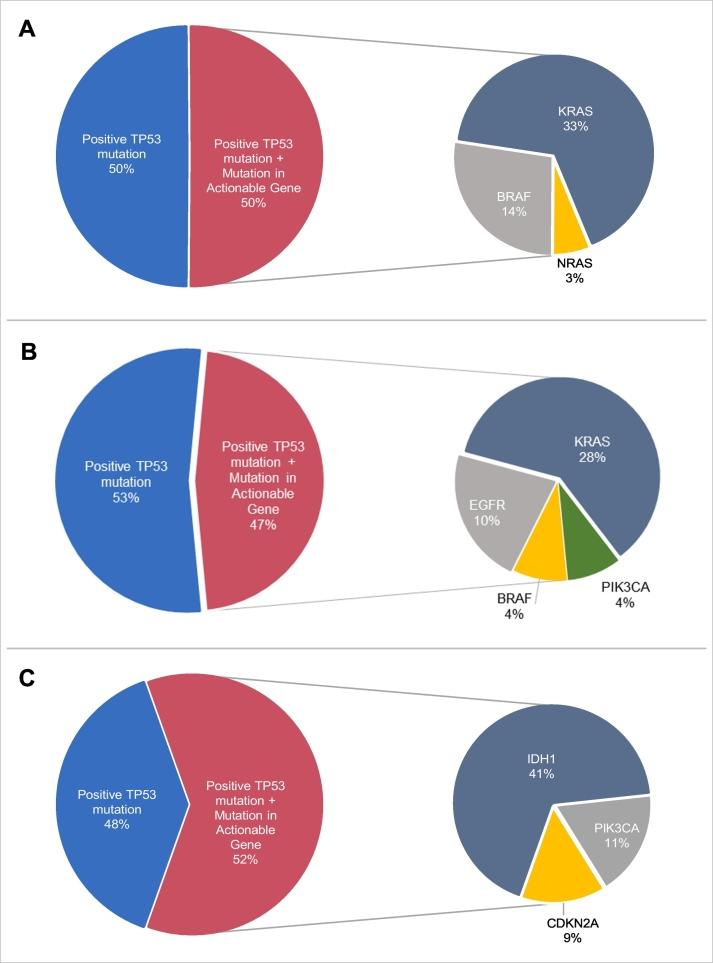
The tumor suppressor gene TP53 is the most frequently mutated gene in human cancer. It encodes p53, a DNA-binding transcription factor that regulates multiple genes involved in DNA repair, metabolism, cell cycle arrest, apoptosis, and senescence. TP53 is associated with human cancer by mutations that lead to a loss of wild-type p53 function as well as mutations that confer alternate oncogenic functions that enable them to promote invasion, metastasis, proliferation, and cell survival. Identifying the discrete TP53 mutations in tumor cells may help direct therapies that are more effective. In this study, we identified the frequency of individual TP53 mutations in patients with colon adenocarcinoma (48%), non-small cell lung carcinoma (NSCLC) (36%), and glioma/glioblastoma (28%) at our institution using next-generation sequencing. We also identified the occurrence of somatic mutations in numerous actionable genes including BRAF, EGFR, KRAS, IDH1, and PIK3CA that occurred concurrently with these TP53 mutations. Of the 480 tumors examined that contained one or more mutations in the TP53 gene, 219 were colon adenocarcinomas, 215 were NSCLCs, and 46 were gliomas/glioblastomas. Among the patients positive for TP53 mutations diagnosed with colon adenocarcinoma, 50% also showed at least one mutation in pathogenic genes of which 14% were BRAF, 33% were KRAS, and 3% were NRAS. Forty-seven percent of NSCLC patients harboring TP53 mutations also had a mutation in at least one actionable pathogenic variant with the following frequencies: BRAF: 4%, EGFR: 10%, KRAS: 28%, and PIK3CA: 4%. Fifty-two percent of patients diagnosed with glioma/glioblastoma with a positive TP53 mutation had at least one concurrent mutation in a known pathogenic gene of which 9% were CDKN2A, 41% were IDH1, and 11% were PIK3CA.
抑癌基因 TP53 是人类癌症中最常发生突变的基因。它编码 p53,这是一种 DNA 结合转录因子,可调节参与 DNA 修复、代谢、细胞周期停滞、细胞凋亡和衰老的多个基因。TP53 与人类癌症相关,其突变导致野生型 p53 功能丧失,以及赋予其他致癌功能的突变,使它们能够促进侵袭、转移、增殖和细胞存活。鉴定肿瘤细胞中离散的 TP53 突变可能有助于指导更有效的治疗。在这项研究中,我们使用下一代测序技术在我们机构中鉴定了结肠癌(48%)、非小细胞肺癌(NSCLC)(36%)和胶质瘤/胶质母细胞瘤(28%)患者中单个 TP53 突变的频率。我们还鉴定了与这些 TP53 突变同时发生的许多可操作基因中的体细胞突变,包括 BRAF、EGFR、KRAS、IDH1 和 PIK3CA。在检查的含有 TP53 基因一个或多个突变的 480 个肿瘤中,219 个是结肠癌,215 个是 NSCLC,46 个是胶质瘤/胶质母细胞瘤。在诊断为结肠癌且 TP53 突变阳性的患者中,50%的患者至少有一种致病性基因的突变,其中 14%为 BRAF,33%为 KRAS,3%为 NRAS。47%的携带 TP53 突变的 NSCLC 患者也至少有一种可操作的致病性变异体的突变,其频率如下:BRAF:4%,EGFR:10%,KRAS:28%,PIK3CA:4%。诊断为胶质母细胞瘤且 TP53 突变阳性的患者中有 52%至少有一种已知致病性基因的同时突变,其中 9%为 CDKN2A,41%为 IDH1,11%为 PIK3CA。

 Zotero 插件