
17-DMAG 抑制几种巴贝虫物种和马媾疫锥虫在体外培养物中的增殖,以及微小巴贝斯虫在小鼠中的增殖。
17-DMAG inhibits the multiplication of several Babesia species and Theileria equi on in vitro cultures, and Babesia microti in mice.
机构信息
National Research Center for Protozoan Diseases, Obihiro University of Agriculture and Veterinary Medicine, Nishi 2-13 Inada-cho, Obihiro 080-8555, Japan; Balai Veteriner Subang (DIC Subang), Jl. Terusan Garuda 33/11 Blok Werasari Dangdeur, Subang, Jawa Barat 41212, Indonesia.
National Research Center for Protozoan Diseases, Obihiro University of Agriculture and Veterinary Medicine, Nishi 2-13 Inada-cho, Obihiro 080-8555, Japan; Department of Animal Infectious Diseases and Veterinary Public Health, Faculty of Veterinary Medicine, Bogor Agricultural University, Jl. Agatis, Kampus IPB Dramaga, Bogor, Indonesia.
出版信息
Int J Parasitol Drugs Drug Resist. 2018 Apr;8(1):104-111. doi: 10.1016/j.ijpddr.2018.02.005. Epub 2018 Mar 1.
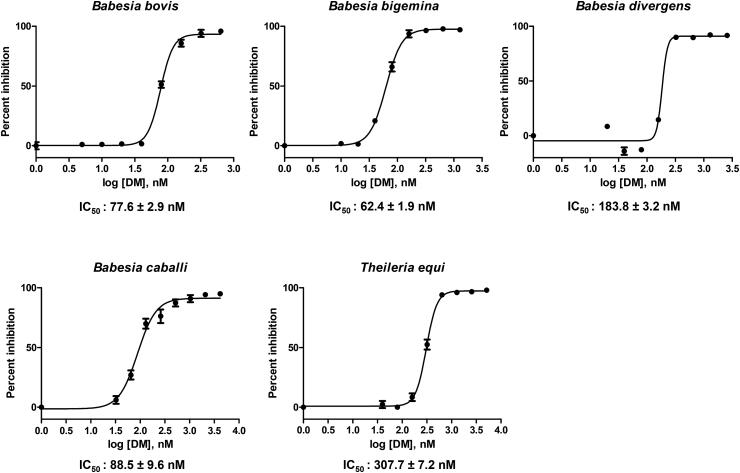
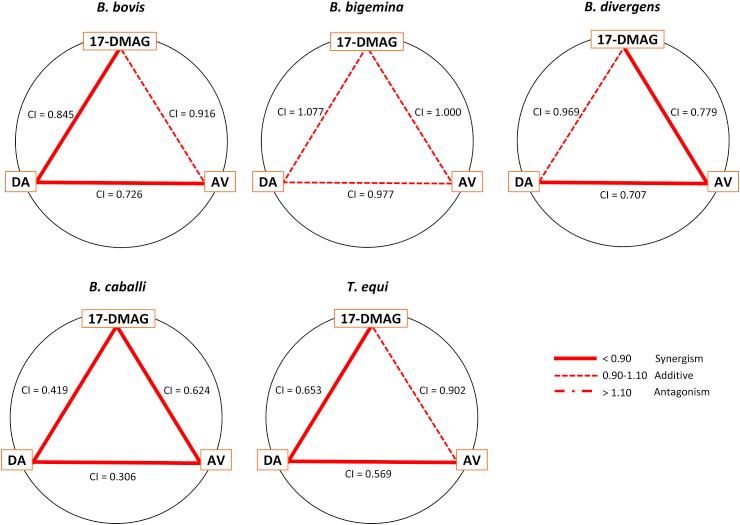
Heat shock protein 90 (Hsp90) is a chaperone protein that stabilizes cells during stress or non-stress responses. Previous reports have shown that Hsp90 is a potential drug target to suppress the multiplication of several protozoan parasites. In this study, 17-dimethylaminoethylamino-17-demethoxygeldanamycin (17-DMAG), an Hsp90 inhibitor, was evaluated for its inhibitory effect on five in vitro cultures of Babesia and Theileria species, including B. bovis, B. bigemina, B. divergens, B. caballi, and T. equi, and on the multiplication of a B. microti-infected mouse model. 17-DMAG showed the inhibitory effect in all of the species tested. The half maximum inhibition concentration (IC) of 17-DMAG on B. bovis, B. bigemina, B. divergens, B. caballi, and T. equi was 77.6 ± 2.9, 62.4 ± 1.9, 183.8 ± 3.2, 88.5 ± 9.6, and 307.7 ± 7.2 nM, respectively. The toxicity assay on MDBK and NIH/3T3 cell lines showed that 17-DMAG affected the viability of cells with an IC of 15.5 ± 4 and 8.8 ± 2 μM, respectively. Since the ICs were much lower on the parasites than on the host cell lines, the selectivity index were high for all tested species. Furthermore, the two-drug combination of 17-DMAG with diminazene aceturate (DA) and atovaquone (AV) showed synergism or addition on in vitro cultures of Babesia and Theileria parasites. In the mouse model, 17-DMAG at a concentration of 30 mg/kg BW effectively inhibited the multiplication of B. microti. Moreover, if combined with DA or AV, 17-DMAG showed a comparable inhibition at the half dose. Taken together, these results indicate that 17-DMAG is a potent drug for treating piroplamosis. The data warrant further evaluation of 17-DMAG as an antibabesial drug and as an option in combination with atovaquone for the treatment of human babesiosis.
热休克蛋白 90(Hsp90)是一种伴侣蛋白,可在应激或非应激反应期间稳定细胞。先前的报告表明,Hsp90 是抑制几种原生动物寄生虫繁殖的潜在药物靶标。在这项研究中,评估了 Hsp90 抑制剂 17-二甲基氨基乙基氨基-17-去甲氧基格尔德霉素(17-DMAG)对五种牛巴贝斯虫和泰勒虫属体外培养物的抑制作用,包括 B. bovis、B. bigemina、B. divergens、B. caballi 和 T. equi,以及对感染 B. microti 的小鼠模型的增殖作用。17-DMAG 在所有测试的物种中均显示出抑制作用。17-DMAG 对半最大抑制浓度(IC)对 B. bovis、B. bigemina、B. divergens、B. caballi 和 T. equi 的抑制作用分别为 77.6±2.9、62.4±1.9、183.8±3.2、88.5±9.6 和 307.7±7.2 nM。对 MDBK 和 NIH/3T3 细胞系的毒性测定表明,17-DMAG 以 15.5±4 和 8.8±2 μM 的 IC 影响细胞活力,分别。由于 IC 在寄生虫上远低于在宿主细胞系上,因此所有测试物种的选择性指数都很高。此外,17-DMAG 与双脒苯脲(DA)和阿托伐醌(AV)的两药联合在牛巴贝斯虫和泰勒虫属寄生虫的体外培养中表现出协同作用或相加作用。在小鼠模型中,浓度为 30mg/kg BW 的 17-DMAG 有效抑制 B. microti 的繁殖。此外,如果与 DA 或 AV 联合使用,17-DMAG 以半剂量表现出相当的抑制作用。综上所述,这些结果表明 17-DMAG 是治疗梨形虫病的有效药物。这些数据证明 17-DMAG 作为抗巴贝斯虫药物进一步评估是合理的,并且作为治疗人类巴贝斯虫病的阿托伐醌的一种选择是合理的。



 Zotero 插件