
青少年和青年癌症患者的诊断及时性:BRIGHTLIGHT 队列的横断面分析。
Diagnostic timeliness in adolescents and young adults with cancer: a cross-sectional analysis of the BRIGHTLIGHT cohort.
机构信息
Epidemiology of Cancer Healthcare and Outcomes (ECHO) Research Group, Department of Behavioural Sciences & Health, University College London, London, UK.
Cancer Division, University College London Hospitals NHS Foundation Trust, London, UK.
出版信息
Lancet Child Adolesc Health. 2018 Mar;2(3):180-190. doi: 10.1016/S2352-4642(18)30004-X.
BACKGROUND
Adolescents and young adults (AYAs) are thought to experience prolonged intervals to cancer diagnosis, but evidence quantifying this hypothesis and identifying high-risk patient subgroups is insufficient. We aimed to investigate diagnostic timeliness in a cohort of AYAs with incident cancers and to identify factors associated with variation in timeliness.
METHODS
We did a cross-sectional analysis of the BRIGHTLIGHT cohort, which included AYAs aged 12-24 years recruited within an average of 6 months from new primary cancer diagnosis from 96 National Health Service hospitals across England between July 1, 2012, and April 30, 2015. Participants completed structured, face-to-face interviews to provide information on their diagnostic experience (eg, month and year of symptom onset, number of consultations before referral to specialist care); demographic information was extracted from case report forms and date of diagnosis and cancer type from the national cancer registry. We analysed these data to assess patient interval (time from symptom onset to first presentation to a general practitioner [GP] or emergency department), the number of prereferral GP consultations, and the symptom onset-to-diagnosis interval (time from symptom onset to diagnosis) by patient characteristic and cancer site, and examined associations using multivariable regression models.
FINDINGS
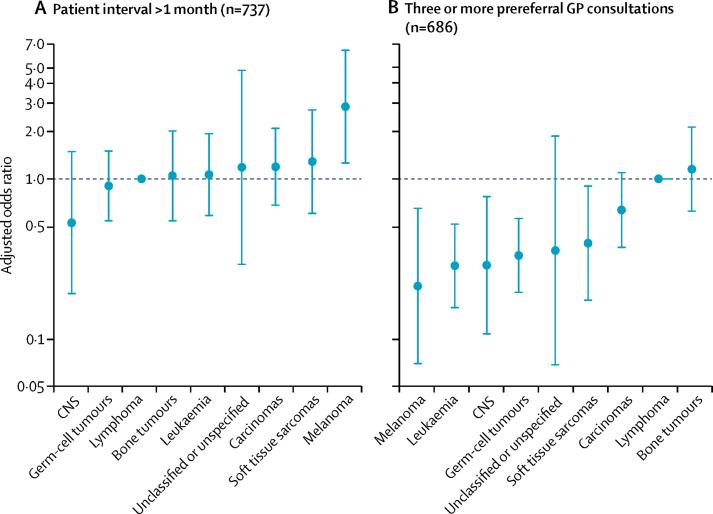
Of 1114 participants recruited to the BRIGHTLIGHT cohort, 830 completed a face-to-face interview. Among participants with available information, 204 (27%) of 748 had a patient interval of more than a month and 242 (35%) of 701 consulting a general practitioner had three or more prereferral consultations. The median symptom onset-to-diagnosis interval was 62 days (IQR 29-153). Compared with male AYAs, female AYAs were more likely to have three or more consultations (adjusted odds ratio [OR] 1·6 [95% CI 1·1-2·3], p=0·0093) and longer median symptom onset-to-diagnosis intervals (adjusted median interval longer by 24 days [95% CI 11-37], p=0·0005). Patients with lymphoma or bone tumours (adjusted OR 1·2 [95% CI 0·6-2·1] compared with lymphoma) were most likely to have three or more consultations and those with melanoma least likely (0·2 [0·1-0·7] compared with lymphoma). The adjusted median symptom onset-to-diagnosis intervals were longest in AYAs with bone tumours (51 days [95% CI 29-73] longer than for lymphoma) and shortest in those with leukaemia (33 days [17-49] shorter than for lymphoma).
INTERPRETATION
The findings provide a benchmark for diagnostic timeliness in young people with cancer and help to identify subgroups at higher risk of a prolonged diagnostic journey. Further research is needed to understand reasons for these findings and to prioritise and stratify early diagnosis initiatives for AYAs.
FUNDING
National Institute for Health Research, Teenage Cancer Trust, and Cancer Research UK.
背景
人们认为青少年和年轻人(AYAs)的癌症诊断时间间隔较长,但定量验证这一假设并确定高危患者亚组的证据不足。我们旨在调查一组患有偶发性癌症的 AYAs 的诊断及时性,并确定与及时性变化相关的因素。
方法
我们对 BRIGHTLIGHT 队列进行了横断面分析,该队列包括 2012 年 7 月 1 日至 2015 年 4 月 30 日期间在英格兰 96 家国民保健服务医院内平均 6 个月内从新原发性癌症诊断中招募的年龄在 12-24 岁的 AYAs。参与者完成了结构化的面对面访谈,提供了有关其诊断经历的信息(例如,症状开始的月份和年份、转诊至专科护理前的咨询次数);人口统计学信息从病例报告表中提取,诊断日期和癌症类型从国家癌症登记处提取。我们分析了这些数据,以评估患者间隔(从症状出现到首次向全科医生或急诊部就诊的时间)、转诊前全科医生咨询的次数以及从症状出现到诊断的时间(从症状出现到诊断的时间),并使用多变量回归模型检查关联。
结果
在 BRIGHTLIGHT 队列中招募的 1114 名参与者中,有 830 名完成了面对面访谈。在有可用信息的参与者中,748 名中有 204 名(27%)患者间隔超过一个月,701 名咨询全科医生中有 242 名(35%)有三次或更多次转诊前咨询。症状出现到诊断的中位数间隔为 62 天(IQR 29-153)。与男性 AYAs 相比,女性 AYAs 更有可能进行三次或更多次咨询(调整后的优势比[OR]1·6 [95%CI 1·1-2·3],p=0·0093),并且中位数症状出现到诊断的间隔更长(调整后的中位数间隔长 24 天[95%CI 11-37],p=0·0005)。与淋巴瘤相比,患有淋巴瘤或骨肿瘤的患者(调整后的 OR 1·2 [95%CI 0·6-2·1])最有可能进行三次或更多次咨询,而患有黑色素瘤的患者则不太可能(0·2 [0·1-0·7])。与淋巴瘤相比,骨肿瘤患者的调整后症状出现到诊断的中位数间隔最长(51 天[95%CI 29-73]比淋巴瘤长),白血病患者最短(33 天[17-49]比淋巴瘤短)。
解释
这些发现为年轻人癌症的诊断及时性提供了基准,并有助于确定风险较高的亚组诊断时间较长。需要进一步研究以了解这些发现的原因,并为 AYAs 的早期诊断计划确定和分层优先级。
资金
英国国家卫生研究院、青少年癌症信托基金和英国癌症研究中心。

 Zotero 插件