
RNAi 是密切相关真菌着丝粒进化的关键决定因素。
RNAi is a critical determinant of centromere evolution in closely related fungi.
机构信息
Molecular Biology and Genetics Unit, Jawaharlal Nehru Centre for Advanced Scientific Research, Bangalore 560064, India.
Department of Molecular Genetics and Microbiology, Duke University Medical Center, Durham, NC 27710.
出版信息
Proc Natl Acad Sci U S A. 2018 Mar 20;115(12):3108-3113. doi: 10.1073/pnas.1713725115. Epub 2018 Mar 5.
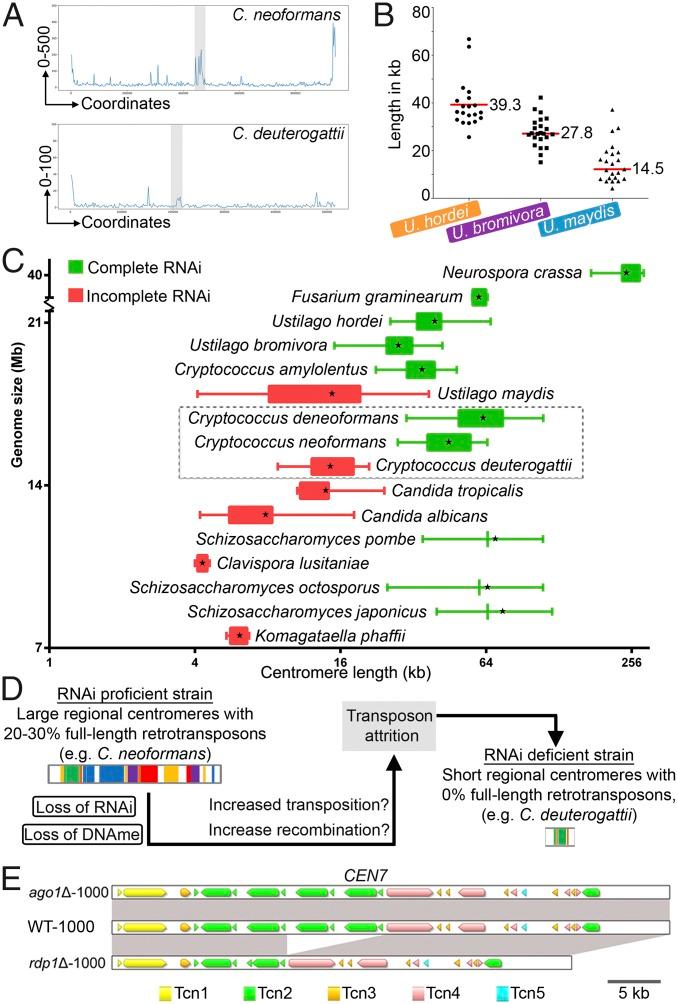
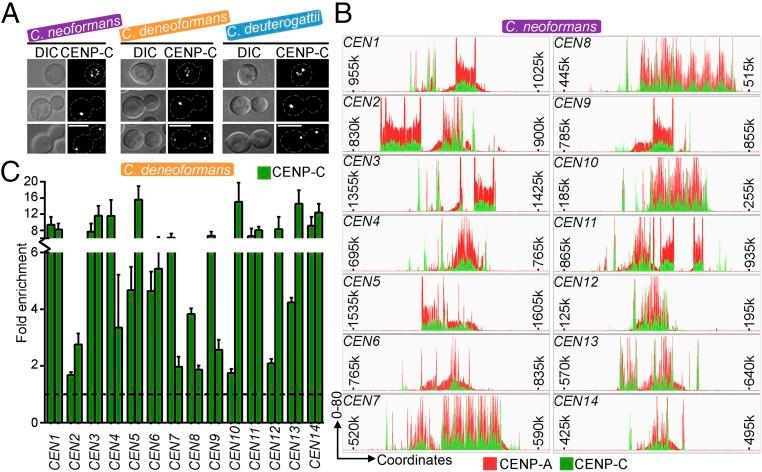
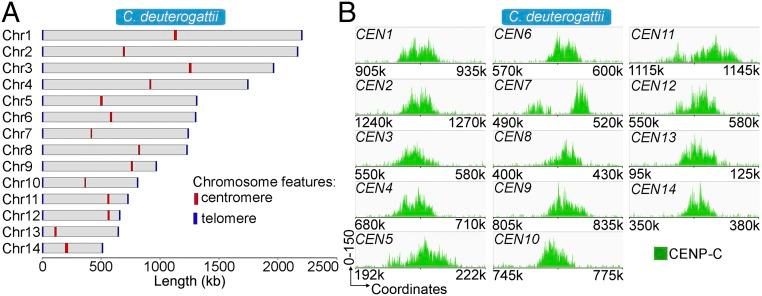
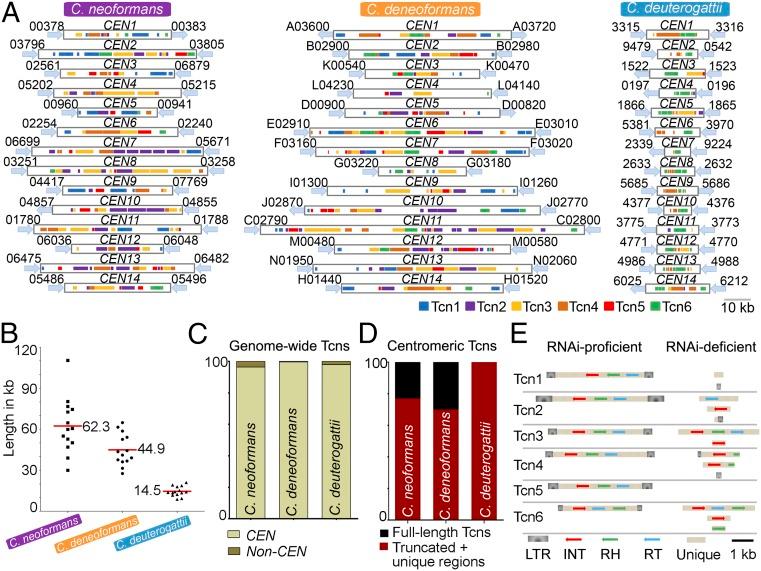
The centromere DNA locus on a eukaryotic chromosome facilitates faithful chromosome segregation. Despite performing such a conserved function, centromere DNA sequence as well as the organization of sequence elements is rapidly evolving in all forms of eukaryotes. The driving force that facilitates centromere evolution remains an enigma. Here, we studied the evolution of centromeres in closely related species in the fungal phylum of Basidiomycota. Using ChIP-seq analysis of conserved inner kinetochore proteins, we identified centromeres in three closely related species: two of which are RNAi-proficient, while the other lost functional RNAi. We find that the centromeres in the RNAi-deficient species are significantly shorter than those of the two RNAi-proficient species. While centromeres are LTR retrotransposon-rich in all cases, the RNAi-deficient species lost all full-length retroelements from its centromeres. In addition, centromeres in RNAi-proficient species are associated with a significantly higher level of cytosine DNA modifications compared with those of RNAi-deficient species. Furthermore, when an RNAi-proficient species and its RNAi-deficient mutants were passaged under similar conditions, the centromere length was found to be occasionally shortened in RNAi mutants. In silico analysis of predicted centromeres in a group of closely related species, also belonging to the Basidiomycota, were found to have undergone a similar transition in the centromere length in an RNAi-dependent fashion. Based on the correlation found in two independent basidiomycetous species complexes, we present evidence suggesting that the loss of RNAi and cytosine DNA methylation triggered transposon attrition, which resulted in shortening of centromere length during evolution.
真核染色体着丝粒 DNA 位点有助于忠实的染色体分离。尽管执行着如此保守的功能,但着丝粒 DNA 序列以及序列元件的组织在所有形式的真核生物中都在迅速进化。促进着丝粒进化的驱动力仍然是一个谜。在这里,我们研究了担子菌门真菌门中密切相关的物种的着丝粒进化。通过对保守的内着丝粒蛋白的 ChIP-seq 分析,我们在三个密切相关的物种中鉴定了着丝粒:其中两个是 RNAi 有效的,而另一个失去了功能性 RNAi。我们发现,在 RNAi 缺陷的物种中,着丝粒明显比两个 RNAi 有效的物种短。虽然所有情况下的着丝粒都富含 LTR 反转录转座子,但 RNAi 缺陷的物种从其着丝粒中丢失了所有全长反转录元件。此外,在 RNAi 有效的物种中,与 RNAi 缺陷的物种相比,着丝粒与更高水平的胞嘧啶 DNA 修饰相关。此外,当 RNAi 有效的物种及其 RNAi 缺陷的突变体在相似的条件下传代时,发现 RNAi 突变体中的着丝粒长度偶尔会缩短。对一组密切相关的物种(也属于担子菌门)的预测着丝粒进行的计算机分析表明,在 RNAi 依赖性方式下,着丝粒长度也发生了类似的转变。基于在两个独立的担子菌门物种复合体中发现的相关性,我们提出了证据表明,RNAi 和胞嘧啶 DNA 甲基化的丧失触发了转座子损耗,导致了进化过程中着丝粒长度的缩短。
 Zotero 插件