
Kv7(KCNQ)钾通道影响雌性而非雄性大鼠的总外周阻力,并抑制两性高血压大鼠的儿茶酚胺释放。
Kv7(KCNQ)-K-Channels Influence Total Peripheral Resistance in Female but Not Male Rats, and Hamper Catecholamine Release in Hypertensive Rats of Both Sexes.
作者信息
Berg Torill
机构信息
Division of Physiology, Department of Molecular Medicine, Institute for Basic Medical Sciences, University of Oslo, Oslo, Norway.
出版信息
Front Physiol. 2018 Feb 20;9:117. doi: 10.3389/fphys.2018.00117. eCollection 2018.
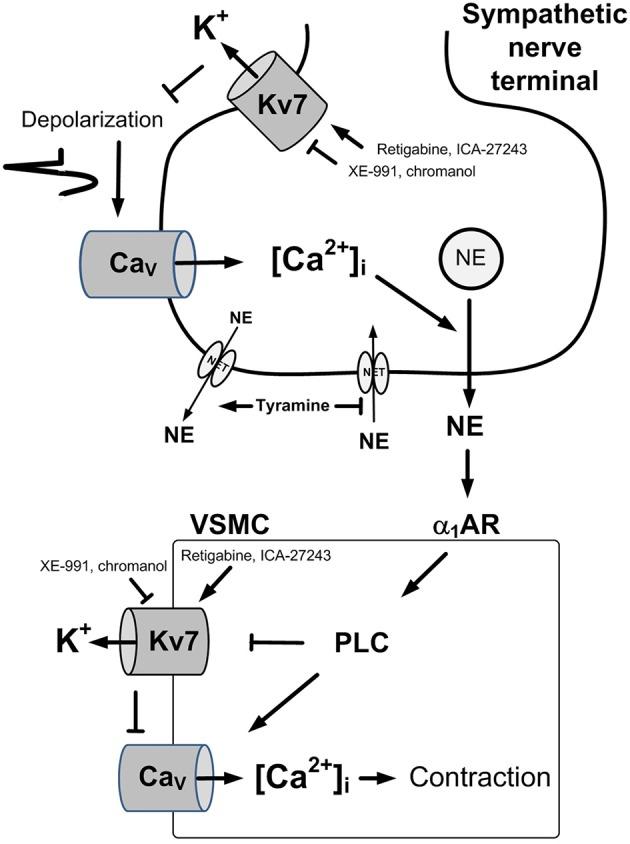
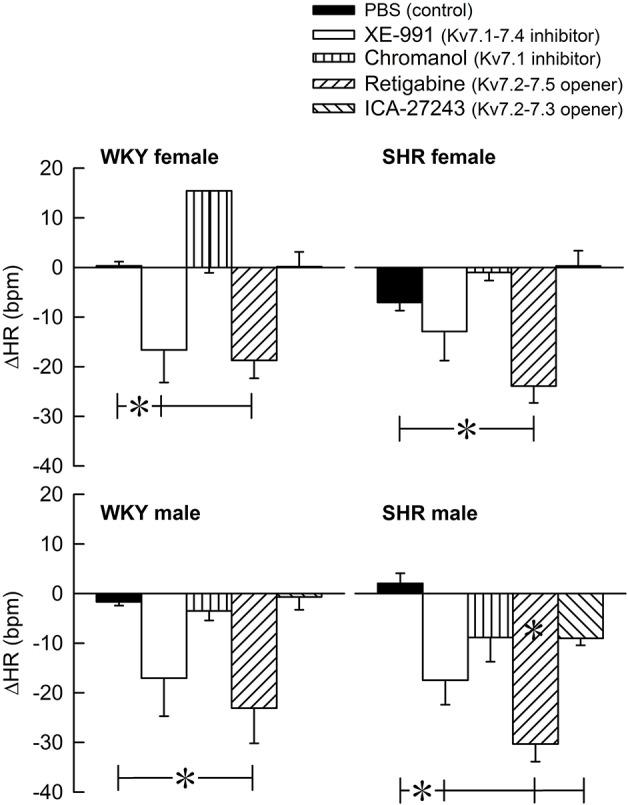
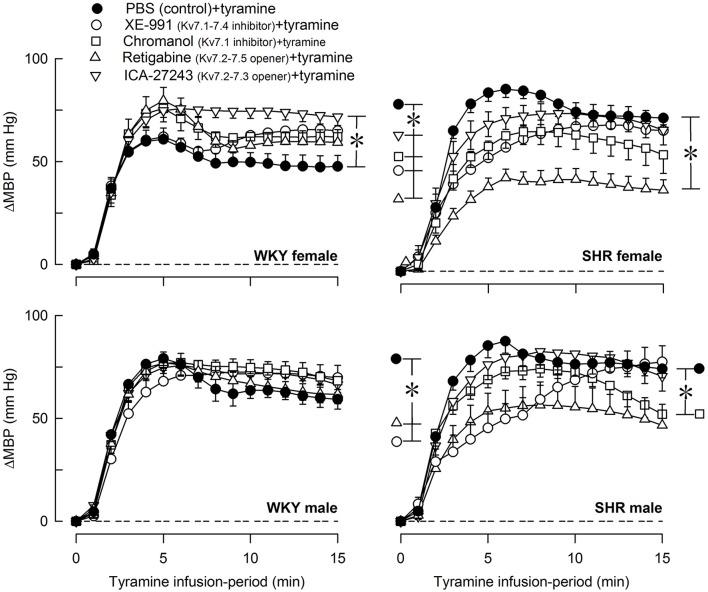
K-channels of the Kv7/KCNQ-family hyperpolarize and stabilize excitable cells such as autonomic neurons and vascular smooth muscle cells (VSMC). Kv7 may therefore play a role in blood pressure (BP) homeostasis, and prevent a high total peripheral vascular resistance (TPR), a hallmark of hypertensive disease. The present study analyzed if Kv7 channels influence catecholamine release and TPR in normotensive (WKY) and spontaneously hypertensive rats (SHR), and if they may contribute to the antihypertensive protection seen in young, female SHR. Tyramine-stimulated norepinephrine release evokes an adrenergic cardiovascular response, and also allows modulation of release to be reflected in the overflow to plasma. The experiment itself activated some secretion of epinephrine. The results show: (1) XE-991 (Kv7.1-7.4-inhibitor), but not chromanol 293B (Kv7.1-inhibitor), increased tyramine-stimulated norepinephrine overflow and epinephrine secretion in both sexes in SHR, but not WKY. (2) Surprisingly, the Kv7-openers retigabine (Kv7.2-7.5) and ICA-27243 (Kv7.2-7.3-preferring) increased catecholamine release in female SHR. (3) The rise in TPR following tyramine-stimulated norepinephrine release was increased by XE-991 but not chromanol in the female WKY only. (4) Retigabine and ICA-27243 reduced the TPR-response to tyramine in the female SHR only. These results suggested: (1) Up-regulation of Kv7.2-7.3 function in sympathetic neurons and chromaffin cells hampered catecholamine release in SHR of both sexes. (2) The increase catecholamine release observed after channel openers in the female SHR may possibly involve reduced transmission in cholinergic neurons which hamper catecholamine release. These two mechanisms may serve to counter-act the hyperadrenergic state in SHR. (3) Kv7.4, most likely in the vasculature, opposed the tension-response to norepinephrine in the female WKY. (4) Vascular Kv7.4-7.5 could be stimulated and then opposed norepinephrine-induced vasoconstriction in the female SHR. (5) Vascular Kv7 channels did not counter-act norepinephrine induced vasoconstriction in male rats, possibly due to different Kv7 channel regulation. Kv7 channels may represent a novel target for antihypertensive therapy.
Kv7/KCNQ家族的钾通道可使自主神经元和血管平滑肌细胞(VSMC)等可兴奋细胞超极化并使其稳定。因此,Kv7可能在血压(BP)稳态中发挥作用,并预防高血压疾病的标志性特征——高总外周血管阻力(TPR)。本研究分析了Kv7通道是否影响正常血压大鼠(WKY)和自发性高血压大鼠(SHR)的儿茶酚胺释放和TPR,以及它们是否有助于年轻雌性SHR中所见的降压保护作用。酪胺刺激的去甲肾上腺素释放会引发肾上腺素能心血管反应,并且还能使释放的调节反映在血浆溢流量中。实验本身激活了一些肾上腺素的分泌。结果显示:(1)XE - 991(Kv7.1 - 7.4抑制剂)而非色满醇293B(Kv7.1抑制剂)增加了SHR雌雄两性中酪胺刺激的去甲肾上腺素溢流量和肾上腺素分泌,但对WKY大鼠无此作用。(2)令人惊讶的是,Kv7开放剂瑞替加滨(Kv7.2 - 7.5)和ICA - 27243(优先作用于Kv7.2 - 7.3)增加了雌性SHR中的儿茶酚胺释放。(3)仅在雌性WKY大鼠中,酪胺刺激的去甲肾上腺素释放后TPR的升高被XE - 991增强,但色满醇无此作用。(4)瑞替加滨和ICA - 27243仅降低了雌性SHR中对酪胺的TPR反应。这些结果表明:(1)交感神经元和嗜铬细胞中Kv7.2 - 7.3功能的上调阻碍了SHR雌雄两性的儿茶酚胺释放。(2)在雌性SHR中通道开放剂后观察到的儿茶酚胺释放增加可能涉及胆碱能神经元中传递减少,从而阻碍儿茶酚胺释放。这两种机制可能有助于对抗SHR中的高肾上腺素能状态。(3)最有可能在脉管系统中的Kv7.4,在雌性WKY中对抗对去甲肾上腺素的张力反应。(4)血管中的Kv7.4 - 7.5可被刺激,然后在雌性SHR中对抗去甲肾上腺素诱导的血管收缩。(5)血管Kv7通道在雄性大鼠中不对抗去甲肾上腺素诱导的血管收缩,可能是由于Kv7通道调节不同。Kv7通道可能代表抗高血压治疗的新靶点。




 Zotero 插件