
细胞密度会抵消基质硬度对人骨髓间充质干细胞形态和增殖的影响。
Cell density overrides the effect of substrate stiffness on human mesenchymal stem cells' morphology and proliferation.
机构信息
Institute of Stem Cell Biology and Regenerative Medicine, Bangalore 560065, India.
出版信息
Biomater Sci. 2018 May 1;6(5):1109-1119. doi: 10.1039/c7bm00853h.
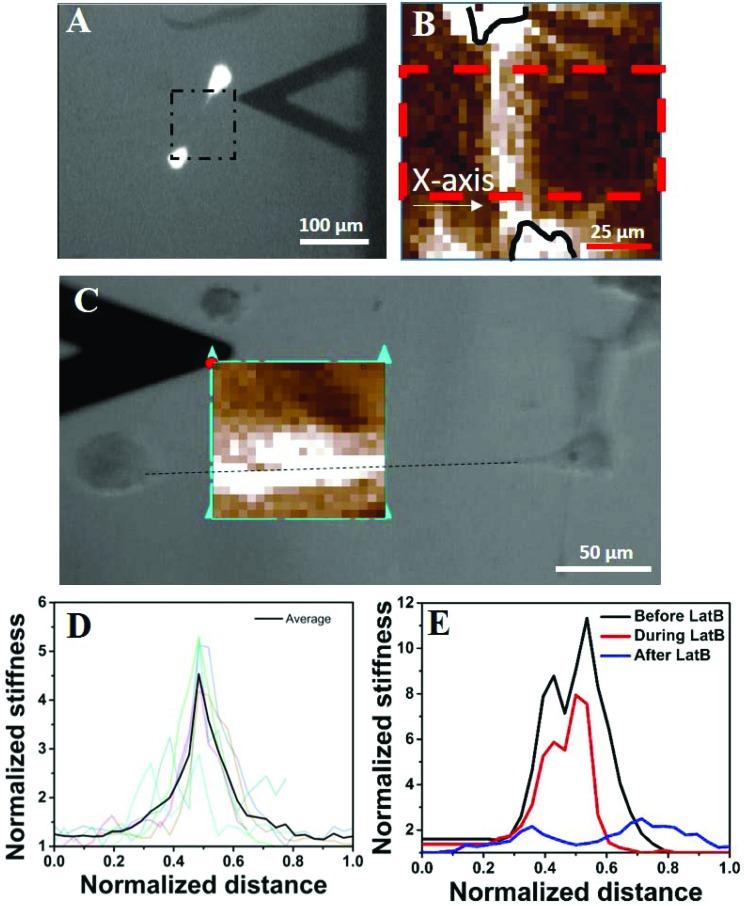
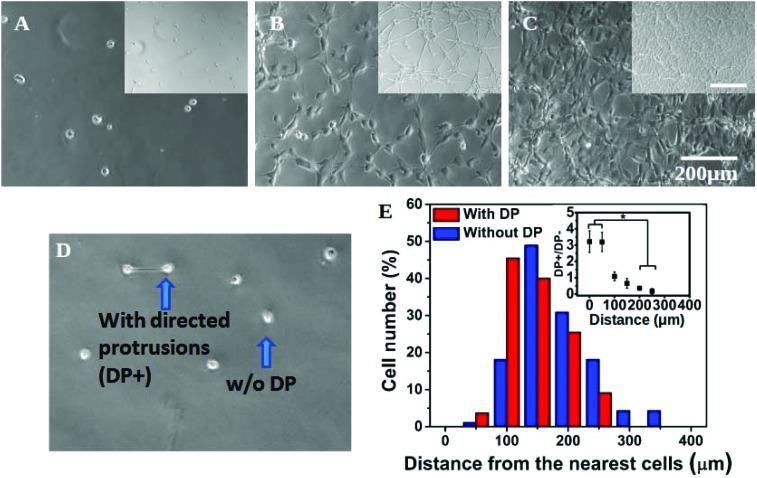
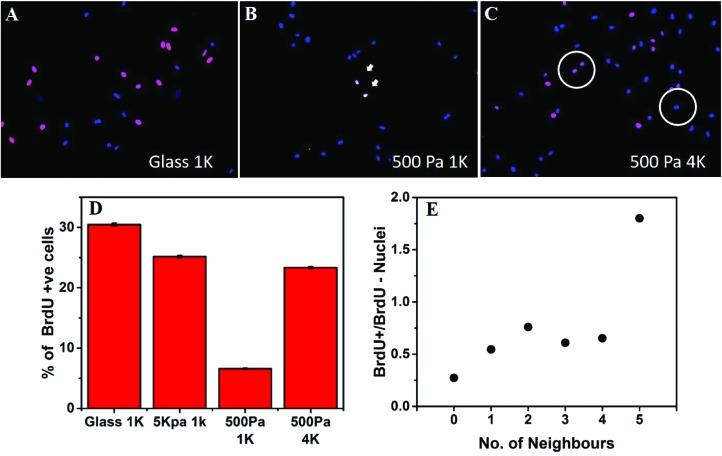
The effect of substrate stiffness on the cellular morphology, proliferation, and differentiation of human mesenchymal stem cells (hMSCs) has been extensively researched and well established. However, the majority of these studies are done with a low seeding density where cell to cell interactions do not play a significant role. While these conditions permit an analysis of cell-substratum interactions at the single cell level, such a model system fails to capture a critical aspect of the cellular micro-environment in vivo, i.e. the cell-cell interaction via matrix deformation (i.e., strain). To address this question, we seeded hMSCs on soft poly-acrylamide (PAA) gels, at a seeding density that permits cells to be mechanically interacting via the underlying substrate. We found that as the intercellular distance decreases with the increasing seeding density, cellular sensitivity towards the substrate rigidity becomes significantly diminished. With the increasing seeding density, the cell spread area increased on a soft substrate (500 Pa) but reduced on an even slightly stiffer substrate (2 kPa) as well as on glass making them indistinguishable at a high seeding density. Not only in terms of cell spread area but also at a high seeding density, cells formed mature focal adhesions and prominent stress fibres on a soft substrate similar to that of the cells being cultured on a stiff substrate. The decreased intercellular distance also influenced the proliferation rate of the cells: higher seeding density on the soft substrate showed cell cycle progression similar to that of the cells on glass substrates. In summary, this paper demonstrates how the effect of substrate rigidity on the cell morphology and fate is a function of inter-cellular distance when seeded on a soft substrate. Our AFM data suggest that such changes happen due to local strain stiffening of the soft PAA gel, an effect that has been rarely reported in the literature so far.
基质硬度对人骨髓间充质干细胞(hMSCs)的细胞形态、增殖和分化的影响已经得到了广泛的研究和证实。然而,大多数这些研究都是在细胞间相互作用不显著的低接种密度下进行的。虽然这些条件允许在单细胞水平上分析细胞-基质相互作用,但这种模型系统无法捕捉到细胞微环境的一个关键方面,即通过基质变形(即应变)的细胞间相互作用。为了解决这个问题,我们在软聚丙烯酰胺(PAA)凝胶上接种 hMSCs,接种密度允许细胞通过底层基质进行机械相互作用。我们发现,随着细胞间距离随着接种密度的增加而减小,细胞对基质硬度的敏感性显著降低。随着接种密度的增加,细胞在软基质(500 Pa)上的铺展面积增加,但在稍硬的基质(2 kPa)和玻璃上的铺展面积减少,使得在高接种密度下无法区分。不仅在细胞铺展面积方面,而且在高接种密度下,细胞在软基质上形成成熟的焦点粘附和明显的应力纤维,类似于在硬基质上培养的细胞。细胞间距离的减小也影响了细胞的增殖速度:在软基质上的高接种密度显示出与玻璃基质上的细胞相似的细胞周期进展。总之,本文证明了当在软基质上接种时,基质刚性对细胞形态和命运的影响是细胞间距离的函数。我们的原子力显微镜数据表明,这种变化是由于软 PAA 凝胶的局部应变硬化引起的,到目前为止,这一效应在文献中很少有报道。


 Zotero 插件