
家庭收入、收入不平等与健康相关生命质量(用 EQ-5D 量表测量)在中国陕西的横断面研究。
Household income, income inequality, and health-related quality of life measured by the EQ-5D in Shaanxi, China: a cross-sectional study.
机构信息
Department of Health Statistics, Fourth Military Medical University, Xi'an, Shaanxi Province, China.
Department of Health Statistics, School of Public Health, Weifang Medical College, Shangdong Province, Weifang, China.
出版信息
Int J Equity Health. 2018 Mar 14;17(1):32. doi: 10.1186/s12939-018-0745-9.
BACKGROUND
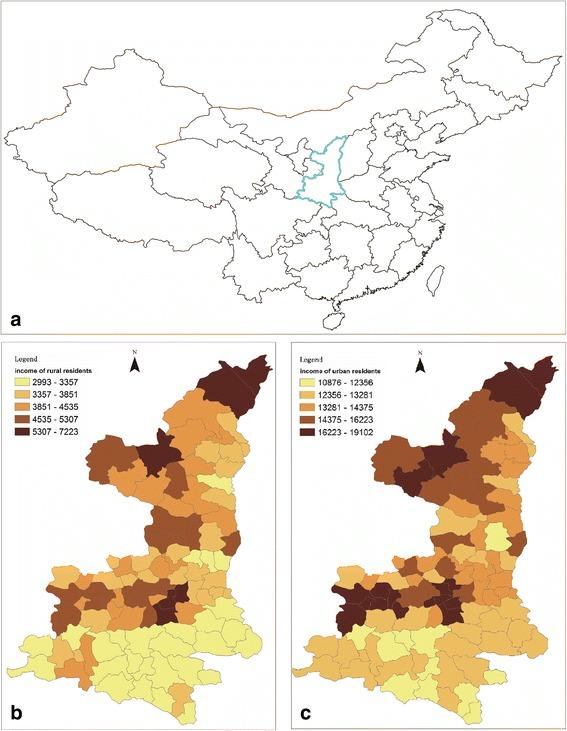
In advanced economies, economic factors have been found to be associated with many health outcomes, including health-related quality of life (HRQL), and people's health is affected more by income inequality than by absolute income. However, few studies have examined the association of income inequality and absolute income with HRQL in transitional economies using individual data. This paper focuses on the effects of county or district income inequality and absolute income on the HRQL measured by EQ-5D and the differences between rural and urban regions in Shaanxi province, China.
METHODS
Data were collected from the 2008 National Health Service Survey conducted in Shaanxi, China. The EQ-5D index based on Japanese weights was employed as a health indicator. The income inequality was calculated on the basis of self-reported income. The special requirements for complex survey data analysis were considered in the bivariate analysis and linear regression models.
RESULTS
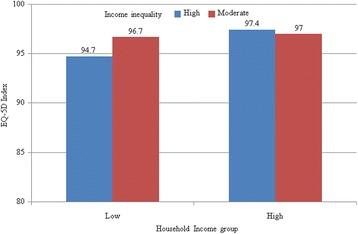
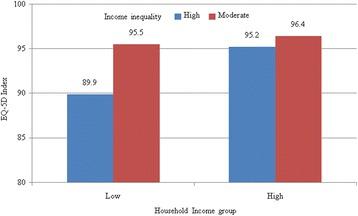
The mean of the EQ-5D index was 94.6. The EQ-5D index of people with low income was lower than that in the high-income group (for people in the rural region: 93.2 v 96.1, P < 0.01; for people in the urban region: 95.5 v 96.8, P < 0.01). Compared with people with moderate inequality, the EQ-5D index of those with high inequality was relatively lower (for people living in the rural region: 91.1 v 95.8, P < 0.01; for people living in the urban region: 95.6 v 97.3, P < 0.01). Adjusted by age, gender, education, marital status, employment, medical insurance, and chronic disease, all the coefficients of the low-income group and high income inequality were significantly negative. After stratifying by income group, all the effects of high income inequality remained negative in both income groups. However, the coefficients of the models in the high income group were not statistically significant.
CONCLUSION
Income inequality has damaging effects on HRQL in Shaanxi, China, especially for people with low income. In addition, people living in rural regions were more vulnerable to economic factors.
背景
在发达经济体中,经济因素与许多健康结果相关,包括与健康相关的生活质量(HRQL),并且人们的健康受到收入不平等的影响大于受到绝对收入的影响。然而,使用个人数据研究转型经济体中收入不平等和绝对收入与 HRQL 之间关联的研究较少。本文主要关注县级或区级收入不平等和绝对收入对陕西省 EQ-5D 测量的 HRQL 的影响,以及城乡地区的差异。
方法
数据来自 2008 年在中国陕西进行的国家卫生服务调查。采用基于日本权重的 EQ-5D 指数作为健康指标。收入不平等是根据自我报告的收入计算的。在双变量分析和线性回归模型中考虑了复杂调查数据的特殊分析要求。
结果
EQ-5D 指数的平均值为 94.6。低收入人群的 EQ-5D 指数低于高收入人群(农村地区:93.2 比 96.1,P<0.01;城市地区:95.5 比 96.8,P<0.01)。与收入中等不平等的人群相比,收入高度不平等的人群的 EQ-5D 指数相对较低(农村地区:91.1 比 95.8,P<0.01;城市地区:95.6 比 97.3,P<0.01)。调整年龄、性别、教育、婚姻状况、就业、医疗保险和慢性病后,低收入组和高收入不平等组的所有系数均为显著负。在按收入分组后,高收入不平等组在两个收入组中的所有效应仍然为负。然而,高收入组模型的系数在统计学上并不显著。
结论
收入不平等对中国陕西的 HRQL 有不利影响,尤其是对低收入人群。此外,农村地区的人更容易受到经济因素的影响。
 Zotero 插件