
孟鲁司特钠治疗肺移植后闭塞性细支气管炎综合征:一项随机对照试验。
Montelukast for bronchiolitis obliterans syndrome after lung transplantation: A randomized controlled trial.
机构信息
KULeuven and UZ Leuven, Dept. of Clinical and Experimental Medicine, Division of Respiratory Diseases, Lung Transplant Unit, Leuven, Belgium.
KU Leuven, Department of Rehabilitation Sciences, Leuven, Belgium.
出版信息
PLoS One. 2018 Apr 6;13(4):e0193564. doi: 10.1371/journal.pone.0193564. eCollection 2018.
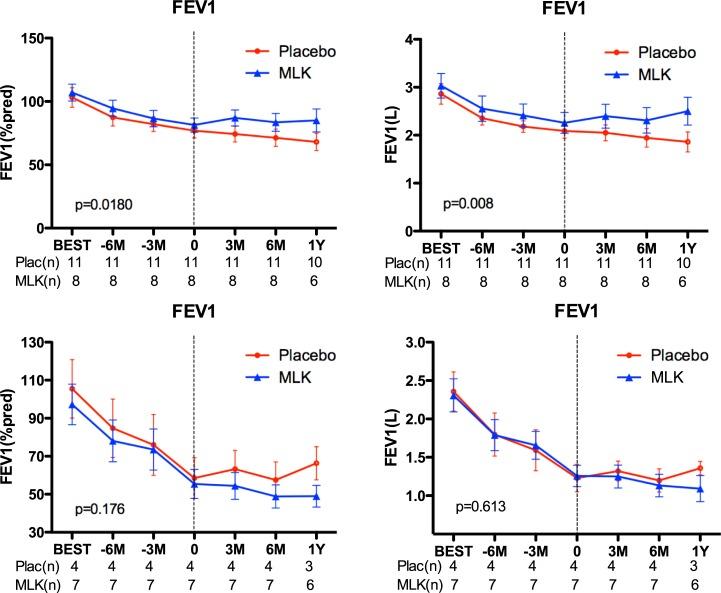
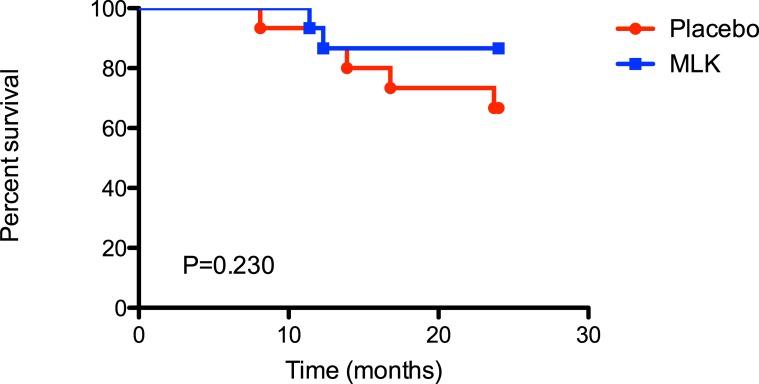
Bronchiolitis obliterans syndrome (BOS) remains the major problem which precludes long-term survival after lung transplantation. Previously, an open label pilot study from our group demonstrated a possible beneficial effect of montelukast in progressive BOS patients with low airway neutrophilia (<15%), and already on azithromycin treatment, in whom the further decline in pulmonary function was attenuated. This was, however, a non-randomized and non-placebo controlled trial. The study design is a single center, prospective, interventional, randomized, double blind, placebo-controlled trial, with a two arm parallel group design and an allocation ratio of 1:1. Randomization to additional montelukast (10 mg/day, n = 15) or placebo (n = 15) was performed from 2010 to 2014 at the University Hospitals Leuven (Leuven, Belgium) in all consecutive patients with late-onset (>2years posttransplant) BOS ≥1. Primary end-point was freedom from graft loss 1 year after randomization; secondary end-points were acute rejection, lymphocytic bronchiolitis, respiratory infection rate; and change in FEV1, airway and systemic inflammation during the study period. Graft loss at 1 y and 2y was similar in both groups (respectively p = 0. 981 and p = 0.230). Montelukast had no effect on lung function decline in the overall cohort. However, in a post-hoc subanalysis of BOS stage 1 patients, montelukast attenuated further decline of FEV1 during the study period, both in absolute (L) (p = 0.008) and % predicted value (p = 0.0180). A linear mixed model confirmed this association. Acute rejection, lymphocytic bronchiolitis, respiratory infections, systemic and airway inflammation were comparable between groups over the study period. This randomized controlled trial showed no additional survival benefit with montelukast compared to placebo, although the study was underpowered. The administration of montelukast was associated with an attenuation of the rate of FEV1 decline, however, only in recipients with late-onset BOS stage 1.
闭塞性细支气管炎综合征(BOS)仍然是肺移植后长期生存的主要问题。此前,我们小组的一项开放性标签试点研究表明,在已经接受阿奇霉素治疗且气道中性粒细胞<15%的进展性 BOS 患者中,孟鲁司特可能具有有益作用,可减轻肺功能进一步下降。然而,这是一项非随机和非安慰剂对照试验。该研究设计为单中心、前瞻性、干预性、随机、双盲、安慰剂对照试验,采用两臂平行组设计,分配比例为 1:1。2010 年至 2014 年,在比利时鲁汶大学医院(Leuven, Belgium)对所有迟发性(移植后>2 年)BOS≥1 的患者进行了孟鲁司特(10mg/天,n=15)或安慰剂(n=15)的附加随机分组。主要终点为随机分组后 1 年无移植物丢失;次要终点为急性排斥反应、淋巴细胞性细支气管炎、呼吸道感染率;以及研究期间 FEV1、气道和全身炎症的变化。两组 1 年和 2 年的移植物丢失率相似(分别为 p=0.981 和 p=0.230)。孟鲁司特对整个队列的肺功能下降均无影响。然而,在 BOS 1 期患者的事后亚分析中,孟鲁司特在研究期间减弱了 FEV1 的进一步下降,无论是绝对值(L)(p=0.008)还是预计值百分比(p=0.0180)。线性混合模型证实了这种关联。在研究期间,各组之间的急性排斥反应、淋巴细胞性细支气管炎、呼吸道感染、全身和气道炎症无差异。与安慰剂相比,这项随机对照试验显示孟鲁司特没有额外的生存获益,尽管研究的效力不足。然而,孟鲁司特的给药与 FEV1 下降率的降低相关,仅在迟发性 BOS 1 期的患者中。


 Zotero 插件