
尿 microRNA-196a 可预测慢性肾脏病患者的疾病进展。
Urinary miR-196a predicts disease progression in patients with chronic kidney disease.
机构信息
National Clinical Research Center of Kidney Diseases, Jinling Hospital, Nanjing University School of Medicine, Nanjing, 210002, Jiangsu, China.
Shanghai Center for Bioinformation Research Technology, Shanghai Academy of Science and Technology, Shanghai, China.
出版信息
J Transl Med. 2018 Apr 10;16(1):91. doi: 10.1186/s12967-018-1470-2.
BACKGROUND
Urinary miRNAs may potentially serve as noninvasive biomarkers in various kidney diseases to reflect disease activity, severity and progression, especially those correlated with the pathogenesis of kidney diseases. This study demonstrates that urinary miR-196a, a kidney-enriched miRNA, can predict progression of chronic kidney disease (CKD).
METHODS
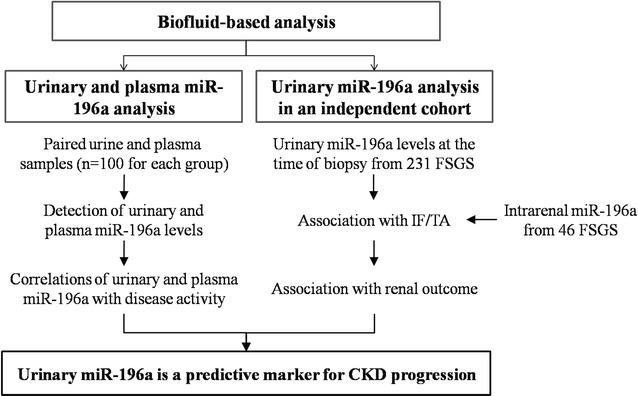
Focal segmental glomerulosclerosis (FSGS) cohorts were used as the representative example of CKD. First, correlation of miR-196a with disease activity was analyzed using paired urine and plasma samples from FSGS patients with nephrotic-range proteinuria (FSGS-A), complete remission (FSGS-CR) and normal controls (NCs). Then, the value of urinary miR-196a in predicting disease progression was validated using another cohort of 231 FSGS patients who were followed-up until over 36 months or reaching end-stage renal disease (ESRD). MiR-196a levels were analyzed by quantitative reverse transcription-polymerase chain reaction.
RESULTS
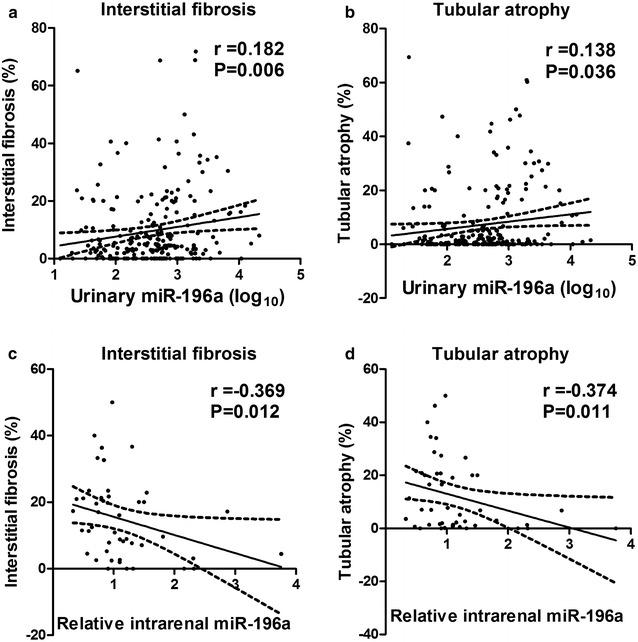
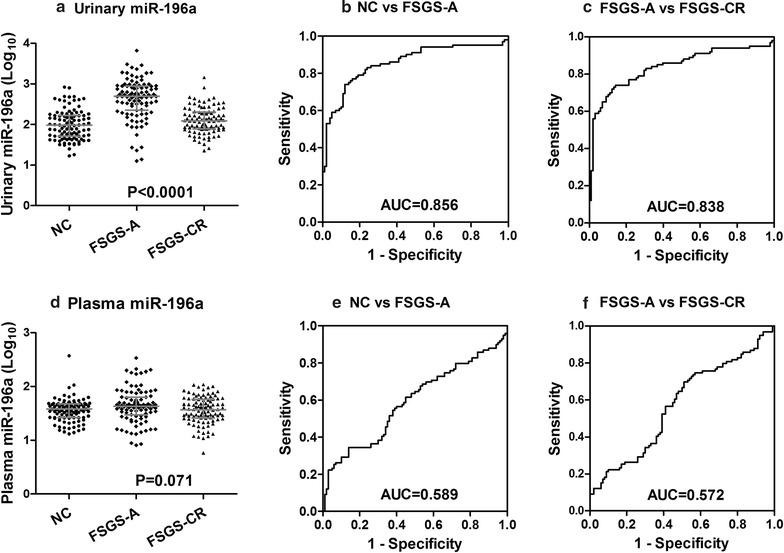
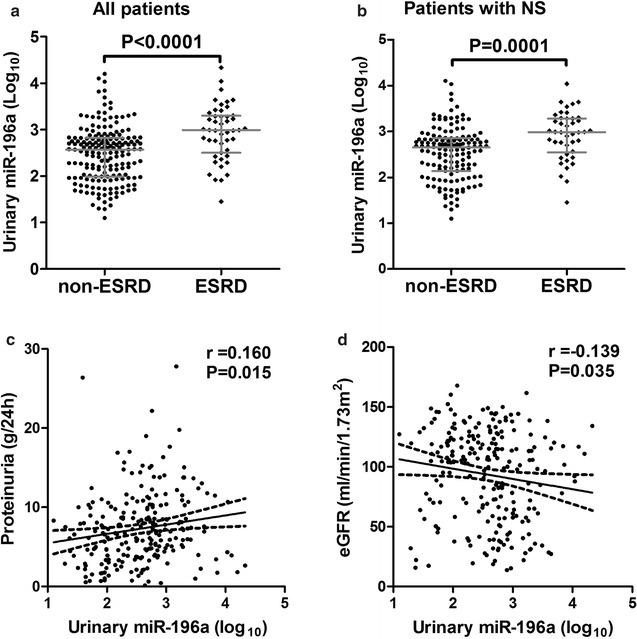
The results showed that urinary miR-196a significantly increased in FSGS-A compared with FSGS-CR and NCs, clearly distinguishing FSGS-A from FSGS-CR and NCs, whereas plasma miR-196a showed no difference among these groups. Moreover, urinary miR-196a, which was associated with proteinuria, estimated glomerular filtration rate (eGFR), interstitial fibrosis and tubular atrophy, significantly increased in patients progressed to ESRD compared to those not. Furthermore, patients with higher urinary miR-196a displayed poorer renal survival than those with lower urinary miR-196a. Multivariate Cox analysis confirmed urinary miR-196a as an independent risk factor for FSGS progression after adjusting for age, sex, proteinuria and eGFR. Prediction accuracy of ESRD was significantly improved by combining urinary miR-196a with other indicators including eGFR and proteinuria.
CONCLUSION
Urinary miR-196a may serve as a biomarker for predicting CKD progression.
背景
尿液 microRNA(miRNA)可能作为各种肾脏疾病的非侵入性生物标志物,反映疾病的活动度、严重程度和进展,特别是那些与肾脏疾病发病机制相关的 miRNA。本研究表明,尿液中丰富表达的 microRNA-196a(miR-196a)可以预测慢性肾脏病(CKD)的进展。
方法
局灶节段性肾小球硬化症(FSGS)队列被用作 CKD 的代表性例子。首先,通过分析 FSGS 患者肾病范围蛋白尿(FSGS-A)、完全缓解(FSGS-CR)和正常对照(NC)的配对尿液和血浆样本,分析 miR-196a 与疾病活动度的相关性。然后,使用另一队列的 231 例 FSGS 患者,对尿 miR-196a 预测疾病进展的价值进行验证,这些患者随访时间超过 36 个月或进展至终末期肾病(ESRD)。采用实时定量逆转录聚合酶链反应(qRT-PCR)分析 miR-196a 水平。
结果
结果显示,与 FSGS-CR 和 NC 相比,FSGS-A 患者尿液 miR-196a 水平显著升高,可明显区分 FSGS-A 与 FSGS-CR 和 NC,而血浆 miR-196a 在这些组之间无差异。此外,与蛋白尿、估算肾小球滤过率(eGFR)、间质纤维化和肾小管萎缩相关的尿 miR-196a 在进展为 ESRD 的患者中明显高于未进展的患者。进一步分析显示,尿 miR-196a 水平较高的患者肾脏存活率较尿 miR-196a 水平较低的患者差。多变量 Cox 分析证实,在校正年龄、性别、蛋白尿和 eGFR 后,尿 miR-196a 是 FSGS 进展的独立危险因素。将尿 miR-196a 与包括 eGFR 和蛋白尿在内的其他指标相结合,可显著提高对 ESRD 的预测准确性。
结论
尿 miR-196a 可能作为预测 CKD 进展的生物标志物。
 Zotero 插件