
一项针对患有2型糖尿病合并超重或肥胖的弱势群体,采用移动和联网工具进行多行为自我监测强化的行为生活方式干预:试点比较有效性试验
A Behavioral Lifestyle Intervention Enhanced With Multiple-Behavior Self-Monitoring Using Mobile and Connected Tools for Underserved Individuals With Type 2 Diabetes and Comorbid Overweight or Obesity: Pilot Comparative Effectiveness Trial.
作者信息
Wang Jing, Cai Chunyan, Padhye Nikhil, Orlander Philip, Zare Mohammad
机构信息
Cizik School of Nursing, The University of Texas Health Science Center at Houston, Houston, TX, United States.
McGovern Medical School, The University of Texas Health Science Center at Houston, Houston, TX, United States.
出版信息
JMIR Mhealth Uhealth. 2018 Apr 10;6(4):e92. doi: 10.2196/mhealth.4478.
BACKGROUND
Self-monitoring is a cornerstone of behavioral lifestyle interventions for obesity and type 2 diabetes mellitus. Mobile technology has the potential to improve adherence to self-monitoring and patient outcomes. However, no study has tested the use of a smartphone to facilitate self-monitoring in overweight or obese adults with type 2 diabetes mellitus living in the underserved community.
OBJECTIVE
The aim of this study was to examine the feasibility of and compare preliminary efficacy of a behavioral lifestyle intervention using smartphone- or paper-based self-monitoring of multiple behaviors on weight loss and glycemic control in a sample of overweight or obese adults with type 2 diabetes mellitus living in underserved communities.
METHODS
We conducted a randomized controlled trial to examine the feasibility and preliminary efficacy of a behavioral lifestyle intervention. Overweight or obese patients with type 2 diabetes mellitus were recruited from an underserved minority community health center in Houston, Texas. They were randomly assigned to one of the three groups: (1) behavior intervention with smartphone-based self-monitoring, (2) behavior intervention with paper diary-based self-monitoring, and (3) usual care group. Both the mobile and paper groups received a total of 11 face-to-face group sessions in a 6-month intervention. The mobile group received an Android-based smartphone with 2 apps loaded to help them record their diet, physical activity, weight, and blood glucose, along with a connected glucometer, whereas the paper group used paper diaries for these recordings. Primary outcomes of the study included percentage weight loss and glycated hemoglobin (HbA) changes over 6 months.
RESULTS
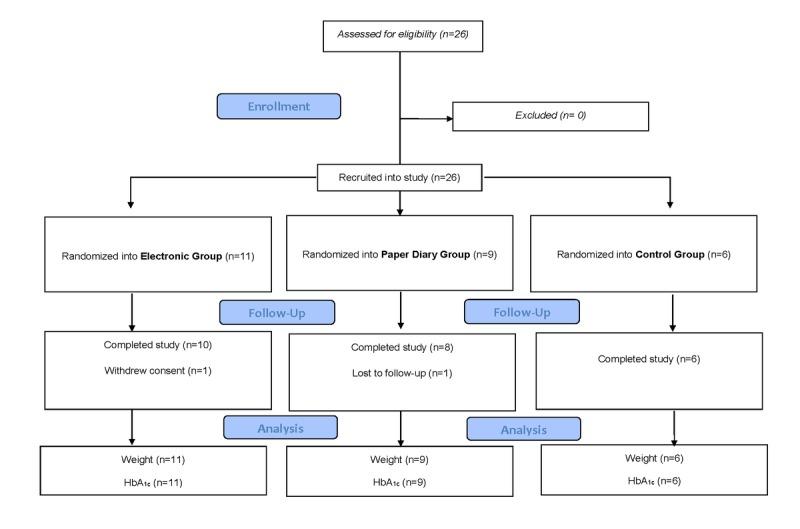
A total of 26 patients were enrolled: 11 in the mobile group, 9 in the paper group, and 6 in the control group. We had 92% (24/26) retention rate at 6 months. The sample is predominantly African Americans with an average age of 56.4 years and body mass index of 38.1. Participants lost an average of 2.73% (mobile group) and 0.13% (paper group) weight at 6 months, whereas the control group had an average 0.49% weight gain. Their HbA changed from 8% to 7 % in mobile group, 10% to 9% in paper group, and maintained at 9% for the control group. We found a significant difference on HbA at 6 months among the 3 groups (P=.01). We did not find statistical group significance on percentage weight loss (P=.20) and HbA changes (P=.44) overtime; however, we found a large effect size of 0.40 for weight loss and a medium effect size of 0.28 for glycemic control.
CONCLUSIONS
Delivering a simplified behavioral lifestyle intervention using mobile health-based self-monitoring in an underserved community is feasible and acceptable and shows higher preliminary efficacy, as compared with paper-based self-monitoring. A full-scale randomized controlled trial is needed to confirm the findings in this pilot study.
TRIAL REGISTRATION
ClinicalTrials.gov NCT02858648; https://clinicaltrials.gov/ct2/show/NCT02858648 (Archived by WebCite at http://www.webcitation.org/6ySidjmT7).
背景
自我监测是肥胖症和2型糖尿病行为生活方式干预的基石。移动技术有潜力提高对自我监测的依从性以及改善患者预后。然而,尚无研究测试使用智能手机来促进生活在服务欠缺社区的超重或肥胖2型糖尿病成年人进行自我监测的效果。
目的
本研究旨在探讨在生活于服务欠缺社区的超重或肥胖2型糖尿病成年样本中,使用基于智能手机或纸质的多种行为自我监测进行行为生活方式干预对体重减轻和血糖控制的可行性,并比较其初步疗效。
方法
我们进行了一项随机对照试验,以检验行为生活方式干预的可行性和初步疗效。从得克萨斯州休斯敦一个服务欠缺的少数族裔社区健康中心招募超重或肥胖的2型糖尿病患者。他们被随机分配到三组中的一组:(1)基于智能手机自我监测的行为干预组,(2)基于纸质日记自我监测的行为干预组,以及(3)常规护理组。移动组和纸质组在为期6个月的干预中总共接受11次面对面的小组会议。移动组收到一部装有2个应用程序的安卓智能手机,用于帮助他们记录饮食、身体活动、体重和血糖,还配备了一台联网血糖仪,而纸质组使用纸质日记进行这些记录。该研究的主要结局包括6个月内的体重减轻百分比和糖化血红蛋白(HbA)变化。
结果
总共招募了26名患者:移动组11名,纸质组9名,对照组6名。6个月时我们的保留率为92%(24/26)。样本主要是非洲裔美国人,平均年龄56.4岁,体重指数38.1。6个月时,移动组参与者平均体重减轻2.73%,纸质组为0.13%,而对照组平均体重增加0.49%。移动组的HbA从8%降至7%,纸质组从10%降至9%,对照组维持在9%。我们发现3组在6个月时的HbA有显著差异(P = 0.01)。我们未发现随时间推移在体重减轻百分比(P = 0.20)和HbA变化(P = 0.44)方面存在组间统计学显著性;然而,我们发现体重减轻的效应量为0.40,血糖控制为0.28。
结论
在服务欠缺社区使用基于移动健康的自我监测进行简化的行为生活方式干预是可行且可接受的,并且与基于纸质的自我监测相比显示出更高的初步疗效。需要进行一项全面的随机对照试验来证实本试点研究的结果。
试验注册
ClinicalTrials.gov NCT02858648;https://clinicaltrials.gov/ct2/show/NCT02858648 (由WebCite存档于http://www.webcitation.org/6ySidjmT7)
 Zotero 插件