
7-苄氧基吲哚和其他卤代吲哚抑制白色念珠菌生物膜和菌丝形成的功效。
Efficacy of 7-benzyloxyindole and other halogenated indoles to inhibit Candida albicans biofilm and hyphal formation.
机构信息
School of Chemical Engineering, Yeungnam University, Gyeongsan, 38541, Korea.
出版信息
Microb Biotechnol. 2018 Nov;11(6):1060-1069. doi: 10.1111/1751-7915.13268. Epub 2018 Apr 15.
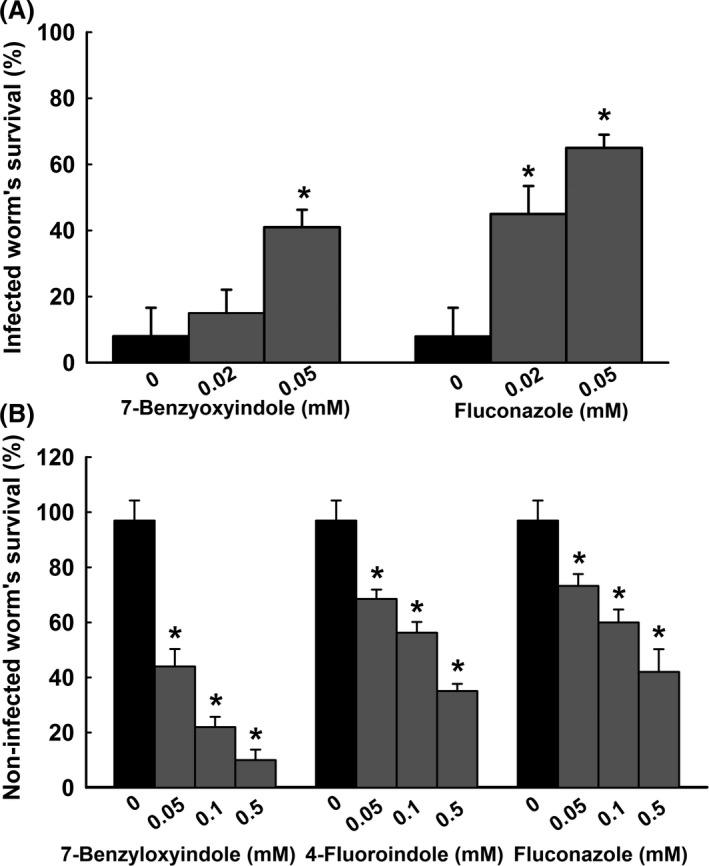
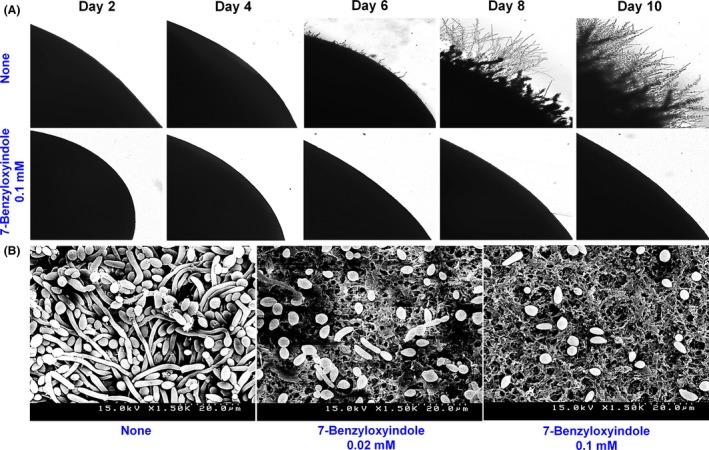
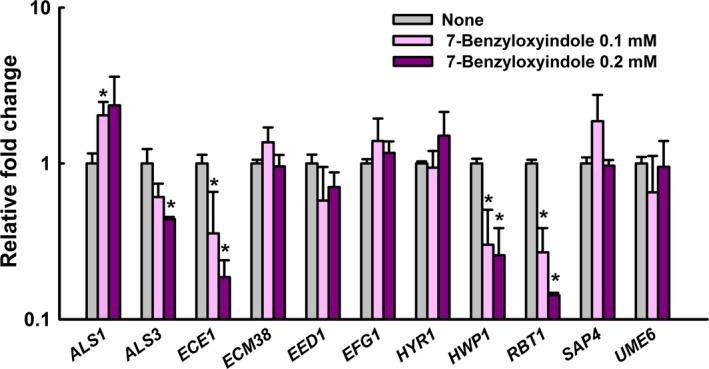
Certain pathogenic bacteria and yeast form biofilms on biotic and abiotic surfaces including medical devices and implants. Hence, the development of antibiofilm coating materials becomes relevant. The virulence of those colonizing pathogens can be reduced by inhibiting biofilm formation rather than killing pathogens using excessive amounts of antimicrobials, which is touted as one of the main reasons for the development of drug resistance. Candida albicans is an opportunistic fungal pathogen, and the transition of yeast cells to hyphal cells is believed to be a crucial virulence factor. Previous studies have shown that indole and its derivatives possess antivirulence properties against various bacterial pathogens. In this study, we used various indole derivatives to investigate biofilm-inhibiting activity against C. albicans. Our study revealed that 7-benzyloxyindole, 4-fluoroindole and 5-iodoindole effectively inhibited biofilm formation compared to the antifungal agent fluconazole. Particularly, 7-benzyloxyindole at 0.02 mM (4.5 μg ml ) significantly reduced C. albicans biofilm formation, but had no effect on planktonic cells, and this finding was confirmed by a 2,3-bis-(2-methoxy-4-nitro-5-sulfophenyl)-2H-tetrazolium-5-carboxanilide (XTT) assay and three-dimensional confocal laser scanning microscopy. Scanning electron microscopy analyses revealed that 7-benzyloxyindole effectively inhibited hyphal formation, which explains biofilm inhibition. Transcriptomic analysis showed that 7-benzyloxyindole downregulated the expressions of several hypha/biofilm-related genes (ALS3, ECE1, HWP1 and RBT1). A C. albicans-infected Caenorhabditis elegans model system was used to confirm the antivirulence efficacy of 7-benzyloxyindole.
某些病原细菌和酵母会在生物和非生物表面形成生物膜,包括医疗器械和植入物。因此,开发抗生物膜涂层材料变得尤为重要。通过抑制生物膜形成而不是使用过量的抗生素杀死病原体,可以降低定植病原体的毒力,这被吹捧为抗生素耐药性发展的主要原因之一。白色念珠菌是一种机会性真菌病原体,酵母细胞向菌丝细胞的转化被认为是一个关键的毒力因素。先前的研究表明,吲哚及其衍生物对各种细菌病原体具有抗毒力特性。在本研究中,我们使用各种吲哚衍生物来研究其对白色念珠菌的抗生物膜活性。我们的研究表明,7-苄氧基吲哚、4-氟吲哚和 5-碘吲哚与抗真菌药物氟康唑相比,能有效抑制生物膜形成。特别是,0.02 mM(4.5 μg ml )的 7-苄氧基吲哚可显著减少白色念珠菌生物膜的形成,但对浮游细胞没有影响,这一发现通过 2,3-双-(2-甲氧基-4-硝基-5-磺苯基)-2H-四唑-5-羧基苯胺(XTT)测定和三维共聚焦激光扫描显微镜得到了证实。扫描电子显微镜分析表明,7-苄氧基吲哚能有效抑制菌丝形成,从而解释了生物膜的抑制作用。转录组分析表明,7-苄氧基吲哚下调了几个菌丝/生物膜相关基因(ALS3、ECE1、HWP1 和 RBT1)的表达。利用白色念珠菌感染秀丽隐杆线虫模型系统证实了 7-苄氧基吲哚的抗毒力功效。



 Zotero 插件