
新型盐皮质激素受体拮抗剂使用者高钾血症的发生率、预测因素和临床管理。
Incidence, predictors and clinical management of hyperkalaemia in new users of mineralocorticoid receptor antagonists.
机构信息
Department of Medical Epidemiology and Biostatistics, Karolinska Institutet, Stockholm, Sweden.
Department of Statistics and Quantitative Methods, University of Milano-Bicocca, Milan, Italy.
出版信息
Eur J Heart Fail. 2018 Aug;20(8):1217-1226. doi: 10.1002/ejhf.1199. Epub 2018 Apr 18.
BACKGROUND
Concerns for hyperkalaemia limit the use of mineralocorticoid receptor antagonists (MRAs). The frequency of MRA-associated hyperkalaemia in real-world settings and the extent of subsequent MRA discontinuation are poorly quantified.
METHODS AND RESULTS
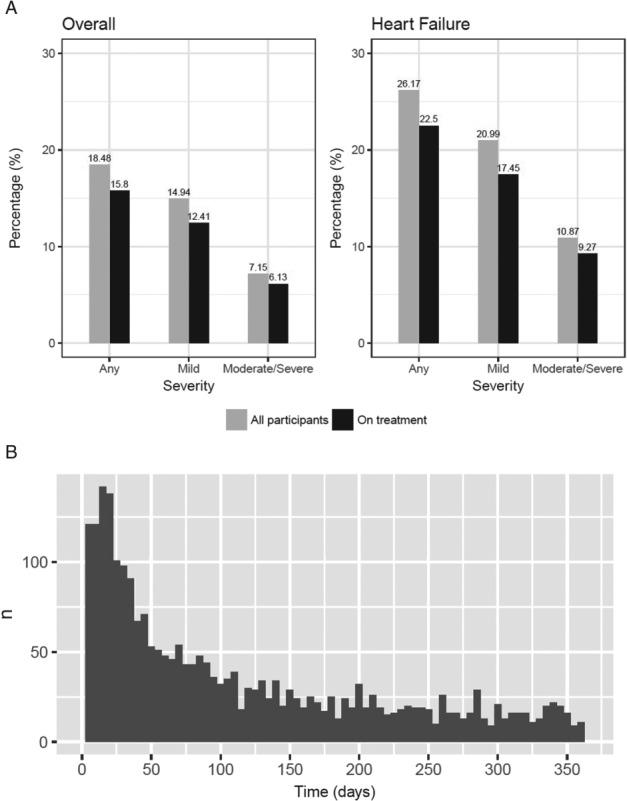
Observational study including all Stockholm citizens initiating MRA therapy during 2007-2010. Hyperkalaemias were identified from all potassium (K ) measurements in healthcare. MRA treatment lengths and dosages were obtained from complete collection of pharmacy dispensations. We assessed the 1-year incidence and clinical hyperkalaemia predictors, and quantified drug prescription changes after an episode of hyperkalaemia. Overall, 13 726 new users of MRA were included, with median age of 73 years, 53% women and median plasma K of 3.9 mmol/L. Within a year, 18.5% experienced at least one detected hyperkalaemia (K > 5.0 mmol/L), the majority within the first 3 monthsnthsnthsnthsnths of therapy. As a comparison, hyperkalaemia was detected in 6.4% of propensity-matched new beta-blocker users. Chronic kidney disease (CKD), older age, male sex, heart failure, peripheral vascular disease, diabetes and concomitant use of angiotensin-converting enzyme inhibitors, angiotensin receptor blockers, beta-blockers and diuretics were associated with increased hyperkalaemia risk. After hyperkalaemia, 47% discontinued MRA and only 10% reduced the prescribed dose. Discontinuation rates were higher after moderate/severe (K > 5.5 mmol/L) and early in therapy (<3 months from initiation) hyperkalaemias. CKD participants carried the highest risk of MRA discontinuation in adjusted analyses. When MRA was discontinued, most patients (76%) were not reintroduced to therapy during the subsequent year.
CONCLUSION
Among real-world adults initiating MRA therapy, hyperkalaemia was very common and frequently followed by therapy interruption, especially among participants with CKD.
背景
对高钾血症的担忧限制了盐皮质激素受体拮抗剂(MRA)的应用。在真实环境中,MRA 相关高钾血症的发生频率以及随后 MRA 停药的程度尚未得到充分量化。
方法
本研究为观察性研究,纳入了 2007 年至 2010 年期间在斯德哥尔摩开始使用 MRA 治疗的所有居民。通过所有医疗保健中钾(K)的测量来识别高钾血症。通过完整收集药房配药来获取 MRA 治疗时长和剂量。我们评估了 1 年的发生率和临床高钾血症预测因素,并量化了高钾血症发作后的药物处方变化。总体而言,纳入了 13726 例新使用 MRA 的患者,中位年龄为 73 岁,53%为女性,中位血浆 K 为 3.9mmol/L。在 1 年内,18.5%的患者至少发生了一次检测到的高钾血症(K > 5.0mmol/L),其中大多数发生在治疗的前 3 个月内。相比之下,在匹配倾向的新β受体阻滞剂使用者中,有 6.4%的患者检测到高钾血症。慢性肾脏病(CKD)、年龄较大、男性、心力衰竭、外周血管疾病、糖尿病以及同时使用血管紧张素转换酶抑制剂、血管紧张素受体阻滞剂、β受体阻滞剂和利尿剂与高钾血症风险增加相关。发生高钾血症后,47%的患者停止使用 MRA,只有 10%的患者减少了处方剂量。中度/重度(K > 5.5mmol/L)和治疗早期(开始后<3 个月)高钾血症后停药率较高。在调整分析中,CKD 患者 MRA 停药的风险最高。当 MRA 停药时,大多数患者(76%)在随后的一年中未再次接受治疗。
结论
在开始使用 MRA 治疗的真实世界成年人中,高钾血症非常常见,且经常导致治疗中断,尤其是在 CKD 患者中。

 Zotero 插件