
多发性骨髓瘤患者接受辅助来那度胺治疗后的自然杀伤细胞活性一年随访。
One-Year Follow-Up of Natural Killer Cell Activity in Multiple Myeloma Patients Treated With Adjuvant Lenalidomide Therapy.
机构信息
CIRI, Centre International de Recherche en Infectiologie-International Center for Infectiology Research, Lyon, France.
INSERM, U1111, Lyon, France.
出版信息
Front Immunol. 2018 Apr 13;9:704. doi: 10.3389/fimmu.2018.00704. eCollection 2018.
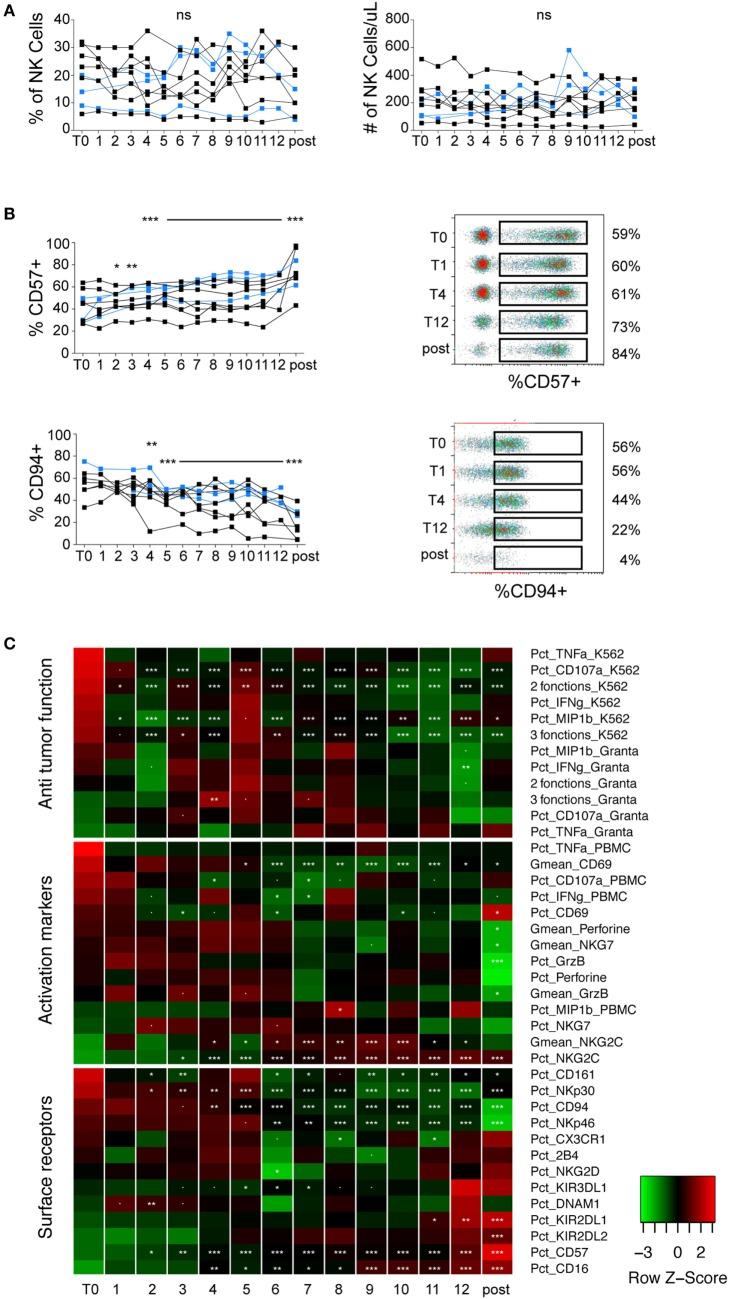
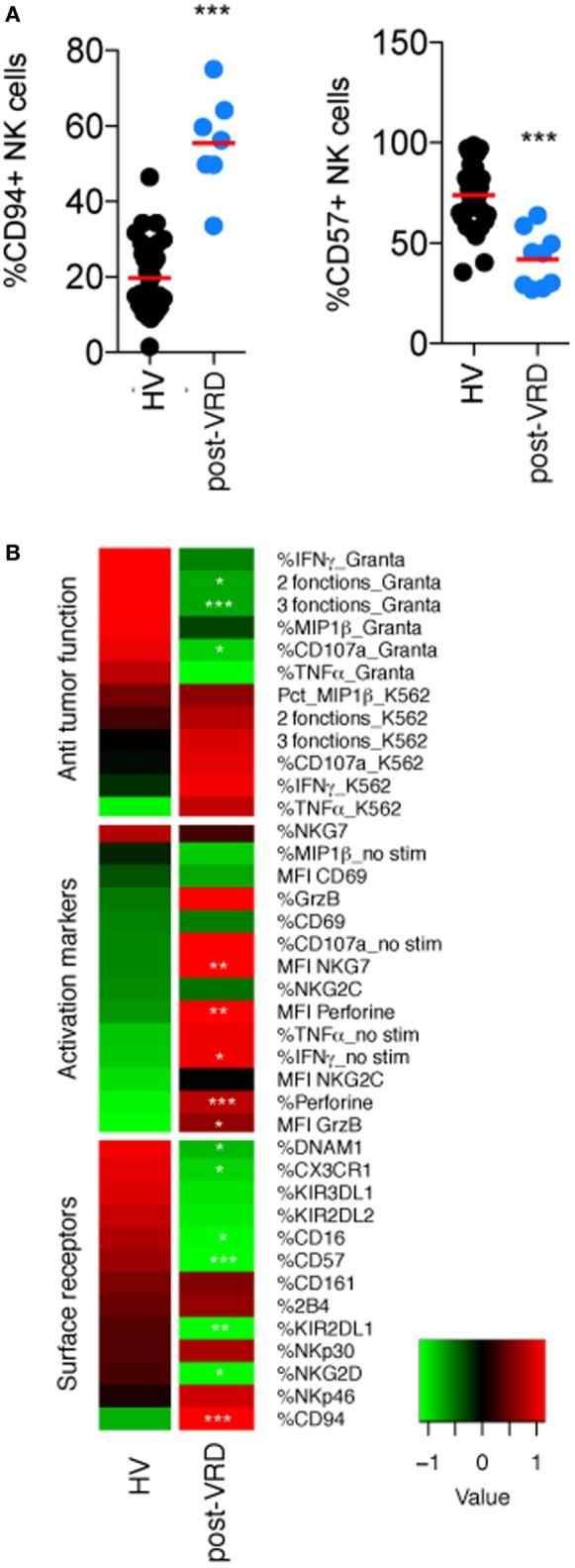
Multiple myeloma (MM) is a proliferation of tumoral plasma B cells that is still incurable. Natural killer (NK) cells can recognize and kill MM cells and can limit MM growth . Previous reports have shown that NK cell function is impaired during MM progression and suggested that treatment with immunomodulatory drugs (IMIDs) such as lenalidomide (LEN) could enhance it. However, the effects of IMIDs on NK cells have been tested mostly or in preclinical models and supporting evidence of their effect in patients is lacking. Here, we monitored NK cell activity in blood samples from 10 MM patients starting after frontline induction chemotherapy (CTX) consisting either of association of bortezomib-lenalidomide-dexamethasone (Velcade Revlimid Dexamethasone) or autologous stem-cell transplantation (SCT). We also monitored NK cell activity longitudinally each month during 1 year, after maintenance therapy with LEN. Following frontline chemotherapy, peripheral NK cells displayed a very immature phenotype and retained poor reactivity toward target cells . Upon maintenance treatment with LEN, we observed a progressive normalization of NK cell maturation, likely caused by discontinuation of chemotherapy. However, LEN treatment neither activated NK cells nor improved their capacity to degranulate or to secrete IFN-γ or MIP1-β following stimulation with MHC-I-deficient or antibody-coated target cells. Upon LEN discontinuation, there was no reduction of NK cell effector function either. These results caution against the use of LEN as single therapy to improve NK cell activity in patients with cancer and call for more preclinical assessments of the potential of IMIDs in NK cell activation.
多发性骨髓瘤(MM)是肿瘤性浆细胞的增殖,目前仍然无法治愈。自然杀伤(NK)细胞可以识别并杀死 MM 细胞,从而限制 MM 的生长。先前的报告表明,在 MM 进展过程中 NK 细胞功能受损,并且表明用免疫调节药物(IMIDs)如来那度胺(LEN)治疗可以增强其功能。然而,IMIDs 对 NK 细胞的影响主要在临床前模型中进行了测试,缺乏其在患者中作用的支持证据。在这里,我们监测了 10 名 MM 患者在一线诱导化疗(CTX)后开始的血液样本中的 NK 细胞活性,CTX 由硼替佐米-来那度胺-地塞米松(Velcade Revlimid Dexamethasone)或自体干细胞移植(SCT)联合组成。我们还在 LEN 维持治疗后每个月纵向监测 NK 细胞活性,为期 1 年。一线化疗后,外周 NK 细胞表现出非常不成熟的表型,并且对靶细胞的反应仍然很差。在用 LEN 维持治疗后,我们观察到 NK 细胞成熟逐渐正常化,这可能是由于停止化疗所致。然而,LEN 治疗既没有激活 NK 细胞,也没有改善它们在刺激 MHC-I 缺陷或抗体包被的靶细胞后脱颗粒或分泌 IFN-γ或 MIP1-β的能力。LEN 停药后,NK 细胞效应功能也没有降低。这些结果告诫不要将 LEN 用作单一疗法来改善癌症患者的 NK 细胞活性,并呼吁对 IMIDs 在 NK 细胞激活中的潜力进行更多的临床前评估。
 Zotero 插件