
BH3 仅蛋白的折叠和结合途径编码在其固有无序序列内,而不是由伴侣蛋白模板化。
Folding and binding pathways of BH3-only proteins are encoded within their intrinsically disordered sequence, not templated by partner proteins.
机构信息
From the Department of Chemistry, University of Cambridge, Cambridge CB2 1EW, United Kingdom.
From the Department of Chemistry, University of Cambridge, Cambridge CB2 1EW, United Kingdom
出版信息
J Biol Chem. 2018 Jun 22;293(25):9718-9723. doi: 10.1074/jbc.RA118.002791. Epub 2018 May 1.
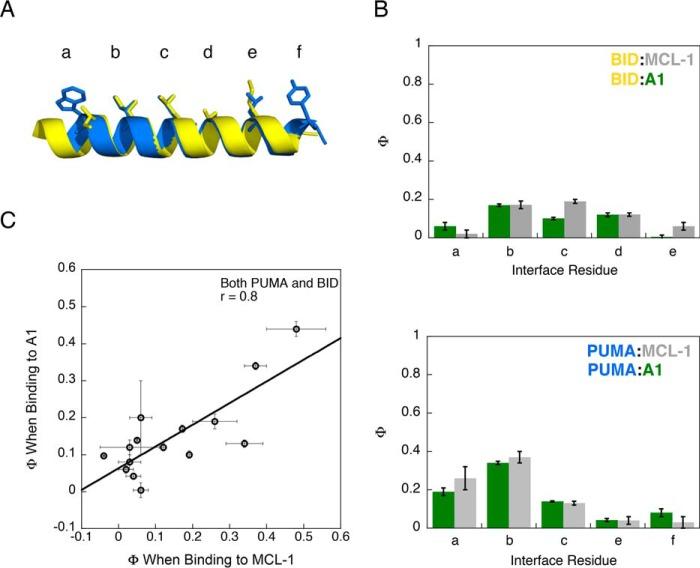
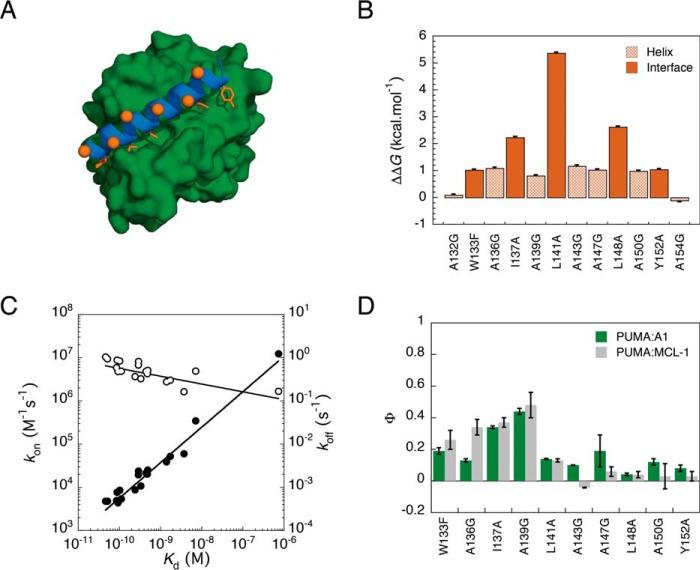
Intrinsically disordered regions are present in one-third of eukaryotic proteins and are overrepresented in cellular processes such as signaling, suggesting that intrinsically disordered proteins (IDPs) may have a functional advantage over folded proteins. Upon interacting with a partner macromolecule, a subset of IDPs can fold and bind to form a well-defined three-dimensional conformation. For example, disordered BH3-only proteins bind promiscuously to a large number of homologous BCL-2 family proteins, where they fold to a helical structure in a groove on the BCL-2-like protein surface. As two protein chains are involved in the folding reaction, and the structure is only formed in the presence of the partner macromolecule, this raises the question of where the folding information is encoded. Here, we examine these coupled folding and binding reactions to determine which component determines the folding and binding pathway. Using Φ value analysis to compare transition state interactions between the disordered BH3-only proteins PUMA and BID and the folded BCL-2-like proteins A1 and MCL-1, we found that, even though the BH3-only protein is disordered in isolation and requires a stabilizing partner to fold, its folding and binding pathway is encoded in the IDP itself; the reaction is not templated by the folded partner. We suggest that, by encoding both its transition state and level of residual structure, an IDP can evolve a specific kinetic profile, which could be a crucial functional advantage of disorder.
无规卷曲结构存在于三分之一的真核蛋白中,并且在信号转导等细胞过程中过度表达,这表明无规卷曲蛋白(IDP)可能比折叠蛋白具有功能优势。在与伴侣大分子相互作用时,IDP 的一个亚类可以折叠并结合形成明确的三维构象。例如,无规 BH3 仅蛋白与大量同源的 BCL-2 家族蛋白随机结合,在那里它们在 BCL-2 样蛋白表面的凹槽中折叠成螺旋结构。由于两条蛋白质链参与折叠反应,并且只有在存在伴侣大分子的情况下才形成结构,这就提出了折叠信息编码的问题。在这里,我们检查这些偶联的折叠和结合反应,以确定哪个组件决定了折叠和结合途径。使用 Φ 值分析来比较无规 BH3 仅蛋白 PUMA 和 BID 与折叠的 BCL-2 样蛋白 A1 和 MCL-1 之间的过渡态相互作用,我们发现,即使 BH3 仅蛋白在孤立状态下是无规的并且需要稳定的伴侣来折叠,但其折叠和结合途径是由 IDP 本身编码的;该反应不受折叠伴侣的模板化。我们认为,通过编码其过渡态和残留结构的水平,IDP 可以进化出特定的动力学特征,这可能是无序的一个关键功能优势。


 Zotero 插件