
韩国成年人剩余牙齿数量及其与社会经济地位的关系:来自 2012-2013 年韩国国家健康和营养检查调查的数据。
Number of remaining teeth and its association with socioeconomic status in South Korean adults: Data from the Korean National Health and Nutrition Examination Survey 2012-2013.
机构信息
Department of Family Medicine, Korea University College of Medicine, Seoul, Republic of Korea.
Department of Medical Statistics, Catholic University College of Medicine, Seoul, Republic of Korea.
出版信息
PLoS One. 2018 May 10;13(5):e0196594. doi: 10.1371/journal.pone.0196594. eCollection 2018.
BACKGROUND
Socioeconomic status (SES) is associated with systemic disease and influences oral and general health. Several studies have found inequalities associated with oral health and SES. We examined the relationship between tooth loss and SES in Korean adults using data from the 2012-2013 Korean National Health and Nutrition Examination Survey. Methods: A total of 7,005 participants were included in this study. Subjects were divided into two groups depending on their total number of natural teeth: <20 and ≥20. Next, participants were divided into quartiles depending on household income and educational level. Multivariate logistic regression was used to obtain odds ratios (OR) for remaining teeth according to income and education levels.
RESULTS
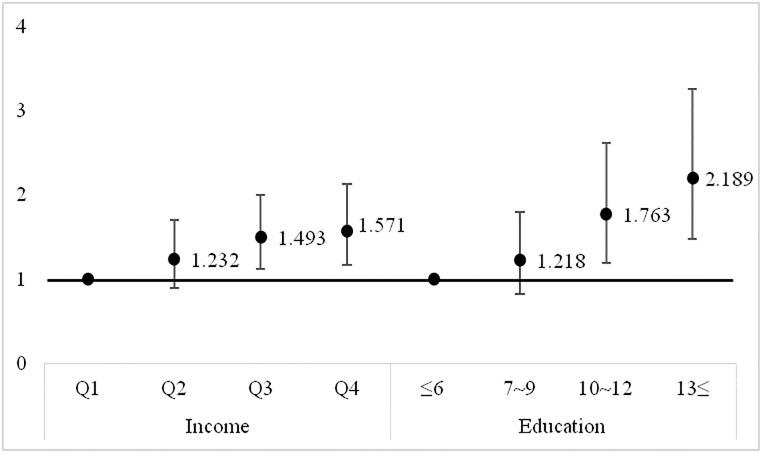
As income and education levels increased, subjects were more likely to have ≥20 remaining teeth (p-value and p-value for trend <0.001), brush their teeth more than three times per day, use extra oral products, and have regular oral-health checkups (all p<0.001). The odds of having ≥20 remaining teeth increased with increases in income and education, after adjusting for all covariates (OR = 1.493 for income Q3, OR = 1.571 for income Q4; OR = 1.763 for 10-12 years education, OR = 2.189 for ≥13years education).
CONCLUSION
Subjects with higher SES had more remaining teeth than subjects with lower SES. Preserving remaining teeth should be encouraged in subjects with low SES by promoting good oral-health behavior and encouraging more oral-health checkups.
背景
社会经济地位(SES)与系统性疾病有关,并影响口腔和整体健康。多项研究发现,口腔健康与 SES 存在不平等关系。我们利用 2012-2013 年韩国国家健康和营养检查调查的数据,研究了韩国成年人牙齿缺失与 SES 之间的关系。
方法
本研究共纳入 7005 名参与者。根据其自然牙总数将受试者分为两组:<20 颗和≥20 颗。然后,根据家庭收入和教育水平将参与者分为四分位组。采用多变量逻辑回归分析收入和教育水平与剩余牙齿数量的比值比(OR)。
结果
随着收入和教育水平的提高,受试者更有可能拥有≥20 颗剩余牙齿(p 值和趋势 p 值均<0.001),每天刷牙超过三次、使用额外的口腔产品、定期进行口腔健康检查(均<0.001)。在校正所有协变量后,随着收入和教育水平的增加,拥有≥20 颗剩余牙齿的几率增加(收入第 3 四分位数的 OR=1.493,收入第 4 四分位数的 OR=1.571;10-12 年教育程度的 OR=1.763,≥13 年教育程度的 OR=2.189)。
结论
SES 较高的受试者比 SES 较低的受试者拥有更多的剩余牙齿。应通过促进良好的口腔健康行为和鼓励更多的口腔健康检查,鼓励 SES 较低的受试者保留剩余牙齿。

 Zotero 插件