
囊性纤维化患儿下呼吸道细菌采样评估的 CF-诱导痰试验(CF-SpIT):一项前瞻性内部对照干预性试验。
The CF-Sputum Induction Trial (CF-SpIT) to assess lower airway bacterial sampling in young children with cystic fibrosis: a prospective internally controlled interventional trial.
机构信息
Department of Paediatric Respiratory Medicine, Noah's Ark Children's Hospital for Wales, Cardiff, UK; Department of Paediatric Physiotherapy, Noah's Ark Children's Hospital for Wales, Cardiff, UK.
School of Biosciences, Cardiff University, UK.
出版信息
Lancet Respir Med. 2018 Jun;6(6):461-471. doi: 10.1016/S2213-2600(18)30171-1. Epub 2018 May 16.
BACKGROUND
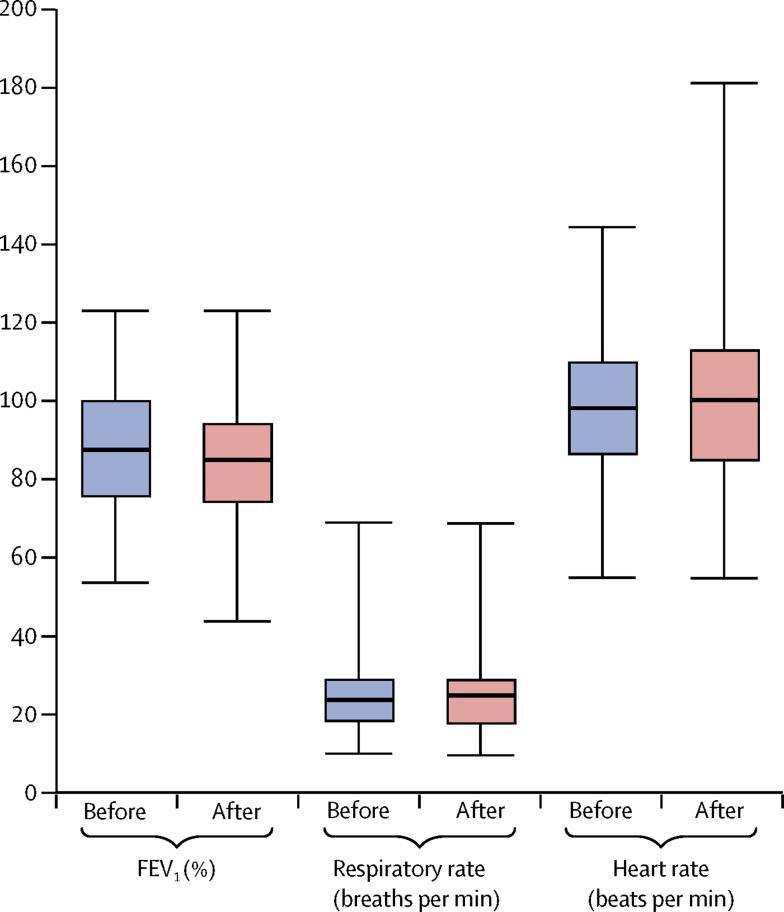
Pathogen surveillance is challenging but crucial in children with cystic fibrosis-who are often non-productive of sputum even if actively coughing-because infection and lung disease begin early in life. The role of sputum induction as a diagnostic tool for infection has not previously been systematically addressed in young children with cystic fibrosis. We aimed to assess the pathogen yield from sputum induction compared with that from cough swab and single-lobe, two-lobe, and six-lobe bronchoalveolar lavage.
METHODS
This prospective internally controlled interventional trial was done at the Children's Hospital for Wales (Cardiff, UK) in children with cystic fibrosis aged between 6 months and 18 years. Samples from cough swab, sputum induction, and single-lobe, two-lobe, and six-lobe bronchoalveolar lavage were matched for within-patient comparisons. Primary outcomes were comparative pathogen yield between sputum induction and cough swab for stage 1, and between sputum induction, and single-lobe, two-lobe, and six-lobe bronchoalveolar lavage for stage 2. Data were analysed as per protocol. This study is registered with the UK Clinical Research Network (14615) and with the International Standard Randomised Controlled Trial Network Registry (12473810).
FINDINGS
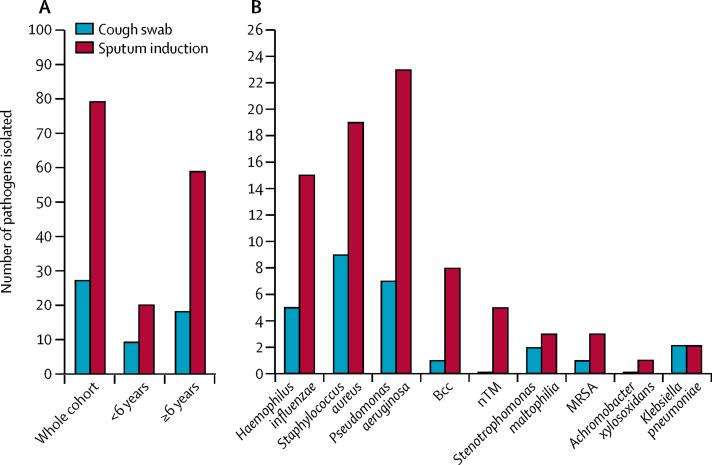
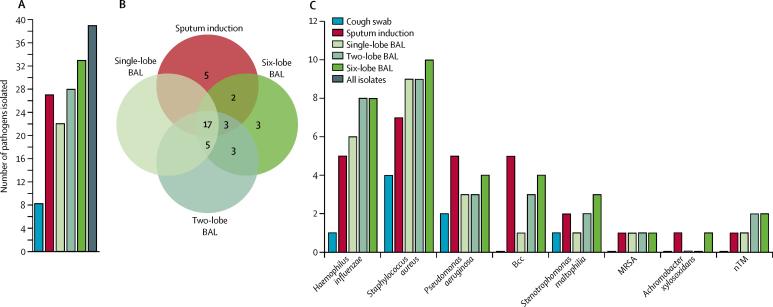
Between Jan 23, 2012, and July 4, 2017, 124 patients were prospectively recruited to the trial and had 200 sputum induction procedures for stage 1. 167 (84%) procedures were successful and the procedure was well tolerated. Of the 167 paired samples, 63 (38%) sputum-induction samples were pathogen positive compared with 24 (14%) cough swabs (p<0·0001; odds ratio [OR] 7·5; 95% CI 3·19-17·98). More pathogens were isolated from sputum induction than cough swab (79 [92%] of 86 vs 27 [31%] of 86; p<0·0001). For stage 2, 35 patients had a total of 41 paired sputum-induction and bronchoalveolar lavage procedures. Of the 41 paired samples, 28 (68%) were positive for at least one of the concurrent samples. 39 pathogens were isolated. Sputum induction identified 27 (69%) of the 39 pathogens, compared with 22 (56%; p=0·092; OR 3·3, 95% CI 0·91-12·11) on single-lobe, 28 (72%; p=1·0; OR 1·1, 95% CI 0·41-3·15) on two-lobe, and 33 (85%; p=0·21; OR 2·2, 95% CI 0·76-6·33) on six-lobe bronchoalveolar lavage.
INTERPRETATION
Sputum induction is superior to cough swab for pathogen detection, is effective at sampling the lower airway, and is a credible surrogate for bronchoalveolar lavage in symptomatic children. A substantial number of bronchoscopies could be avoided if sputum induction is done first and pathogens are appropriately treated. Both sputum induction and six-lobe bronchoalveolar lavage provide independent, sizeable gains in pathogen detection compared with the current gold-standard two-lobe bronchoalveolar lavage. We propose that sputum induction and six-lobe bronchoalveolar lavage combined are used as standard of care for comprehensive lower airway pathogen detection in children with cystic fibrosis.
FUNDING
Health and Care Research Wales-Academic Health Science Collaboration and Wellcome Trust Institutional Strategic Support Fund.
背景
在患有囊性纤维化的儿童中,病原体监测具有挑战性,但至关重要,因为这些儿童即使积极咳嗽也往往无法产生痰液,而且感染和肺部疾病在生命早期就开始了。痰液诱导作为感染的诊断工具,在患有囊性纤维化的幼儿中尚未得到系统研究。本研究旨在评估痰液诱导与咳嗽拭子以及单叶、双叶和六叶支气管肺泡灌洗相比的病原体产率。
方法
本前瞻性内部对照干预性试验在英国加的夫的威尔士儿童医院(Cardiff,英国)进行,入组年龄在 6 个月至 18 岁之间的囊性纤维化儿童。为了进行患者内比较,对咳嗽拭子、痰液诱导以及单叶、双叶和六叶支气管肺泡灌洗样本进行了匹配。主要结局是痰液诱导与咳嗽拭子在第 1 阶段以及痰液诱导与单叶、双叶和六叶支气管肺泡灌洗在第 2 阶段之间的比较病原体产率。数据按照方案进行分析。本研究在英国临床研究网络(14615)和国际标准随机对照试验网络注册中心(12473810)进行注册。
结果
在 2012 年 1 月 23 日至 2017 年 7 月 4 日期间,前瞻性招募了 124 名患者进行试验,并进行了 200 次第 1 阶段的痰液诱导程序。167 次(84%)程序成功,且耐受性良好。在 167 对配对样本中,与 24 次(14%)咳嗽拭子相比,63 次(38%)痰液诱导样本呈病原体阳性(p<0·0001;优势比[OR]7·5;95%CI 3·19-17·98)。痰液诱导样本比咳嗽拭子分离出更多的病原体(79 [92%] 比 27 [31%];p<0·0001)。在第 2 阶段,35 名患者共进行了 41 次痰液诱导和支气管肺泡灌洗的配对程序。在 41 对配对样本中,28 次(68%)至少有一个同时采集的样本呈阳性。共分离出 39 种病原体。痰液诱导鉴定出 27 种(69%)病原体,而单叶支气管肺泡灌洗鉴定出 22 种(56%;p=0·092;OR 3·3,95%CI 0·91-12·11),双叶支气管肺泡灌洗鉴定出 28 种(72%;p=1·0;OR 1·1,95%CI 0·41-3·15),六叶支气管肺泡灌洗鉴定出 33 种(85%;p=0·21;OR 2·2,95%CI 0·76-6·33)。
解释
与咳嗽拭子相比,痰液诱导更有利于病原体检测,可有效采集下呼吸道样本,并且在有症状的儿童中可作为支气管肺泡灌洗的可靠替代方法。如果首先进行痰液诱导并适当治疗病原体,可以避免大量的支气管镜检查。与当前的金标准双叶支气管肺泡灌洗相比,痰液诱导和六叶支气管肺泡灌洗都能独立地提供大量病原体检测的增益。我们建议将痰液诱导和六叶支气管肺泡灌洗联合作为囊性纤维化儿童全面下呼吸道病原体检测的标准护理方法。
资金
威尔士健康和护理研究-学术健康科学合作组织和惠康信托机构战略支持基金。

 Zotero 插件