
结肠癌及其前期病变(良性腺瘤和炎症性肠病)中 DNA 表观遗传修饰的特征谱。
Characteristic profiles of DNA epigenetic modifications in colon cancer and its predisposing conditions-benign adenomas and inflammatory bowel disease.
机构信息
1Department of Clinical Biochemistry, Faculty of Pharmacy, Collegium Medicum in Bydgoszcz, Nicolaus Copernicus University in Torun, Torun, Poland.
7Department of Clinical Biochemistry, Collegium Medicum in Bydgoszcz, Nicolaus Copernicus University, Karlowicza 24, 85-095 Bydgoszcz, Poland.
出版信息
Clin Epigenetics. 2018 May 30;10:72. doi: 10.1186/s13148-018-0505-0. eCollection 2018.
BACKGROUND
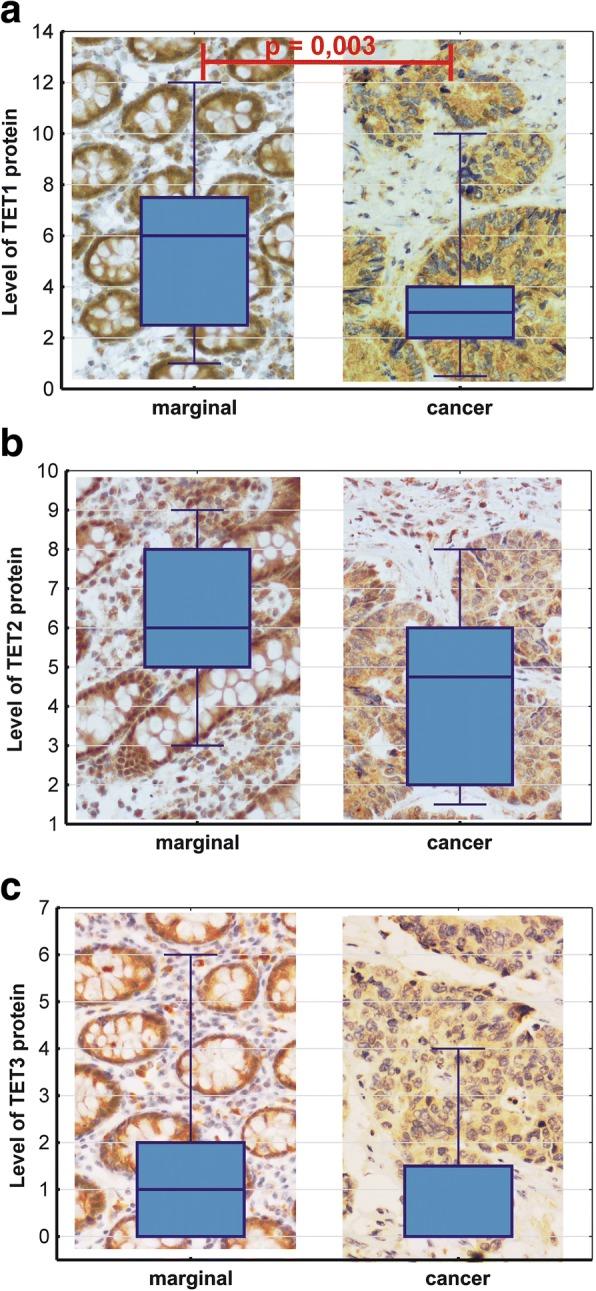
Active demethylation of 5-methyl-2'-deoxycytidine (5-mdC) in DNA occurs by oxidation to 5-(hydroxymethyl)-2'-deoxycytidine (5-hmdC) and further oxidation to 5-formyl-2'-deoxycytidine (5-fdC) and 5-carboxy-2'-deoxycytidine (5-cadC), and is carried out by enzymes of the ten-eleven translocation family (TETs 1, 2, 3). Decreased level of epigenetic DNA modifications in cancer tissue may be a consequence of reduced activity/expression of TET proteins. To determine the role of epigenetic DNA modifications in colon cancer development, we analyzed their levels in normal colon and various colonic pathologies. Moreover, we determined the expressions of TETs at mRNA and protein level.The study included material from patients with inflammatory bowel disease (IBD), benign polyps (AD), and colorectal cancer (CRC). The levels of epigenetic DNA modifications and 8-oxo-7,8-dihydro-2'-deoxyguanosine (8-oxodG) in examined tissues were determined by means of isotope-dilution automated online two-dimensional ultraperformance liquid chromatography with tandem mass spectrometry (2D-UPLC-MS/MS). The expressions of mRNA were measured with RT-qPCR, and the expressions of TET proteins were determined immunohistochemically.
RESULTS
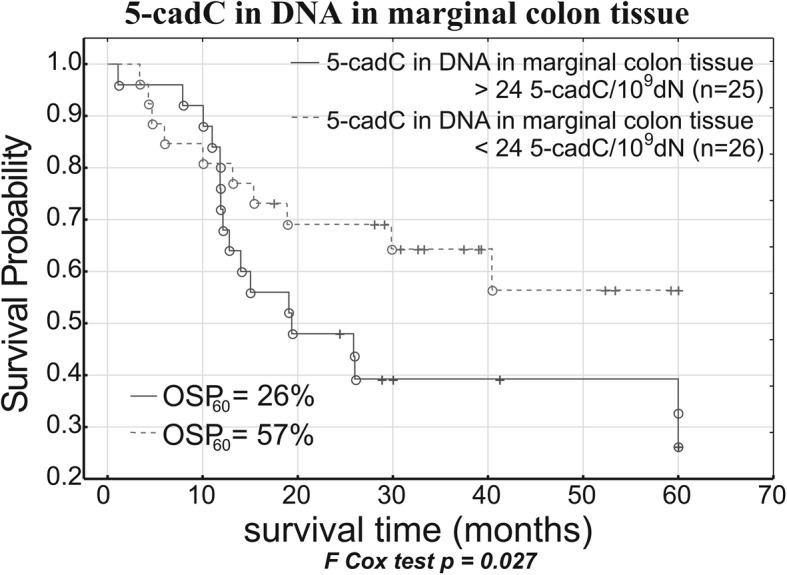
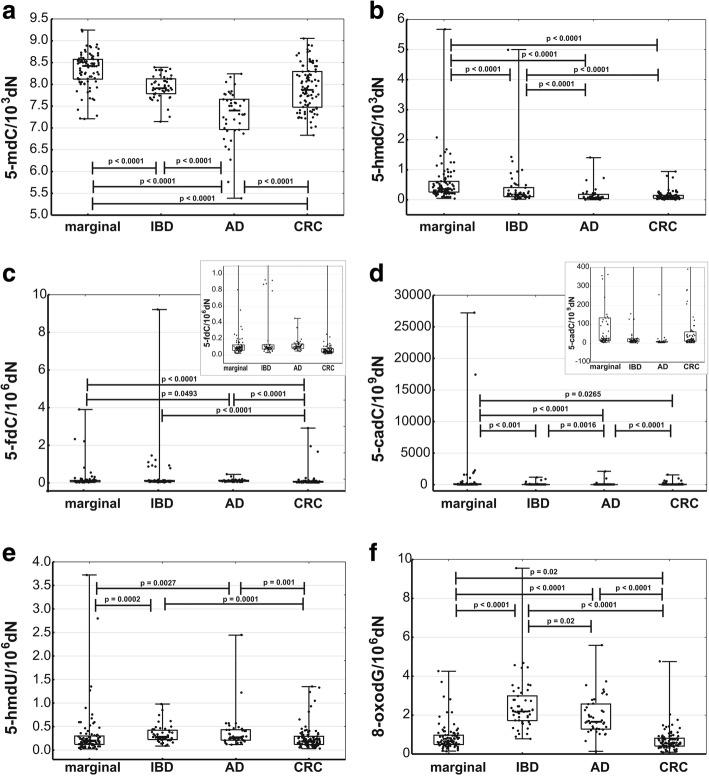
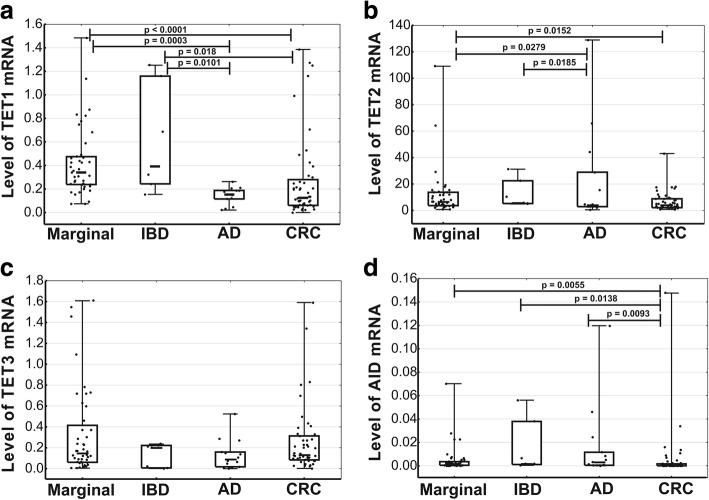
IBD was characterized by the highest level of 8-oxodG among all analyzed tissues, as well as by a decrease in 5-hmdC and 5-mdC levels (at a midrange between normal colon and CRC). AD had the lowest levels of 5-hmdC and 5-mdC of all examined tissues and showed an increase in 8-oxodG and 5-(hydroxymethyl)-2'-deoxyuridine (5-hmdU) levels. CRC was characterized by lower levels of 5-hmdC and 5-mdC, the lowest level of 5-fdC among all analyzed tissues, and relatively high content of 5-cadC. The expression of mRNA in CRC and AD was significantly weaker than in IBD and normal colon. Furthermore, CRC and AD showed significantly lower levels of and mRNA than normal colonic tissue.
CONCLUSIONS
Our findings suggest that a complex relationship between aberrant pattern of DNA epigenetic modification and cancer development does not depend solely on the transcriptional status of TET proteins, but also on the characteristics of premalignant/malignant cells. This study showed for the first time that the examined colonic pathologies had their unique epigenetic marks, distinguishing them from each other, as well as from normal colonic tissue. A decrease in 5-fdC level may be a characteristic feature of largely undifferentiated cancer cells.
背景
5-甲基-2'-脱氧胞苷(5-mdC)在 DNA 中的活性去甲基化是通过氧化为 5-(羟甲基)-2'-脱氧胞苷(5-hmdC),进一步氧化为 5-甲酰基-2'-脱氧胞苷(5-fdC)和 5-羧基-2'-脱氧胞苷(5-cadC)来实现的,这是由十-十一易位家族(TETs 1、2、3)的酶完成的。癌症组织中表观遗传 DNA 修饰水平的降低可能是 TET 蛋白活性/表达降低的结果。为了确定表观遗传 DNA 修饰在结肠癌发展中的作用,我们分析了正常结肠和各种结肠病变中的这些修饰水平。此外,我们还在 mRNA 和蛋白质水平上测定了 TET 的表达。该研究包括炎症性肠病(IBD)、良性息肉(AD)和结直肠癌(CRC)患者的材料。通过同位素稀释自动化在线二维超高效液相色谱-串联质谱(2D-UPLC-MS/MS)测定检测组织中表观遗传 DNA 修饰和 8-氧代-7,8-二氢-2'-脱氧鸟苷(8-oxodG)的水平。用 RT-qPCR 测定 mRNA 的表达,并用免疫组织化学法测定 TET 蛋白的表达。
结果
IBD 的特点是所有分析组织中 8-oxodG 水平最高,5-hmdC 和 5-mdC 水平降低(在正常结肠和 CRC 之间的中间范围)。AD 是所有检测组织中 5-hmdC 和 5-mdC 水平最低的,8-oxodG 和 5-(羟甲基)-2'-脱氧尿苷(5-hmdU)水平升高。CRC 的特点是 5-hmdC 和 5-mdC 水平较低,所有分析组织中 5-fdC 水平最低,5-cadC 含量相对较高。CRC 和 AD 的 mRNA 表达明显弱于 IBD 和正常结肠。此外,CRC 和 AD 显示的 和 mRNA 水平明显低于正常结肠组织。
结论
我们的研究结果表明,DNA 表观遗传修饰的异常模式与癌症发展之间的复杂关系不仅取决于 TET 蛋白的转录状态,还取决于前恶性/恶性细胞的特征。本研究首次表明,所研究的结肠病变具有独特的表观遗传标记,将它们彼此区分开来,也与正常结肠组织区分开来。5-fdC 水平的降低可能是未分化癌细胞的一个特征。
 Zotero 插件