
减少农村慢性病老年人口的食物贫困和脆弱性:中国新型农村社会养老保险的作用。
Reducing Food Poverty and Vulnerability among the Rural Elderly with Chronic Diseases: The Role of the New Rural Pension Scheme in China.
机构信息
College of Economics and Management, Shandong Agricultural University, Tai'an 271018, China.
School of Economics and Management, Guangxi Normal University, Guilin 541004, China.
出版信息
Int J Environ Res Public Health. 2018 Jun 13;15(6):1253. doi: 10.3390/ijerph15061253.
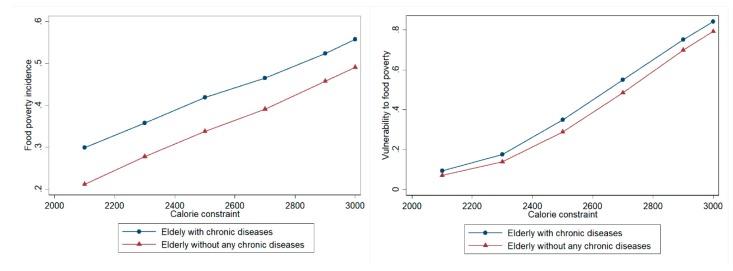
Vulnerability to food poverty is the probability of an individual falling below the food poverty line in the near future, which provides a forward-looking welfare analysis. Applying a nationally representative survey dataset, this study investigates the role of the New Rural Pension Scheme (NRPS) in reducing food poverty and vulnerability among the rural elderly with chronic diseases. By designing province-specific food poverty lines to account for variations in the elderly’s needs, as well as the prices across provinces using a least-cost linear programming approach, the food poverty incidences among the elderly with chronic diseases are calculated. Applying a three-stage feasible generalized least squares (FGLS) procedure, the vulnerability to food poverty is estimated. Our results show that food poverty incidence and vulnerability of the elderly with chronic diseases in rural China is 41.9% and 35% respectively, which is 8% and 6% higher, respectively, than the elderly that are in good health. To address the potential endogeneity of pension payment, a fuzzy regression discontinuity (RD) regression is employed to investigate the effects of pension income on food poverty and vulnerability for different population groups. We found that pension income decreases the probability of being food poor and the vulnerability to food poverty among the elderly with chronic diseases by 12.9% and 16.8% respectively, while it has no significant effect on the elderly in good health.
食物贫困脆弱性是指个体在不久的将来陷入食物贫困线以下的概率,它提供了一种前瞻性的福利分析。本研究利用全国代表性调查数据集,考察了新型农村社会养老保险(NRPS)在降低农村慢性病老年人口食物贫困和脆弱性方面的作用。通过设计特定省份的食物贫困线,以考虑老年人需求的差异以及各省的价格差异,使用最小成本线性规划方法,计算了慢性病老年人口的食物贫困发生率。应用三阶段可行广义最小二乘法(FGLS)程序,估计了食物贫困脆弱性。研究结果表明,中国农村慢性病老年人口的食物贫困发生率和脆弱性分别为 41.9%和 35%,分别比健康老年人口高 8%和 6%。为了解决养老金支付的潜在内生性问题,采用模糊回归不连续性(RD)回归来研究养老金收入对不同人群食物贫困和脆弱性的影响。结果发现,养老金收入使慢性病老年人口陷入食物贫困的概率降低了 12.9%,使他们面临食物贫困脆弱性的概率降低了 16.8%,而对健康老年人口则没有显著影响。

 Zotero 插件