
基于抗CTLA-4的疗法在转移性黑色素瘤患者中引发了针对半乳糖凝集素-3的体液免疫。
Anti-CTLA-4 based therapy elicits humoral immunity to galectin-3 in patients with metastatic melanoma.
作者信息
Wu Xinqi, Giobbie-Hurder Anita, Connolly Erin M, Li Jingjing, Liao Xiaoyun, Severgnini Mariano, Zhou Jun, Rodig Scott, Hodi F Stephen
机构信息
Department of Medical Oncology, Dana-Farber Cancer Institute and Harvard Medical School, Boston, MA.
Center for Immuno-oncology, Dana-Farber Cancer Institute and Harvard Medical School, Boston, MA.
出版信息
Oncoimmunology. 2018 Mar 13;7(7):e1440930. doi: 10.1080/2162402X.2018.1440930. eCollection 2018.
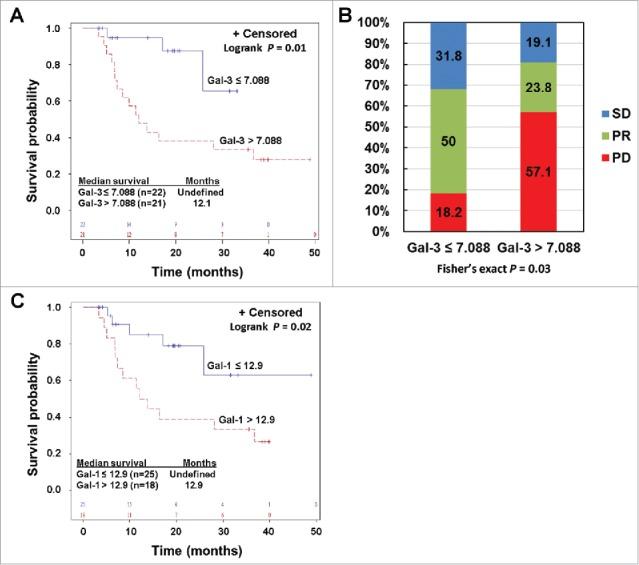
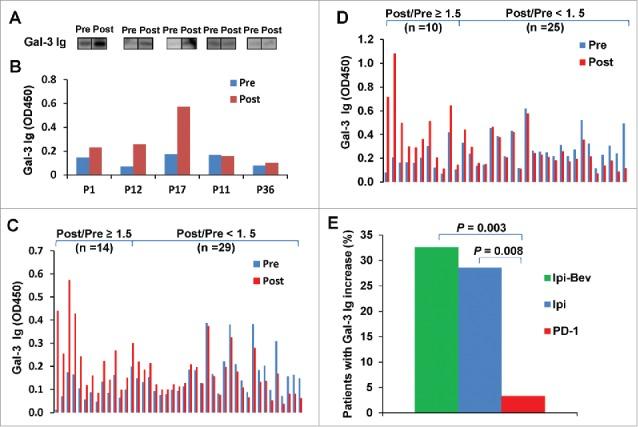
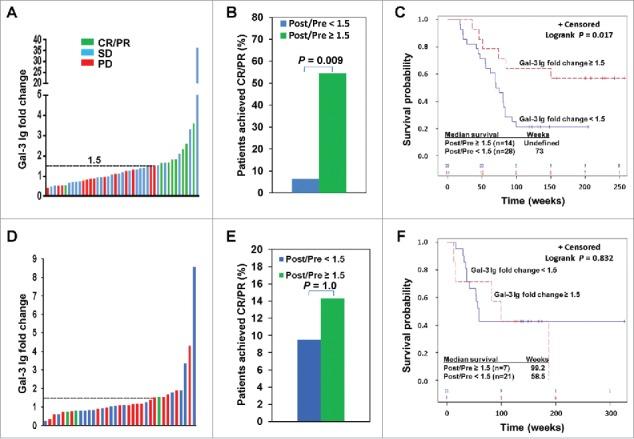
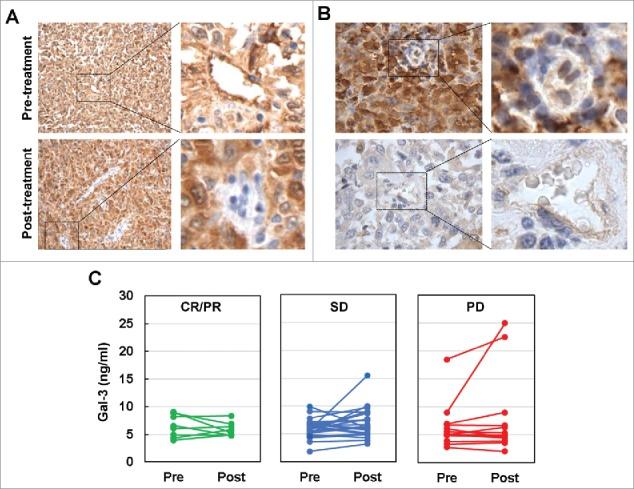
The combination of CTLA-4 blockade ipilimumab (Ipi) with VEGF-A blocking antibody bevacizumab (Bev) has demonstrated favorable clinical outcomes in patients with advanced melanoma. Galectin-3 (Gal-3) plays a prominent role in tumor growth, metastasis, angiogenesis, and immune evasion. Here we report that Ipi plus Bev (Ipi-Bev) therapy increased Gal-3 antibody titers by 50% or more in approximately one third of treated patients. Antibody responses to Gal-3 were associated with higher complete and partial responses and better overall survival. Ipi alone also elicited antibody responses to Gal-3 at a frequency comparable to the Ipi-Bev combination. However, an association of elicited antibody responses to Gal-3 with clinical outcomes was not observed in Ipi alone treated patients. In contrast to being neutralized in Ipi-Bev treated patients, circulating VEGF-A increased by 100% or more in a subset of patients after Ipi treatment, with most having progressive disease. Among the Ipi treated patients with therapy-induced Gal-3 antibody increases, circulating VEGF-A was increased in 3 of 6 nonresponders but in none of 4 responders as a result of treatment. Gal-3 antibody responses occurred significantly less frequently (3.2%) in a cohort of patients receiving PD-1 blockade where high pre-treatment serum Gal-3 was associated with reduced OS and response rates. Our findings suggest that anti-CTLA-4 elicited humoral immune responses to Gal-3 in melanoma patients which may contribute to the antitumor effect in the presence of an anti-VEGF-A combination. Furthermore, pre-treatment circulating Gal-3 may potentially have prognostic and predictive value for immune checkpoint therapy.
细胞毒性T淋巴细胞相关抗原4(CTLA-4)阻断剂伊匹单抗(Ipi)与血管内皮生长因子A(VEGF-A)阻断抗体贝伐单抗(Bev)联合使用,已在晚期黑色素瘤患者中显示出良好的临床疗效。半乳凝素-3(Gal-3)在肿瘤生长、转移、血管生成和免疫逃逸中起着重要作用。在此我们报告,在大约三分之一的接受治疗的患者中,Ipi加Bev(Ipi-Bev)疗法使Gal-3抗体滴度提高了50%或更多。对Gal-3的抗体反应与更高的完全缓解和部分缓解以及更好的总生存期相关。单独使用Ipi也能引发对Gal-3的抗体反应,其频率与Ipi-Bev联合使用时相当。然而,在单独接受Ipi治疗的患者中,未观察到对Gal-3引发的抗体反应与临床疗效之间的关联。与在接受Ipi-Bev治疗的患者中被中和不同,在一部分接受Ipi治疗后病情进展的患者中,循环VEGF-A增加了100%或更多。在接受Ipi治疗且Gal-3抗体因治疗而增加的患者中,6名无反应者中有3名循环VEGF-A增加,而4名有反应者中无一例因治疗导致循环VEGF-A增加。在一组接受程序性死亡蛋白1(PD-1)阻断治疗的患者中,Gal-3抗体反应的发生率显著较低(3.2%),其中治疗前血清Gal-3水平高与总生存期和缓解率降低相关。我们的研究结果表明,抗CTLA-4在黑色素瘤患者中引发了对Gal-3的体液免疫反应,这在联合抗VEGF-A治疗时可能有助于抗肿瘤作用。此外,治疗前循环Gal-3可能对免疫检查点治疗具有潜在的预后和预测价值。
 Zotero 插件