
冷等离体压等离子体和等离子体激活水对病毒灭活的作用机制。
Mechanism of Virus Inactivation by Cold Atmospheric-Pressure Plasma and Plasma-Activated Water.
机构信息
State Key Laboratory of Electrical Insulation and Power Equipment, Center for Plasma Biomedicine, Xi'an Jiaotong University, Xi'an, People's Republic of China
School of Life Science and Technology, Xi'an Jiaotong University, Xi'an, People's Republic of China.
出版信息
Appl Environ Microbiol. 2018 Aug 17;84(17). doi: 10.1128/AEM.00726-18. Print 2018 Sep 1.
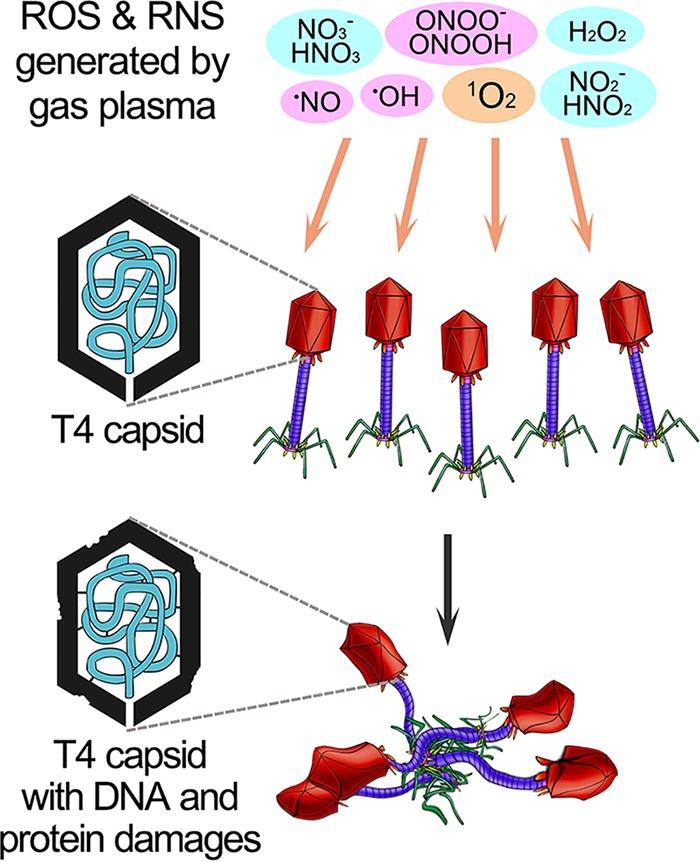
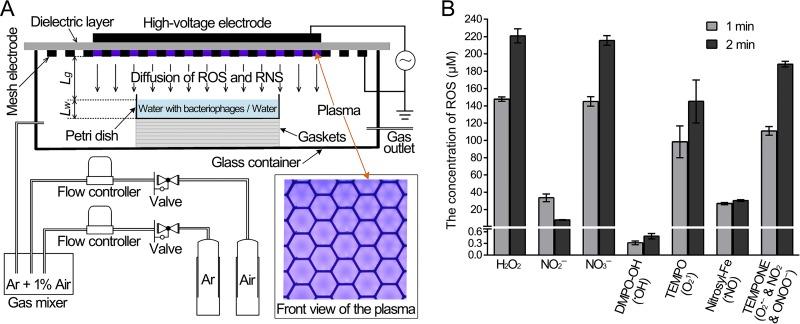
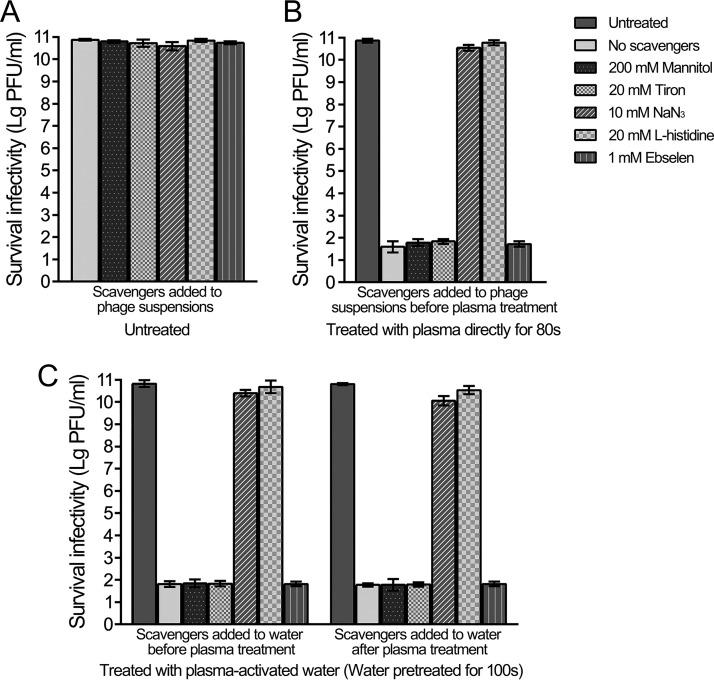
Viruses cause serious pathogenic contamination that severely affects the environment and human health. Cold atmospheric-pressure plasma efficiently inactivates pathogenic bacteria; however, the mechanism of virus inactivation by plasma is not fully understood. In this study, surface plasma in argon mixed with 1% air and plasma-activated water was used to treat water containing bacteriophages. Both agents efficiently inactivated bacteriophages T4, Φ174, and MS2 in a time-dependent manner. Prolonged storage had marginal effects on the antiviral activity of plasma-activated water. DNA and protein analysis revealed that the reactive species generated by plasma damaged both nucleic acids and proteins, consistent with the morphological examination showing that plasma treatment caused the aggregation of bacteriophages. The inactivation of bacteriophages was alleviated by the singlet oxygen scavengers, demonstrating that singlet oxygen played a primary role in this process. Our findings provide a potentially effective disinfecting strategy to combat the environmental viruses using cold atmospheric-pressure plasma and plasma-activated water. Contamination with pathogenic and infectious viruses severely threatens human health and animal husbandry. Current methods for disinfection have different disadvantages, such as inconvenience and contamination of disinfection by-products (e.g., chlorine disinfection). In this study, atmospheric surface plasma in argon mixed with air and plasma-activated water was found to efficiently inactivate bacteriophages, and plasma-activated water still had strong antiviral activity after prolonged storage. Furthermore, it was shown that bacteriophage inactivation was associated with damage to nucleic acids and proteins by singlet oxygen. An understanding of the biological effects of plasma-based treatment is useful to inform the development of plasma into a novel disinfecting strategy with convenience and no by-product.
病毒会造成严重的病原污染,严重影响环境和人类健康。冷大气压等离子体可以有效地灭活致病菌;然而,等离子体灭活病毒的机制尚未完全了解。在这项研究中,使用了混合有 1%空气的氩气的表面等离子体和等离子体激活水来处理含有噬菌体的水。这两种试剂都能有效地、时间依赖地灭活噬菌体 T4、Φ174 和 MS2。长时间储存对等离子体激活水的抗病毒活性影响不大。DNA 和蛋白质分析表明,等离子体产生的活性物质破坏了核酸和蛋白质,与形态学检查一致,表明等离子体处理导致噬菌体聚集。噬菌体的失活可以通过单线态氧清除剂缓解,这表明单线态氧在这个过程中起主要作用。我们的研究结果提供了一种潜在有效的消毒策略,使用冷大气压等离子体和等离子体激活水来对抗环境中的病毒。致病性和传染性病毒的污染严重威胁着人类健康和畜牧业。目前的消毒方法有不同的缺点,如消毒的不便和消毒副产物的污染(如氯消毒)。在这项研究中,发现混合有空气的氩气的大气压表面等离子体和等离子体激活水能够有效地灭活噬菌体,并且等离子体激活水在长时间储存后仍具有很强的抗病毒活性。此外,还表明噬菌体的失活与单线态氧引起的核酸和蛋白质损伤有关。了解基于等离子体的处理的生物学效应有助于为等离子体开发一种新型的消毒策略提供信息,这种策略方便且无副产物。


 Zotero 插件