
精脒氧化酶在肠上皮损伤或感染诱导的结肠炎中的不同免疫调节作用。
Distinct Immunomodulatory Effects of Spermine Oxidase in Colitis Induced by Epithelial Injury or Infection.
机构信息
Division of Gastroenterology, Hepatology, and Nutrition, Department of Medicine, Vanderbilt University Medical Center, Nashville, TN, United States.
Center for Mucosal Inflammation and Cancer, Vanderbilt University Medical Center, Nashville, TN, United States.
出版信息
Front Immunol. 2018 Jun 5;9:1242. doi: 10.3389/fimmu.2018.01242. eCollection 2018.
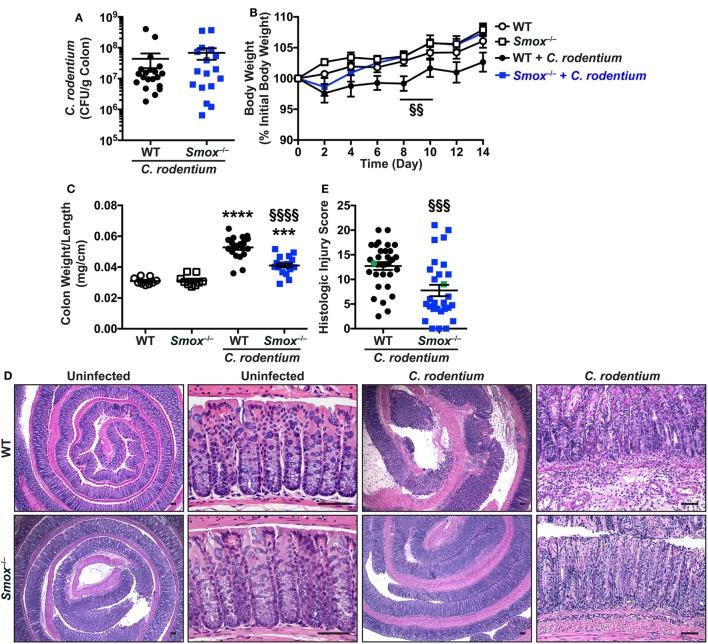
Polyamines have been implicated in numerous biological processes, including inflammation and carcinogenesis. Homeostatic regulation leads to interconversion of the polyamines putrescine and the downstream metabolites spermidine and spermine. The enzyme spermine oxidase (SMOX), which back-converts spermine to spermidine, contributes to regulation of polyamine levels, but can also have other effects. We have implicated SMOX in gastric inflammation and carcinogenesis due to infection by the pathogen . In addition, we reported that SMOX can be upregulated in humans with inflammatory bowel disease. Herein, we utilized -deficient mice to examine the role of SMOX in two murine colitis models, infection and dextran sulfate sodium (DSS)-induced epithelial injury. In -infected wild-type (WT) mice, there were marked increases in colon weight/length and histologic injury, with mucosal hyperplasia and inflammatory cell infiltration; these changes were ameliorated in mice. In contrast, with DSS, mice exhibited substantial mortality, and increased body weight loss, colon weight/length, and histologic damage. In -infected WT mice, there were increased colonic levels of the chemokines CCL2, CCL3, CCL4, CXCL1, CXCL2, and CXCL10, and the cytokines IL-6, TNF-α, CSF3, IFN-γ, and IL-17; each were downregulated in mice. In DSS colitis, increased levels of IL-6, CSF3, and IL-17 were further increased in mice. In both models, putrescine and spermidine were increased in WT mice; in mice, the main effect was decreased spermidine and spermidine/spermine ratio. With , polyamine levels correlated with histologic injury, while with DSS, spermidine was inversely correlated with injury. Our studies indicate that SMOX has immunomodulatory effects in experimental colitis polyamine flux. Thus, SMOX contributes to the immunopathogenesis of infection, but is protective in DSS colitis, indicating the divergent effects of spermidine.
多胺参与了许多生物学过程,包括炎症和癌变。内稳态调节导致多胺腐胺和下游代谢物亚精胺和精胺的相互转化。反精胺酶(SMOX)将精胺转化为亚精胺,有助于调节多胺水平,但也可能有其他作用。我们已经将 SMOX 牵连到病原体感染引起的胃炎症和癌变中。此外,我们报道 SMOX 可以在患有炎症性肠病的人类中上调。在此,我们利用 SMOX 缺陷小鼠检查 SMOX 在两种小鼠结肠炎模型中的作用,即感染和葡聚糖硫酸钠(DSS)诱导的上皮损伤。在感染野生型(WT)小鼠中,结肠重量/长度和组织学损伤明显增加,伴有黏膜增生和炎症细胞浸润;这些变化在 SMOX 缺陷小鼠中得到改善。相比之下,DSS 使 SMOX 缺陷小鼠表现出高死亡率、体重减轻、结肠重量/长度增加和组织学损伤增加。在感染 WT 小鼠中,趋化因子 CCL2、CCL3、CCL4、CXCL1、CXCL2 和 CXCL10 以及细胞因子 IL-6、TNF-α、CSF3、IFN-γ和 IL-17 的结肠水平增加;这些在 SMOX 缺陷小鼠中均下调。在 DSS 结肠炎中,IL-6、CSF3 和 IL-17 的水平在 SMOX 缺陷小鼠中进一步增加。在两种模型中,WT 小鼠中的腐胺和亚精胺增加;在 SMOX 缺陷小鼠中,主要作用是降低亚精胺和亚精胺/精胺比值。随着 SMOX,多胺水平与组织学损伤相关,而 DSS 时,亚精胺与损伤呈负相关。我们的研究表明,SMOX 在实验性结肠炎中具有免疫调节作用 多胺通量。因此,SMOX 有助于感染的免疫发病机制,但在 DSS 结肠炎中具有保护作用,表明了精胺的不同作用。



 Zotero 插件