
混合尿邻苯二甲酸代谢物与分娩时胎龄的关系:使用累积邻苯二甲酸风险评分的事件时间分析。
Associations between mixtures of urinary phthalate metabolites with gestational age at delivery: a time to event analysis using summative phthalate risk scores.
机构信息
Department of Biostatistics, University of Michigan School of Public Health, 1415 Washington Heights, Ann Arbor, MI, 48109, USA.
Department of Environmental Health Sciences, University of Michigan School of Public Health, Ann Arbor, MI, USA.
出版信息
Environ Health. 2018 Jun 20;17(1):56. doi: 10.1186/s12940-018-0400-3.
BACKGROUND
Preterm birth is a significant public health concern and exposure to phthalates has been shown to be associated with an increased odds of preterm birth. Even modest reductions in gestational age at delivery could entail morbid consequences for the neonate and analyzing data with this additional information may be useful. In the present analysis, we consider gestational age at delivery as our outcome of interest and examine associations with multiple phthalates.
METHODS
Women were recruited early in pregnancy as part of a prospective, longitudinal birth cohort at the Brigham and Women's Hospital in Boston, Massachusetts. Urine samples were collected at up to four time points during gestation for urinary phthalate metabolite measurement, and birth outcomes were recorded at delivery. From this population, we selected all 130 cases of preterm birth (< 37 weeks of gestation) as well as 352 random controls. We conducted analysis with both geometric average of the exposure concentrations across the first three visits as well as using repeated measures of the exposure. Two different time to event models were used to examine associations between nine urinary phthalate metabolite concentrations and time to delivery. Two different approaches to constructing a summative phthalate risk score were also considered.
RESULTS
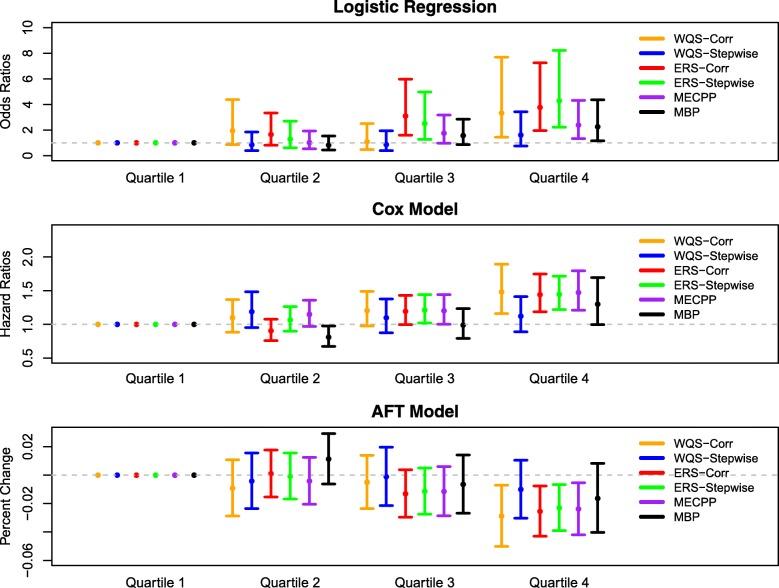
The single-pollutant analysis using a Cox proportional hazards model showed the strongest association with a hazard ratio (HR) of 1.21 (95% confidence interval (CI): 1.09, 1.33) per interquartile range (IQR) change in average log-transformed mono-2-ethyl-5-carboxypentyl phthalate (MECPP) concentration. Using the accelerated failure time model, we observed a 1.19% (95% CI: 0.26, 2.11%) decrease in gestational age in association with an IQR change in average log-transformed MECPP. We next examined associations with an environmental risk score (ERS). The fourth quartile of ERS was significantly associated with a HR of 1.44 (95% CI: 1.19, 1.75) and a reduction of 2.55% (95% CI: 0.76, 4.30%) in time to delivery (in days) compared to the first quartile.
CONCLUSIONS
On average, pregnant women with higher urinary metabolite concentrations of individual phthalates have shorter time to delivery. The strength of the observed associations are amplified with the risk scores when compared to individual pollutants.
背景
早产是一个重大的公共卫生问题,已有研究表明邻苯二甲酸酯的暴露与早产的几率增加有关。即使分娩时的胎龄略有降低,也可能会给新生儿带来严重后果,因此分析这些额外信息可能会有所帮助。在本分析中,我们将分娩时的胎龄作为我们感兴趣的结果,并研究了与多种邻苯二甲酸酯的关联。
方法
本研究招募了马萨诸塞州波士顿布莱根妇女医院的前瞻性纵向出生队列研究中的孕妇作为研究对象。在妊娠期间,最多有四个时间点采集尿液样本,用于测量尿液中邻苯二甲酸酯代谢物的浓度,分娩时记录出生结局。在该人群中,我们选择了所有 130 例早产(<37 周妊娠)病例和 352 例随机对照病例。我们使用暴露浓度在前三个访视期间的几何平均值以及暴露的重复测量进行了分析。使用两种不同的时变模型来检验 9 种尿液邻苯二甲酸酯代谢物浓度与分娩时间之间的关联。还考虑了两种构建累积邻苯二甲酸酯风险评分的方法。
结果
使用 Cox 比例风险模型的单污染物分析显示,与平均对数转化单-2-乙基-5-羧基戊基邻苯二甲酸酯(MECPP)浓度每增加一个四分位间距(IQR)的比值比(HR)为 1.21(95%置信区间(CI):1.09,1.33)。使用加速失效时间模型,我们观察到与平均对数转化 MECPP 的 IQR 变化相关的妊娠年龄下降 1.19%(95%CI:0.26,2.11%)。接下来,我们检查了与环境风险评分(ERS)的关联。第四四分位的 ERS 与 HR 为 1.44(95%CI:1.19,1.75)和分娩时间(以天为单位)减少 2.55%(95%CI:0.76,4.30%)相关与第一四分位相比。
结论
平均而言,尿液中邻苯二甲酸酯代谢物浓度较高的孕妇分娩时间较短。与单个污染物相比,观察到的关联在风险评分中更为显著。
 Zotero 插件