
加拿大安大略省多重疾病患病率的收入不平等:基于链接调查和健康管理数据的分解分析。
Income inequalities in multimorbidity prevalence in Ontario, Canada: a decomposition analysis of linked survey and health administrative data.
机构信息
Institute for Clinical Evaluative Sciences (ICES), G1 06 2075 Bayview Ave, Toronto, ON, M4N 3M5, Canada.
Health System Performance Research Network (HSPRN), 155 College St 4th Floor, Toronto, ON, M5T 3M6, Canada.
出版信息
Int J Equity Health. 2018 Jun 26;17(1):90. doi: 10.1186/s12939-018-0800-6.
BACKGROUND
The burden of multimorbidity is a growing clinical and health system problem that is known to be associated with socioeconomic status, yet our understanding of the underlying determinants of inequalities in multimorbidity and longitudinal trends in measured disparities remains limited.
METHODS
We included all adult respondents from four cycles of the Canadian Community Health Survey (CCHS) (between 2005 to 2011/12), linked at the individual-level to health administrative data in Ontario, Canada (pooled n = 113,627). Multimorbidity was defined at each survey response as having ≥2 (of 17) high impact chronic conditions, based on claims data. Using a decomposition method of the Erreygers-corrected concentration index (C), we measured household income inequality and the contribution of the key determinants of multimorbidity (including socio-demographic, socio-economic, lifestyle and health system factors) to these disparities. Differences over time are described. We tested for statistically significant changes to measured inequality using the slope index (SII) and relative index of inequality (RII) with a 2-way interaction on pooled data.
RESULTS
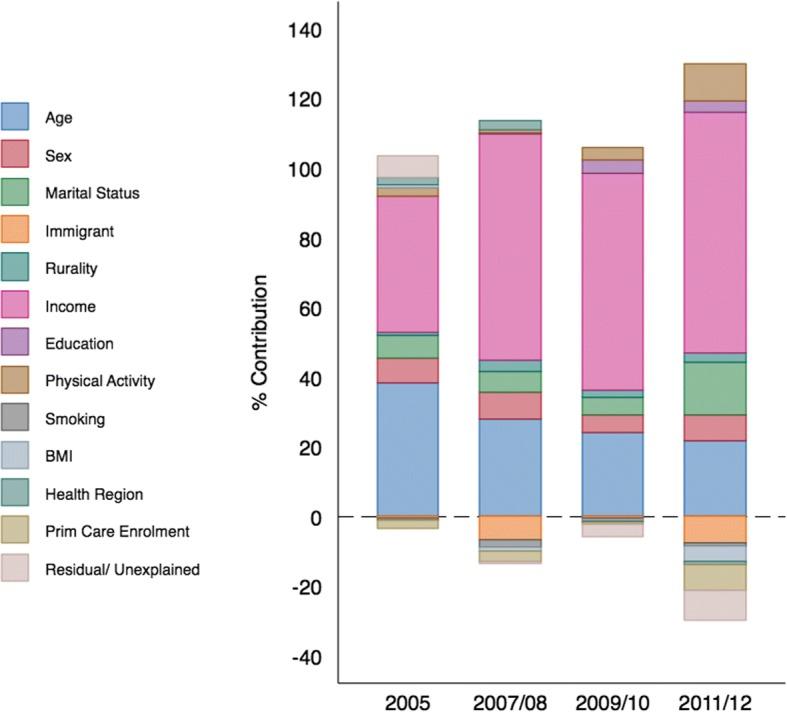
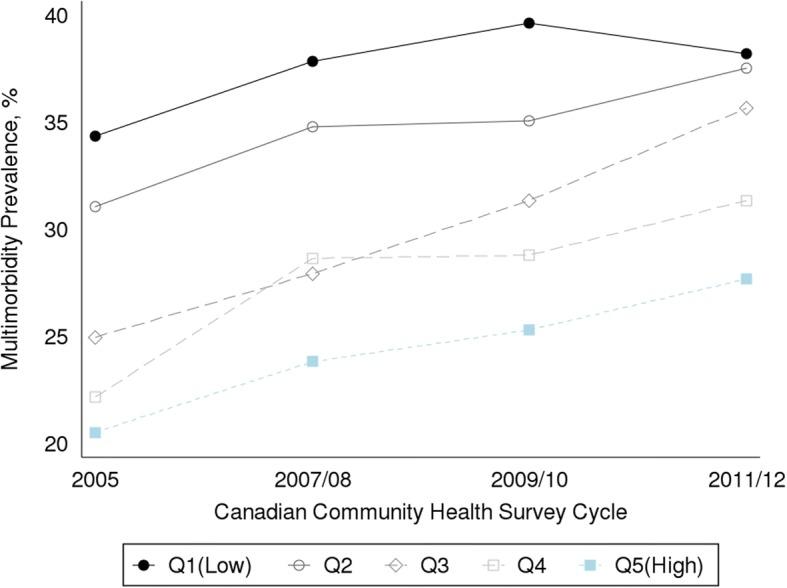
Multimorbidity prevalence in 2011/12 was 33.5% and the C was - 0.085 (CI: -0.108 to - 0.062), indicating a greater prevalence among lower income groups. In decomposition analyses, income itself accounted more than two-thirds (69%) of this inequality. Age (21.7%), marital status (15.2%) and physical inactivity (10.9%) followed, and the contribution of these factors increased from baseline (2005 CCHS survey) with the exception of age. Other lifestyle factors, including heavy smoking and obesity, had minimal contribution to measured inequality (1.8 and 0.4% respectively). Tests for trends (SII/RII) across pooled survey data were not statistically significant (p = 0.443 and 0.405, respectively), indicating no change in inequalities in multimorbidity prevalence over the study period.
CONCLUSIONS
A pro-rich income gap in multimorbidity has persisted in Ontario from 2005 to 2011/12. These empirical findings suggest that to advance equality in multimorbidity prevalence, policymakers should target chronic disease prevention and control strategies focused on older adults, non-married persons and those that are physically inactive, in addition to addressing income disparities directly.
背景
多种疾病的负担是一个日益严重的临床和卫生系统问题,已知其与社会经济地位有关,但我们对多种疾病不平等的潜在决定因素以及测量差异的纵向趋势的理解仍然有限。
方法
我们纳入了加拿大社区健康调查(CCHS)(2005 年至 2011/12 年)四个周期的所有成年受访者,在个人层面上与加拿大安大略省的健康管理数据相关联(汇总 n=113627)。在每次调查中,根据索赔数据,将≥2(17 种)种高影响慢性疾病定义为多种疾病。使用 Erreygers 校正的集中指数(C)的分解方法,我们衡量了家庭收入不平等以及多种疾病的主要决定因素(包括社会人口统计学、社会经济、生活方式和卫生系统因素)对这些差异的贡献。描述了随时间的差异。我们使用斜率指数(SII)和相对不平等指数(RII),并在汇总数据上进行了双向交互,对测量不平等的变化进行了统计检验。
结果
2011/12 年多种疾病的患病率为 33.5%,C 值为-0.085(CI:-0.108 至-0.062),表明低收入群体的患病率更高。在分解分析中,收入本身占不平等的三分之二以上(69%)。年龄(21.7%)、婚姻状况(15.2%)和身体不活动(10.9%)紧随其后,除了年龄之外,这些因素的贡献从基线(2005 年 CCHS 调查)开始增加。其他生活方式因素,包括重度吸烟和肥胖,对测量不平等的贡献很小(分别为 1.8%和 0.4%)。对汇总调查数据的趋势(SII/RII)进行检验没有统计学意义(分别为 p=0.443 和 0.405),表明在研究期间,多种疾病患病率的不平等没有变化。
结论
2005 年至 2011/12 年,安大略省的多种疾病存在有利于富人的收入差距。这些实证发现表明,为了在多种疾病的患病率方面实现平等,政策制定者除了直接解决收入差距外,还应针对慢性病预防和控制策略,重点关注老年人、未婚人士和身体不活跃的人。
 Zotero 插件