
AML 中组合靶向治疗的白血病干细胞标志物的共表达谱。
Coexpression profile of leukemic stem cell markers for combinatorial targeted therapy in AML.
机构信息
Department of Medicine III, University Hospital, LMU Munich, Munich, Germany.
Translational Cancer Immunology, Gene Center, LMU Munich, Munich, Germany.
出版信息
Leukemia. 2019 Jan;33(1):64-74. doi: 10.1038/s41375-018-0180-3. Epub 2018 Jun 26.
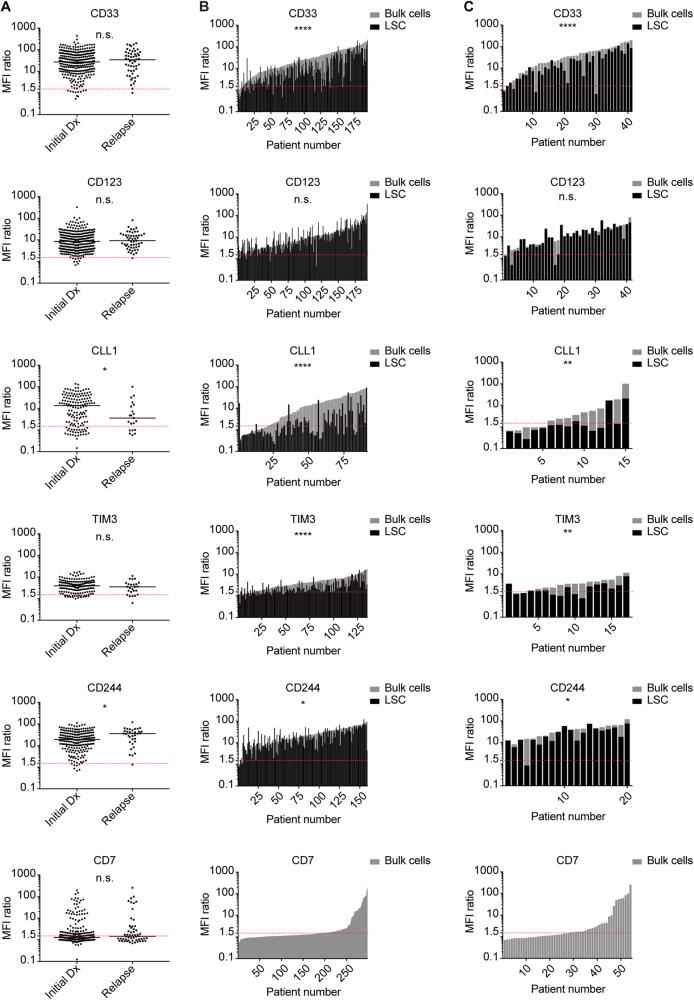
Targeted immunotherapy in acute myeloid leukemia (AML) is challenged by the lack of AML-specific target antigens and clonal heterogeneity, leading to unwanted on-target off-leukemia toxicity and risk of relapse from minor clones. We hypothesize that combinatorial targeting of AML cells can enhance therapeutic efficacy without increasing toxicity. To identify target antigen combinations specific for AML and leukemic stem cells, we generated a detailed protein expression profile based on flow cytometry of primary AML (n = 356) and normal bone marrow samples (n = 34), and a recently reported integrated normal tissue proteomic data set. We analyzed antigen expression levels of CD33, CD123, CLL1, TIM3, CD244 and CD7 on AML bulk and leukemic stem cells at initial diagnosis (n = 302) and relapse (n = 54). CD33, CD123, CLL1, TIM3 and CD244 were ubiquitously expressed on AML bulk cells at initial diagnosis and relapse, irrespective of genetic characteristics. For each analyzed target, we found additional expression in different populations of normal hematopoiesis. Analyzing the coexpression of our six targets in all dual combinations (n = 15), we found CD33/TIM3 and CLL1/TIM3 to be highly positive in AML compared with normal hematopoiesis and non-hematopoietic tissues. Our findings indicate that combinatorial targeting of CD33/TIM3 or CLL1/TIM3 may enhance therapeutic efficacy without aggravating toxicity in immunotherapy of AML.
靶向免疫疗法在急性髓细胞白血病(AML)中面临缺乏 AML 特异性靶抗原和克隆异质性的挑战,导致不必要的靶向脱白血病毒性和来自小克隆的复发风险。我们假设联合靶向 AML 细胞可以增强治疗效果而不增加毒性。为了确定针对 AML 和白血病干细胞的靶向抗原组合,我们基于流式细胞术对原发性 AML(n = 356)和正常骨髓样本(n = 34)进行了详细的蛋白质表达谱分析,并对最近报道的综合正常组织蛋白质组数据集进行了分析。我们分析了 CD33、CD123、CLL1、TIM3、CD244 和 CD7 在 AML 大量细胞和白血病干细胞中的抗原表达水平,这些细胞在初始诊断(n = 302)和复发(n = 54)时均有表达。CD33、CD123、CLL1、TIM3 和 CD244 在初始诊断和复发时在 AML 大量细胞中普遍表达,与遗传特征无关。对于每个分析的靶标,我们在正常造血的不同群体中发现了额外的表达。分析我们六个靶标的所有双组合(n = 15)的共表达情况,我们发现 CD33/TIM3 和 CLL1/TIM3 在 AML 中与正常造血和非造血组织相比高度阳性。我们的研究结果表明,联合靶向 CD33/TIM3 或 CLL1/TIM3 可能在 AML 的免疫治疗中增强治疗效果而不加重毒性。



 Zotero 插件