
一种新型针对中东呼吸综合征冠状病毒(MERS-CoV)受体结合域的纳米抗体具有强大的交叉中和活性和针对 MERS-CoV 的保护效力。
A Novel Nanobody Targeting Middle East Respiratory Syndrome Coronavirus (MERS-CoV) Receptor-Binding Domain Has Potent Cross-Neutralizing Activity and Protective Efficacy against MERS-CoV.
机构信息
State Key Laboratory of Pathogen and Biosecurity, Beijing Institute of Microbiology and Epidemiology, Beijing, China.
Lindsley F. Kimball Research Institute, New York Blood Center, New York, New York, USA.
出版信息
J Virol. 2018 Aug 29;92(18). doi: 10.1128/JVI.00837-18. Print 2018 Sep 15.
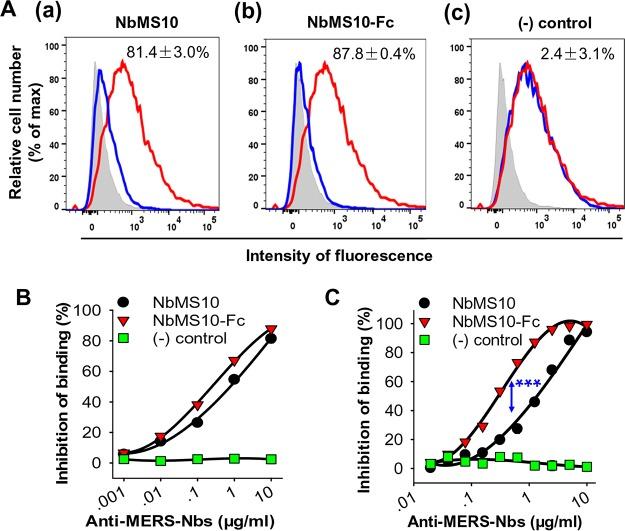
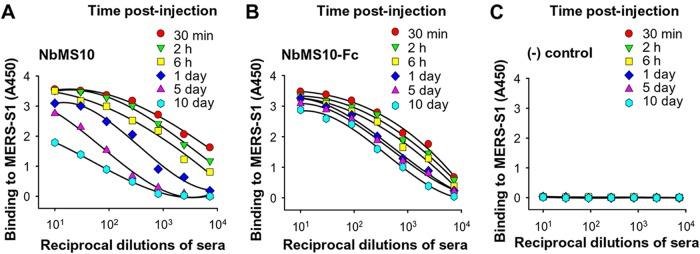
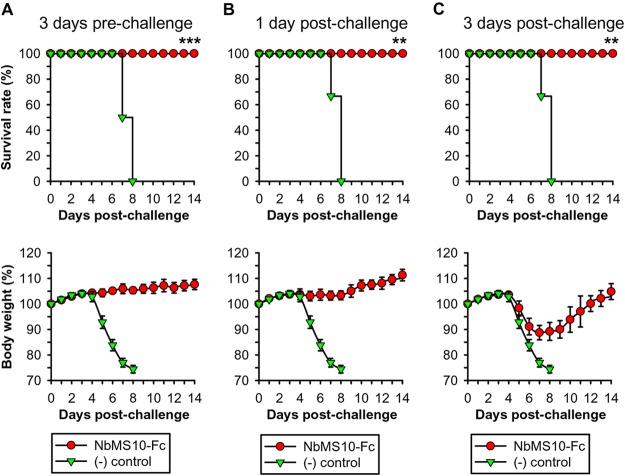
The newly emerged Middle East respiratory syndrome coronavirus (MERS-CoV) continues to infect humans and camels, calling for efficient, cost-effective, and broad-spectrum strategies to control its spread. Nanobodies (Nbs) are single-domain antibodies derived from camelids and sharks and are potentially cost-effective antivirals with small size and great expression yield. In this study, we developed a novel neutralizing Nb (NbMS10) and its human-Fc-fused version (NbMS10-Fc), both of which target the MERS-CoV spike protein receptor-binding domain (RBD). We further tested their receptor-binding affinity, recognizing epitopes, cross-neutralizing activity, half-life, and efficacy against MERS-CoV infection. Both Nbs can be expressed in yeasts with high yield, bind to MERS-CoV RBD with high affinity, and block the binding of MERS-CoV RBD to the MERS-CoV receptor. The binding site of the Nbs on the RBD was mapped to be around residue Asp539, which is part of a conserved conformational epitope at the receptor-binding interface. NbMS10 and NbMS10-Fc maintained strong cross-neutralizing activity against divergent MERS-CoV strains isolated from humans and camels. Particularly, NbMS10-Fc had significantly extended half-life ; a single-dose treatment of NbMS10-Fc exhibited high prophylactic and therapeutic efficacy by completely protecting humanized mice from lethal MERS-CoV challenge. Overall, this study proves the feasibility of producing cost-effective, potent, and broad-spectrum Nbs against MERS-CoV and has produced Nbs with great potentials as anti-MERS-CoV therapeutics. Therapeutic development is critical for preventing and treating continual MERS-CoV infections in humans and camels. Because of their small size, nanobodies (Nbs) have advantages as antiviral therapeutics (e.g., high expression yield and robustness for storage and transportation) and also potential limitations (e.g., low antigen-binding affinity and fast renal clearance). Here, we have developed novel Nbs that specifically target the receptor-binding domain (RBD) of MERS-CoV spike protein. They bind to a conserved site on MERS-CoV RBD with high affinity, blocking RBD's binding to MERS-CoV receptor. Through engineering a C-terminal human Fc tag, the half-life of the Nbs is significantly extended. Moreover, the Nbs can potently cross-neutralize the infections of diverse MERS-CoV strains isolated from humans and camels. The Fc-tagged Nb also completely protects humanized mice from lethal MERS-CoV challenge. Taken together, our study has discovered novel Nbs that hold promise as potent, cost-effective, and broad-spectrum anti-MERS-CoV therapeutic agents.
新型中东呼吸综合征冠状病毒(MERS-CoV)持续感染人类和骆驼,因此需要高效、经济且广谱的策略来控制其传播。纳米抗体(Nbs)是源自骆驼和鲨鱼的单域抗体,具有体积小、表达产量高的特点,是一种有潜力的经济有效的抗病毒药物。在本研究中,我们开发了一种新型中和纳米抗体(NbMS10)及其与人 Fc 融合的版本(NbMS10-Fc),它们均靶向 MERS-CoV 刺突蛋白受体结合域(RBD)。我们进一步测试了它们的受体结合亲和力、识别表位、交叉中和活性、半衰期和对 MERS-CoV 感染的疗效。两种纳米抗体均可在酵母中高产量表达,与 MERS-CoV RBD 高亲和力结合,并阻断 MERS-CoV RBD 与 MERS-CoV 受体的结合。纳米抗体在 RBD 上的结合位点被定位在残基 Asp539 周围,该残基位于受体结合界面上的一个保守构象表位内。NbMS10 和 NbMS10-Fc 对分离自人类和骆驼的不同 MERS-CoV 株保持强烈的交叉中和活性。特别是,NbMS10-Fc 的半衰期显著延长;单次给予 NbMS10-Fc 治疗可完全保护人源化小鼠免受致死性 MERS-CoV 攻击,显示出高预防和治疗功效。总体而言,这项研究证明了生产针对 MERS-CoV 的经济高效、强效且广谱的纳米抗体的可行性,并产生了具有成为抗 MERS-CoV 治疗药物巨大潜力的纳米抗体。治疗开发对于预防和治疗人类和骆驼中的持续 MERS-CoV 感染至关重要。由于体积小,纳米抗体(Nbs)具有作为抗病毒治疗药物的优势(例如,高表达产量和对储存和运输的稳健性),也具有潜在的局限性(例如,抗原结合亲和力低和快速肾清除率)。在这里,我们开发了专门针对 MERS-CoV 刺突蛋白受体结合域(RBD)的新型纳米抗体。它们与 MERS-CoV RBD 上的一个保守位点高亲和力结合,阻断 RBD 与 MERS-CoV 受体的结合。通过在 C 末端工程化一个人 Fc 标签,纳米抗体的半衰期显著延长。此外,这些纳米抗体可以有效地中和分离自人类和骆驼的不同 MERS-CoV 株的感染。Fc 标记的纳米抗体也完全保护人源化小鼠免受致死性 MERS-CoV 攻击。总之,我们的研究发现了具有成为强效、经济且广谱抗 MERS-CoV 治疗药物潜力的新型纳米抗体。




 Zotero 插件