
通过综合生物信息学分析鉴定胃癌中的枢纽基因和潜在分子机制
Identification of hub genes and potential molecular mechanisms in gastric cancer by integrated bioinformatics analysis.
作者信息
Cao Ling, Chen Yan, Zhang Miao, Xu De-Quan, Liu Yan, Liu Tonglin, Liu Shi-Xin, Wang Ping
机构信息
Department of Radiation Oncology, Tianjin Medical University Cancer Institute and Hospital, National Clinical Research Center for Cancer; Key Laboratory of Cancer Prevention and Therapy, Tianjin; Tianjin's Clinical Research Center for Cancer, Tianjin, Tianjin, China.
Department of Radiation Oncology, Cancer Hospital of Jilin Province, Changchun, Jilin, China.
出版信息
PeerJ. 2018 Jul 2;6:e5180. doi: 10.7717/peerj.5180. eCollection 2018.
OBJECTIVE
Gastric cancer (GC) is the fourth most common cause of cancer-related deaths in the world. In the current study, we aim to identify the hub genes and uncover the molecular mechanisms of GC.
METHODS
The expression profiles of the genes and the miRNAs were extracted from the Gene Expression Omnibus database. The identification of the differentially expressed genes (DEGs), including miRNAs, was performed by the GEO2R. Database for Annotation, Visualization and Integrated Discovery was used to perform GO and KEGG pathway enrichment analysis. The protein-protein interaction (PPI) network and miRNA-gene network were constructed using Cytoscape software. The hub genes were identified by the Molecular Complex Detection (MCODE) plugin, the CytoHubba plugin and miRNA-gene network. Then, the identified genes were verified by Kaplan-Meier plotter database and quantitative real-time PCR (qRT-PCR) in GC tissue samples.
RESULTS
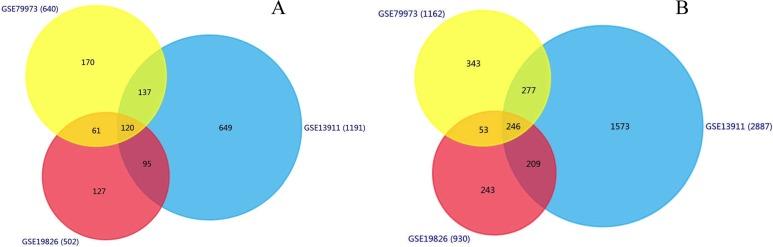
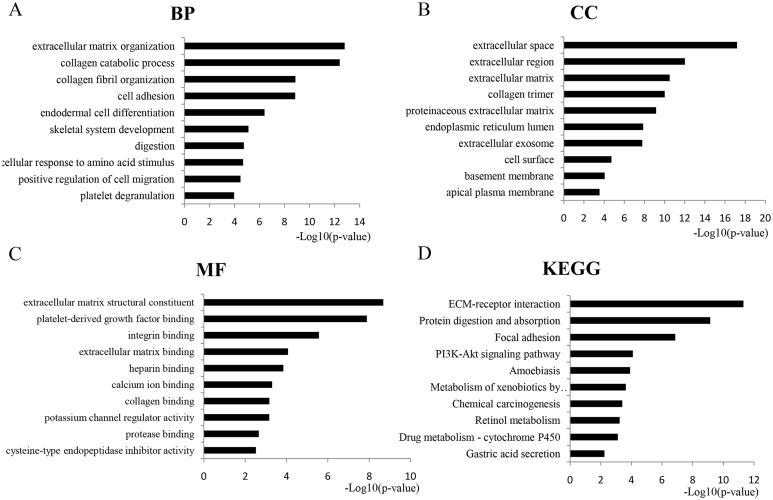
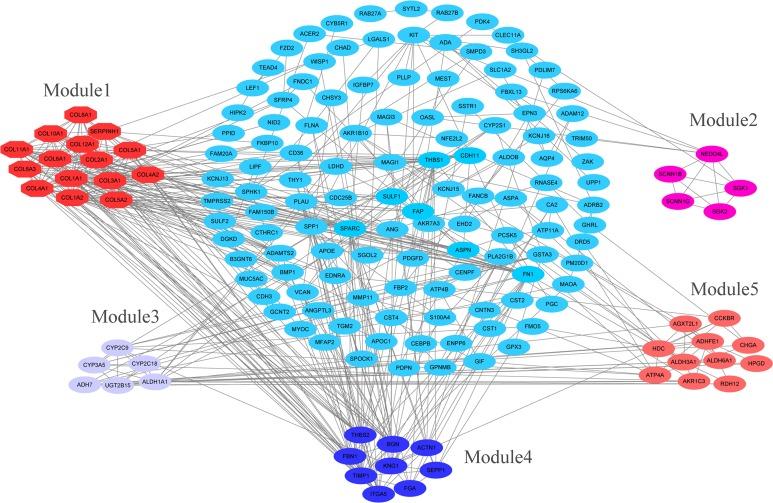
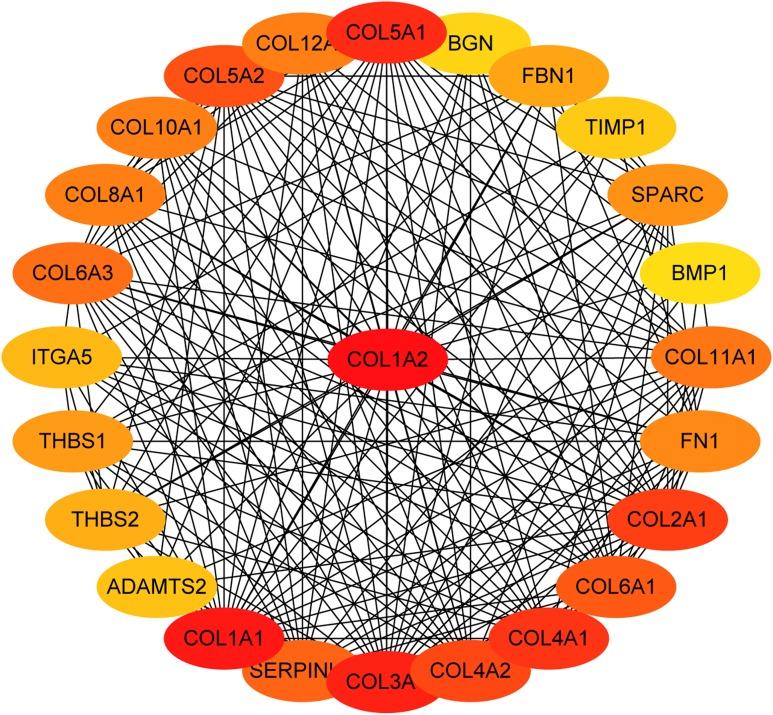
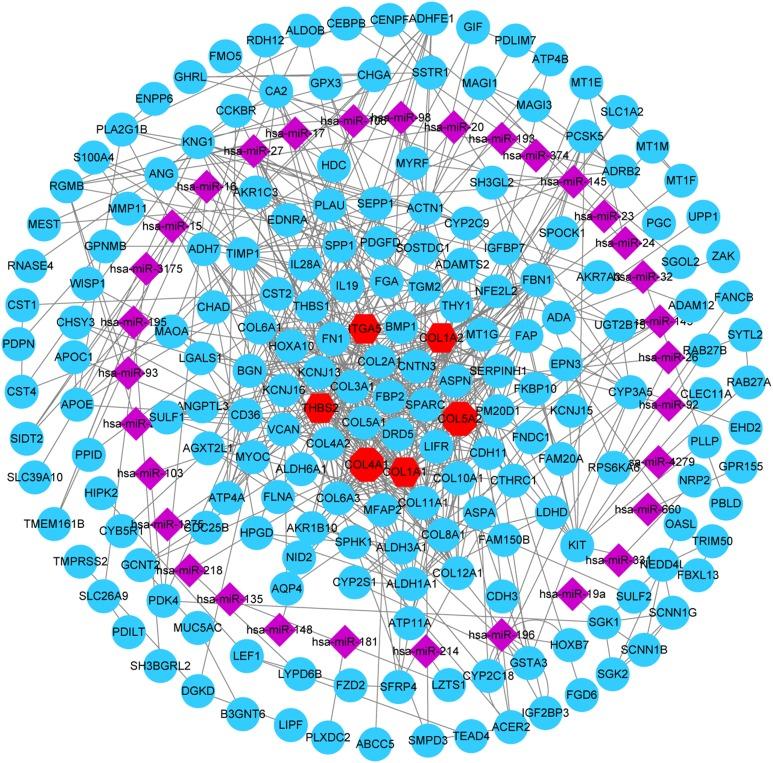
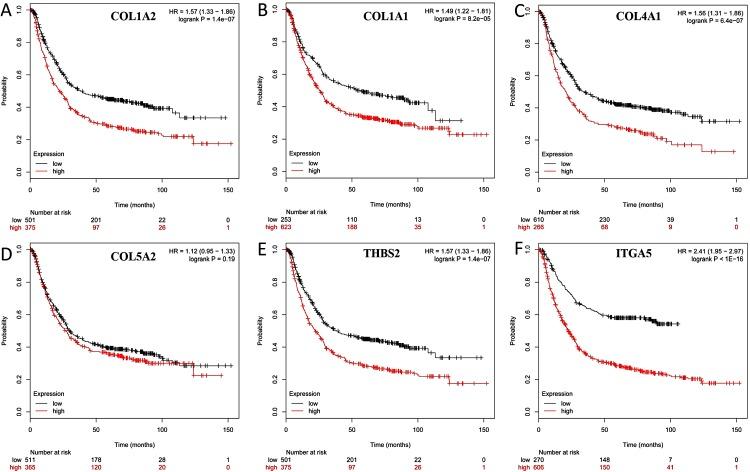
A total of three mRNA expression profiles (GSE13911, GSE79973 and GSE19826) were downloaded from the Gene Expression Omnibus (GEO) database, including 69, 20 and 27cases separately. A total of 120 overlapped upregulated genes and 246 downregulated genes were identified. The majority of the DEGs were enriched in extracellular matrix organization, collagen catabolic process, collagen fibril organization and cell adhesion. In addition, three KEGG pathways were significantly enriched, including ECM-receptor interaction, protein digestion and absorption, and the focal adhesion pathways. In the PPI network, five significant modules were detected, while the genes in the modules were mainly involved in the ECM-receptor interaction and focal adhesion pathways. By combining the results of MCODE, CytoHubba and miRNA-gene network, a total of six hub genes including COL1A2, COL1A1, COL4A1, COL5A2, THBS2 and ITGA5 were chosen. The Kaplan-Meier plotter database confirmed that higher expression levels of these genes were related to lower overall survival, except for COL5A2. Experimental validation showed that the rest of the five genes had the same expression trend as predicted.
CONCLUSION
In conclusion, COL1A2, COL1A1, COL4A1, THBS2 and ITGA5 may be potential biomarkers and therapeutic targets for GC. Moreover, ECM-receptor interaction and focal adhesion pathways play significant roles in the progression of GC.
目的
胃癌(GC)是全球癌症相关死亡的第四大常见原因。在本研究中,我们旨在识别枢纽基因并揭示胃癌的分子机制。
方法
从基因表达综合数据库中提取基因和微小RNA(miRNA)的表达谱。使用GEO2R对包括miRNA在内的差异表达基因(DEG)进行鉴定。利用注释、可视化和综合发现数据库进行基因本体(GO)和京都基因与基因组百科全书(KEGG)通路富集分析。使用Cytoscape软件构建蛋白质-蛋白质相互作用(PPI)网络和miRNA-基因网络。通过分子复合物检测(MCODE)插件、CytoHubba插件和miRNA-基因网络识别枢纽基因。然后,通过Kaplan-Meier绘图数据库和定量实时聚合酶链反应(qRT-PCR)在胃癌组织样本中验证所识别的基因。
结果
从基因表达综合(GEO)数据库下载了总共三个mRNA表达谱(GSE13911、GSE79973和GSE19826),分别包括69例、20例和27例。共鉴定出120个重叠的上调基因和246个下调基因。大多数DEG富集于细胞外基质组织、胶原蛋白分解代谢过程、胶原纤维组织和细胞黏附。此外,三个KEGG通路显著富集,包括细胞外基质-受体相互作用、蛋白质消化和吸收以及黏着斑通路。在PPI网络中,检测到五个显著模块,模块中的基因主要参与细胞外基质-受体相互作用和黏着斑通路。通过结合MCODE、CytoHubba和miRNA-基因网络的结果,共选择了六个枢纽基因,包括COL1A2、COL1A1、COL4A1、COL5A2、THBS2和ITGA5。Kaplan-Meier绘图数据库证实,除COL5A2外,这些基因的较高表达水平与较低的总生存率相关。实验验证表明,其余五个基因的表达趋势与预测一致。
结论
总之,COL1A2、COL1A1、COL4A1、THBS2和ITGA5可能是胃癌的潜在生物标志物和治疗靶点。此外,细胞外基质-受体相互作用和黏着斑通路在胃癌进展中起重要作用。


 Zotero 插件