
韩国兽医诊所收治犬只的主要医学病因,按品种和生命阶段分类:电子病历调查
Major medical causes by breed and life stage for dogs presented at veterinary clinics in the Republic of Korea: a survey of electronic medical records.
作者信息
Kim Eunju, Choe Changyong, Yoo Jae Gyu, Oh Sang-Ik, Jung Younghun, Cho Ara, Kim Suhee, Do Yoon Jung
机构信息
Division of Animal Diseases & Health, National Institute of Animal Science, Rural Development Administration, Wanju-gun, Jeollabuk-do, Republic of Korea.
出版信息
PeerJ. 2018 Jul 3;6:e5161. doi: 10.7717/peerj.5161. eCollection 2018.
BACKGROUND
Age and breed are considered the greatest risk factors for disease prevalence and mortality in companion dogs. Understanding the prevalence of diseases, in relation to age and breed, would support appropriate guidance for future health care strategies and provide useful information for the early diagnosis of diseases. The purpose of this study was to investigate the major medical causes for dogs visiting primary-care veterinary clinics in the Republic of Korea, stratified by age and breed.
METHODS
A total of 15,531 medical records of canine patients were analyzed from 11 veterinary clinics who shared data from January 1, 2016 to December 31, 2016. An electronic medical record (EMR) system was used for data collection, which included the animal identification number, age, breed, gender, neuter status, clinical information, and diagnosis. EMR data were classified using the International Classification of Disease system from the World Health Organization; presenting signs or diagnoses were identified according to breed and life stage.
RESULTS
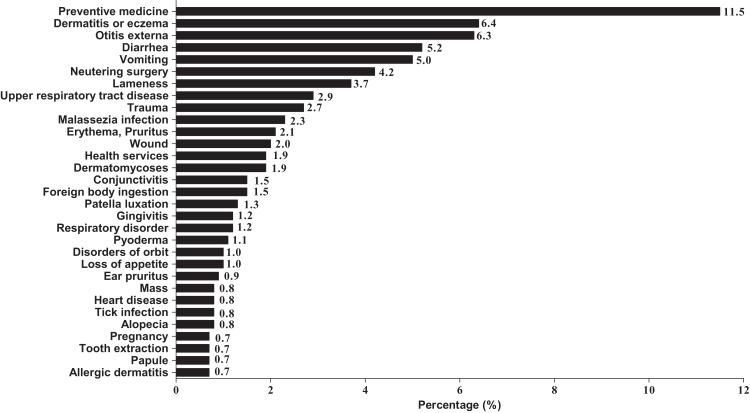
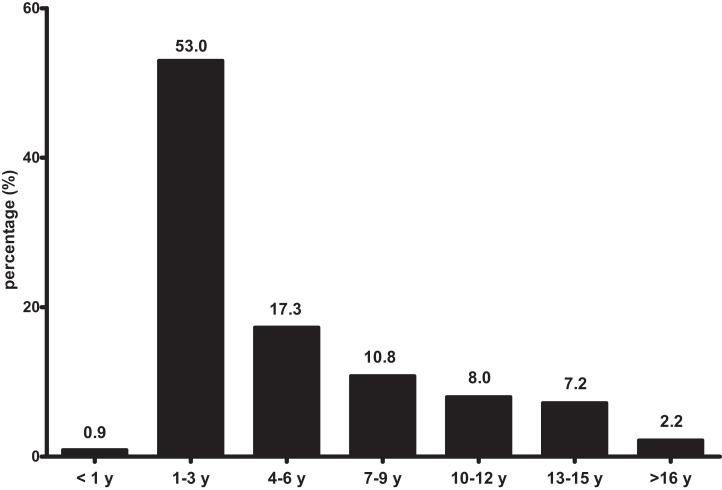
Within the age groups, preventive medicine (16.7% confidence intervals (CI) [15.9-17.5]) was the most common cause for clinic visits for the <1 year and 1-3 year groups. Additionally, neutering surgery (6.6% CI [6.0-7.1]) and patella luxation (1.4% CI [1.8-2.7]) were frequently performed in these age groups. In the 4-6 year group, otitis externa (8.8% CI [7.8-10.0]) and dermatitis or eczema (8.5% CI [7.5-9.6]) were common medical problems. In older dogs (>10 year), the prevalences of heart disease, kidney disease, Cushing's disease, and mammary tumors were higher than in the other age groups. Small and toy breed dogs comprised 67.7% of all dogs in this analysis. For all breeds, otitis externa, dermatitis or eczema, vomiting, and diarrhea were common medical problems.
DISCUSSION
This study identified the most common medical disorders and differences in prevalences of diseases, according to age and breeds. The information from EMRs for dogs visiting primary-care veterinary clinics can provide background knowledge that is required to enable a better understanding of disease patterns and occurrence by age and breeds. The information from this study could enable the creation of strategies for preventing diseases and enable the identification of health problems for more effective disease management in companion dogs.
背景
年龄和品种被认为是伴侣犬疾病患病率和死亡率的最大风险因素。了解与年龄和品种相关的疾病患病率,将有助于为未来的医疗保健策略提供适当指导,并为疾病的早期诊断提供有用信息。本研究的目的是调查韩国初级保健兽医诊所就诊犬只的主要医学病因,并按年龄和品种进行分层。
方法
分析了11家兽医诊所提供的2016年1月1日至2016年12月31日期间15531份犬类患者的病历。使用电子病历(EMR)系统进行数据收集,其中包括动物识别号、年龄、品种、性别、绝育状态、临床信息和诊断。EMR数据根据世界卫生组织的国际疾病分类系统进行分类;根据品种和生命阶段确定呈现的体征或诊断。
结果
在各年龄组中,预防医学(16.7%置信区间[CI][15.9 - 17.5])是1岁以下和1 - 3岁组就诊的最常见原因。此外,这些年龄组中经常进行绝育手术(6.6% CI[6.0 - 7.1])和髌骨脱位(1.4% CI[1.8 - 2.7])。在4 - 6岁组中,外耳炎(8.8% CI[7.8 - 10.0])和皮炎或湿疹(8.5% CI[7.5 - 9.6])是常见的医学问题。在老年犬(>10岁)中,心脏病、肾病、库欣病和乳腺肿瘤的患病率高于其他年龄组。小型和玩具型犬种占本分析中所有犬只的67.7%。对于所有品种,外耳炎、皮炎或湿疹、呕吐和腹泻是常见的医学问题。
讨论
本研究确定了最常见的医学疾病以及疾病患病率在年龄和品种方面的差异。初级保健兽医诊所就诊犬只的EMR信息可以提供背景知识,以便更好地了解按年龄和品种划分的疾病模式和发病情况。本研究的信息可以制定疾病预防策略,并有助于识别健康问题,以便对伴侣犬进行更有效的疾病管理。


 Zotero 插件