
细胞无蛋白体系中乳过氧化物酶产生的次碘酸盐和次硫氰酸盐对流感病毒的敏感性。
Susceptibility of influenza viruses to hypothiocyanite and hypoiodite produced by lactoperoxidase in a cell-free system.
机构信息
University of Georgia, College of Veterinary Medicine, Department of Infectious Diseases, Athens, Georgia, United States of America.
出版信息
PLoS One. 2018 Jul 25;13(7):e0199167. doi: 10.1371/journal.pone.0199167. eCollection 2018.
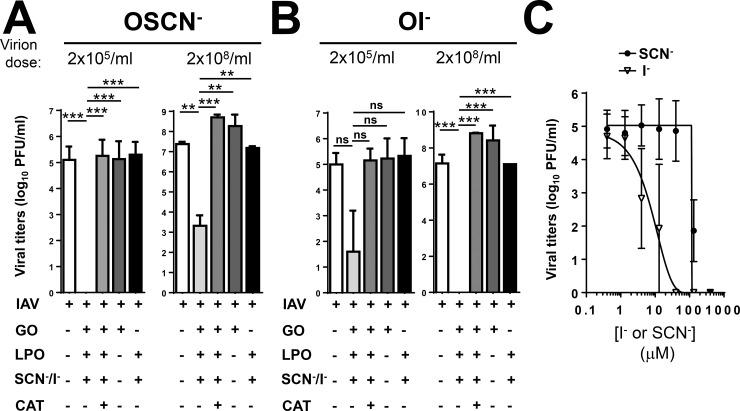
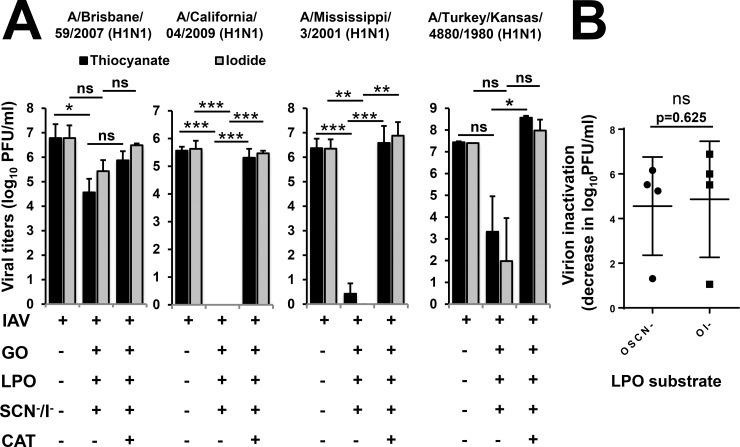
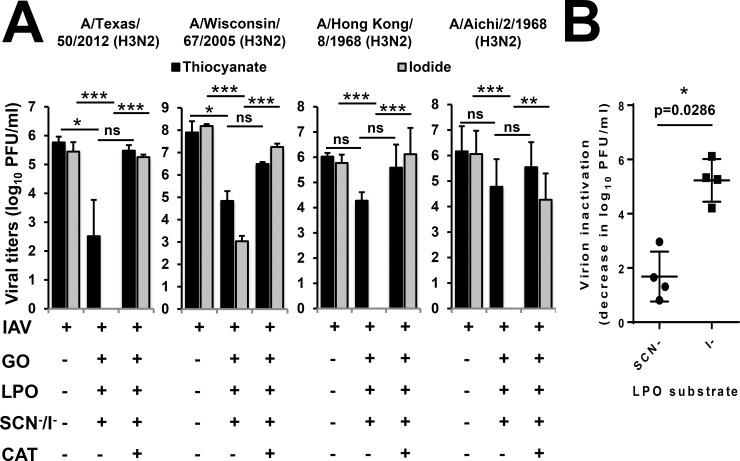
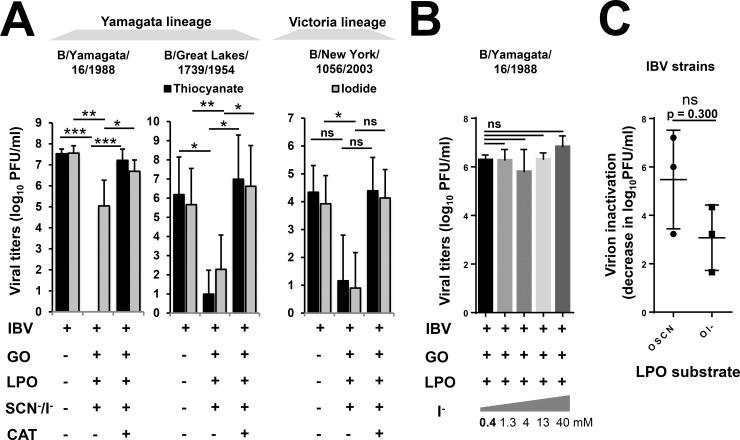
Lactoperoxidase (LPO) is an enzyme found in several exocrine secretions including the airway surface liquid producing antimicrobial substances from mainly halide and pseudohalide substrates. Although the innate immune function of LPO has been documented against several microbes, a detailed characterization of its mechanism of action against influenza viruses is still missing. Our aim was to study the antiviral effect and substrate specificity of LPO to inactivate influenza viruses using a cell-free experimental system. Inactivation of different influenza virus strains was measured in vitro system containing LPO, its substrates, thiocyanate (SCN-) or iodide (I-), and the hydrogen peroxide (H2O2)-producing system, glucose and glucose oxidase (GO). Physiologically relevant concentrations of the components of the LPO/H2O2/(SCN-/I-) antimicrobial system were exposed to twelve different strains of influenza A and B viruses in vitro and viral inactivation was assessed by determining plaque-forming units of non-inactivated viruses using Madin-Darby canine kidney cells (MDCK) cells. Our data show that LPO is capable of inactivating all influenza virus strains tested: H1N1, H1N2 and H3N2 influenza A viruses (IAV) and influenza B viruses (IBV) of both, Yamagata and Victoria lineages. The extent of viral inactivation, however, varied among the strains and was in part dependent on the LPO substrate. Inactivation of H1N1 and H1N2 viruses by LPO showed no substrate preference, whereas H3N2 influenza strains were inactivated significantly more efficiently when iodide, not thiocyanate, was the LPO substrate. Although LPO-mediated inactivation of the influenza B strains tested was strain-dependent, it showed slight preference towards thiocyanate as the substrate. The results presented here show that the LPO/H2O2/(SCN-/I-) cell-free, in vitro experimental system is a functional tool to study the specificity, efficiency and the molecular mechanism of action of influenza inactivation by LPO. These studies tested the hypothesis that influenza strains are all susceptible to the LPO-based antiviral system but exhibit differences in their substrate specificities. We propose that a LPO-based antiviral system is an important contributor to anti-influenza virus defense of the airways.
乳过氧化物酶(LPO)是一种存在于多种外分泌液中的酶,包括气道表面液体,它能从主要的卤化物和拟卤化物底物中产生抗菌物质。尽管 LPO 的先天免疫功能已被证实可以抵抗多种微生物,但针对流感病毒的作用机制的详细特征仍然缺失。我们的目的是使用无细胞实验系统研究 LPO 对流感病毒的抗病毒作用和底物特异性,以灭活流感病毒。我们在包含 LPO、其底物硫氰酸盐(SCN-)或碘化物(I-)以及产生过氧化氢(H2O2)的系统、葡萄糖和葡萄糖氧化酶(GO)的体外系统中测量不同流感病毒株的失活情况。生理相关浓度的 LPO/H2O2/(SCN-/I-)抗菌系统的成分被暴露于十二种不同的流感 A 和 B 病毒株的体外,并通过使用 Madin-Darby 犬肾细胞(MDCK)细胞测定非失活病毒的噬菌斑形成单位来评估病毒失活情况。我们的数据表明,LPO 能够灭活所有测试的流感病毒株:H1N1、H1N2 和 H3N2 甲型流感病毒(IAV)和乙型流感病毒(IBV),包括 Yamagata 和 Victoria 谱系。然而,病毒失活的程度因病毒株而异,部分依赖于 LPO 底物。LPO 对 H1N1 和 H1N2 病毒的失活没有底物偏好,而 LPO 底物为碘化物而非硫氰酸盐时,H3N2 流感病毒株的失活效率显著更高。尽管测试的流感 B 病毒株的 LPO 介导的失活是株依赖性的,但它对硫氰酸盐作为底物略有偏好。这里呈现的结果表明,LPO/H2O2/(SCN-/I-)无细胞、体外实验系统是研究 LPO 灭活流感病毒的特异性、效率和作用机制的功能工具。这些研究检验了流感病毒株均易受 LPO 为基础的抗病毒系统影响,但在其底物特异性方面存在差异的假设。我们提出,基于 LPO 的抗病毒系统是气道抗流感病毒防御的重要贡献者。




 Zotero 插件