
Notch信号作为肿瘤免疫反应的调节因子:靶向与否?
Notch Signaling as a Regulator of the Tumor Immune Response: To Target or Not To Target?
作者信息
Janghorban Mahnaz, Xin Li, Rosen Jeffrey M, Zhang Xiang H-F
机构信息
Department of Molecular and Cellular Biology, Baylor College of Medicine, Houston, TX, United States.
Lester and Sue Smith Breast Center, Baylor College of Medicine, Houston, TX, United States.
出版信息
Front Immunol. 2018 Jul 16;9:1649. doi: 10.3389/fimmu.2018.01649. eCollection 2018.
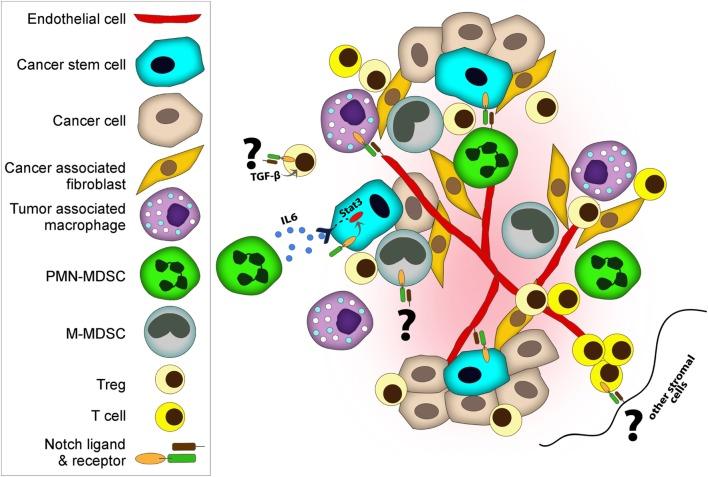
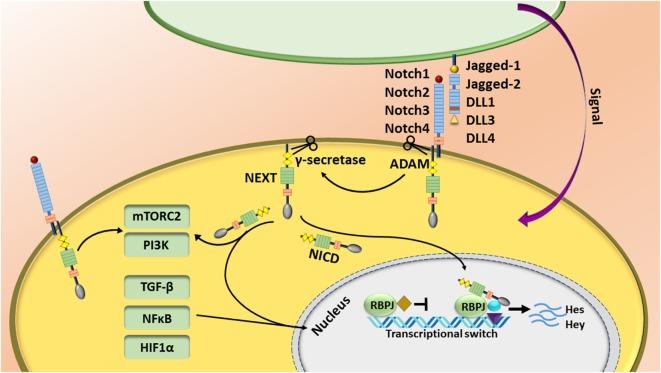
The Notch signaling pathway regulates important cellular processes involved in stem cell maintenance, proliferation, development, survival, and inflammation. These responses to Notch signaling involving both canonical and non-canonical pathways can be spatially and temporally variable and are highly cell-type dependent. Notch signaling can elicit opposite effects in regulating tumorigenicity (tumor-promoting versus tumor-suppressing function) as well as controlling immune cell responses. In various cancer types, Notch signaling elicits a "cancer stem cell (CSC)" phenotype that results in decreased proliferation, but resistance to various therapies, hence potentially contributing to cell dormancy and relapse. CSCs can reshape their niche by releasing paracrine factors and inflammatory cytokines, and the niche in return can support their quiescence and resistance to therapies as well as the immune response. Moreover, Notch signaling is one of the key regulators of hematopoiesis, immune cell differentiation, and inflammation and is implicated in various autoimmune diseases, carcinogenesis (leukemia), and tumor-induced immunosuppression. Notch can control the fate of various T cell types, including Th1, Th2, and the regulatory T cells (Tregs), and myeloid cells including macrophages, dendritic cells, and myeloid-derived suppressor cells (MDSCs). Both MDSCs and Tregs play an important role in supporting tumor cells (and CSCs) and in evading the immune response. In this review, we will discuss how Notch signaling regulates multiple aspects of the tumor-promoting environment by elucidating its role in CSCs, hematopoiesis, normal immune cell differentiation, and subsequently in tumor-supporting immunogenicity.
Notch信号通路调节参与干细胞维持、增殖、发育、存活和炎症的重要细胞过程。这些对Notch信号的反应涉及经典和非经典途径,在空间和时间上可能有所不同,并且高度依赖细胞类型。Notch信号在调节肿瘤发生(促肿瘤与抑肿瘤功能)以及控制免疫细胞反应方面可引发相反的作用。在各种癌症类型中,Notch信号引发“癌症干细胞(CSC)”表型,导致增殖减少,但对各种疗法具有抗性,因此可能导致细胞休眠和复发。癌症干细胞可通过释放旁分泌因子和炎性细胞因子重塑其微环境,而微环境反过来又可支持其静止状态、对疗法的抗性以及免疫反应。此外,Notch信号是造血、免疫细胞分化和炎症的关键调节因子之一,与各种自身免疫性疾病、致癌作用(白血病)和肿瘤诱导的免疫抑制有关。Notch可控制各种T细胞类型的命运,包括Th1、Th2和调节性T细胞(Treg),以及髓样细胞,包括巨噬细胞、树突状细胞和髓源性抑制细胞(MDSC)。MDSC和Treg在支持肿瘤细胞(和癌症干细胞)以及逃避免疫反应方面都发挥着重要作用。在本综述中,我们将通过阐明Notch信号在癌症干细胞、造血、正常免疫细胞分化以及随后在肿瘤支持性免疫原性中的作用,来讨论其如何调节促肿瘤环境的多个方面。
 Zotero 插件