
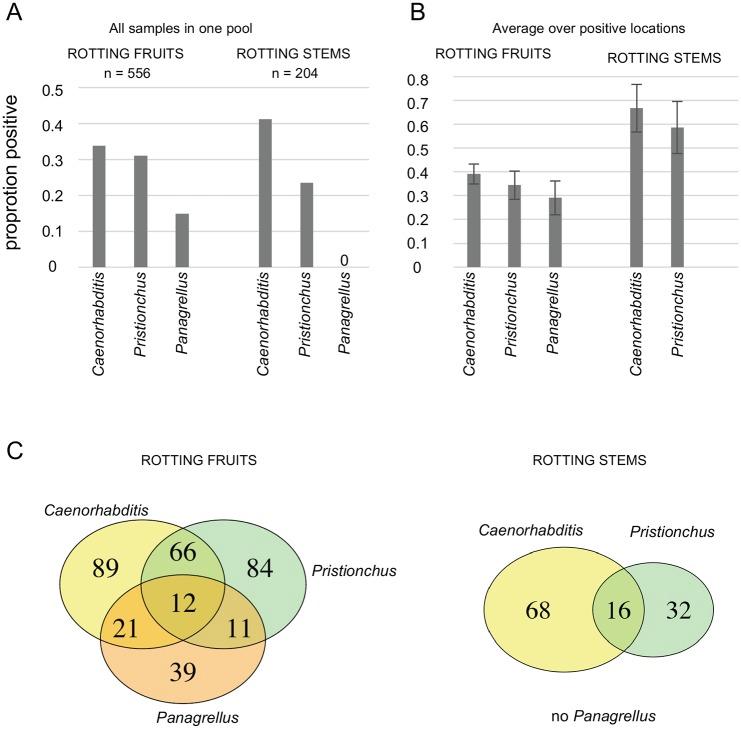
棘头虫常在各种腐烂的植物基质中频繁出现,并不专门以腐肉为食,而蒲螨则专门存在于腐烂的水果中。
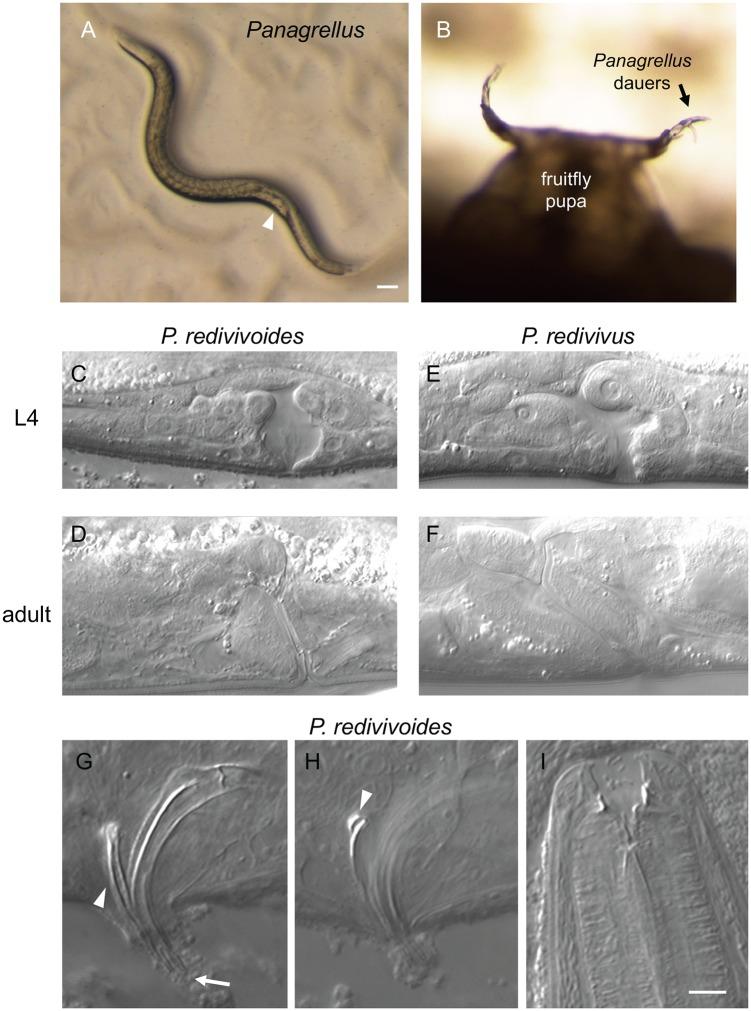
Pristionchus nematodes occur frequently in diverse rotting vegetal substrates and are not exclusively necromenic, while Panagrellus redivivoides is found specifically in rotting fruits.
机构信息
Institut de Biologie de l'Ecole Normale Supérieure, Centre National de la Recherche Scientifique, Institut National de la Santé et de la Recherche Médicale, Paris, France.
Department of Biochemistry, University of Washington, Seattle, Washington, United States of America.
出版信息
PLoS One. 2018 Aug 3;13(8):e0200851. doi: 10.1371/journal.pone.0200851. eCollection 2018.
The lifestyle and feeding habits of nematodes are highly diverse. Several species of Pristionchus (Nematoda: Diplogastridae), including Pristionchus pacificus, have been reported to be necromenic, i.e. to associate with beetles in their dauer diapause stage and wait until the death of their host to resume development and feed on microbes in the decomposing beetle corpse. We review the literature and suggest that the association of Pristionchus to beetles may be phoretic and not necessarily necromenic. The view that Pristionchus nematodes have a necromenic lifestyle is based on studies that have sought Pristionchus only by sampling live beetles. By surveying for nematode genera in different types of rotting vegetal matter, we found Pristionchus spp. at a similar high frequency as Caenorhabditis, often in large numbers and in feeding stages. Thus, these Pristionchus species may feed in decomposing vegetal matter. In addition, we report that one species of Panagrellus (Nematoda: Panagrolaimidae), Panagrellus redivivoides, is found in rotting fruits but not in rotting stems, with a likely association with Drosophila fruitflies. Based on our sampling and the observed distribution of feeding and dauer stages, we propose a life cycle for Pristionchus nematodes and Panagrellus redivivoides that is similar to that of C. elegans, whereby they feed on the microbial blooms on decomposing vegetal matter and are transported between food patches by coleopterans for Pristionchus spp., fruitflies for Panagrellus redivivoides and isopods and terrestrial molluscs for C. elegans.
线虫的生活方式和饮食习惯非常多样化。已报道几种 Pristionchus(线虫:双道科),包括 Pristionchus pacificus,为腐生性的,即与 dauer 滞育阶段的甲虫相关联,并等待其宿主死亡后恢复发育并以分解甲虫尸体中的微生物为食。我们回顾了文献,并提出 Pristionchus 与甲虫的关联可能是寄生物,而不一定是腐生性的。认为 Pristionchus 线虫具有腐生性生活方式的观点是基于仅通过采样活甲虫来寻找 Pristionchus 的研究。通过对不同类型腐烂植物物质中的线虫属进行调查,我们发现 Pristionchus spp. 的出现频率与 Caenorhabditis 相似,通常数量很大且处于摄食阶段。因此,这些 Pristionchus 物种可能以分解的植物物质为食。此外,我们报告一种 Panagrellus(线虫:潘加罗利姆科),Panagrellus redivivoides,存在于腐烂的果实中,但不存在于腐烂的茎中,可能与果蝇有关。基于我们的采样和观察到的摄食和 dauer 阶段的分布,我们提出了 Pristionchus 线虫和 Panagrellus redivivoides 的生命周期,类似于 C. elegans 的生命周期,即在分解的植物物质上的微生物爆发中取食,并通过鞘翅目昆虫(对于 Pristionchus spp.)、果蝇(对于 Panagrellus redivivoides)和等足目动物和陆生软体动物(对于 C. elegans)在食物斑块之间运输。



 Zotero 插件