
ARMOR监测研究期间收集的眼部病原体的地理区域抗生素耐药率
Antibiotic Resistance Rates by Geographic Region Among Ocular Pathogens Collected During the ARMOR Surveillance Study.
作者信息
Asbell Penny A, Pandit Rahul T, Sanfilippo Christine M
机构信息
Cornea Service and Refractive Surgery Center, Icahn School of Medicine at Mount Sinai, New York, NY, USA.
Houston Methodist Eye Associates, Blanton Eye Institute, Houston, TX, USA.
出版信息
Ophthalmol Ther. 2018 Dec;7(2):417-429. doi: 10.1007/s40123-018-0141-y. Epub 2018 Aug 9.
INTRODUCTION
The Antibiotic Resistance Monitoring in Ocular micRoorganisms (ARMOR) study is an ongoing nationwide surveillance program that surveys in vitro antibiotic resistance rates and trends among ocular bacterial pathogens. We report resistance rates by geographic region for isolates collected from 2009 through 2016.
METHODS
Staphylococcus aureus, coagulase-negative staphylococci (CoNS), Streptococcus pneumoniae, Haemophilus influenzae, and Pseudomonas aeruginosa isolates from ocular infections were collected at clinical centers across the US and categorized by geographic region based on state. Minimum inhibitory concentrations (MICs) for various antibiotics were determined at a central laboratory, and isolates were classified as susceptible or resistant based on established breakpoints. Geographic differences in methicillin resistance among staphylococci were evaluated by χ test with multiple comparisons, whereas geographic differences in mean percentage antibiotic resistance were evaluated by one-way analyses of variance and Tukey's test.
RESULTS
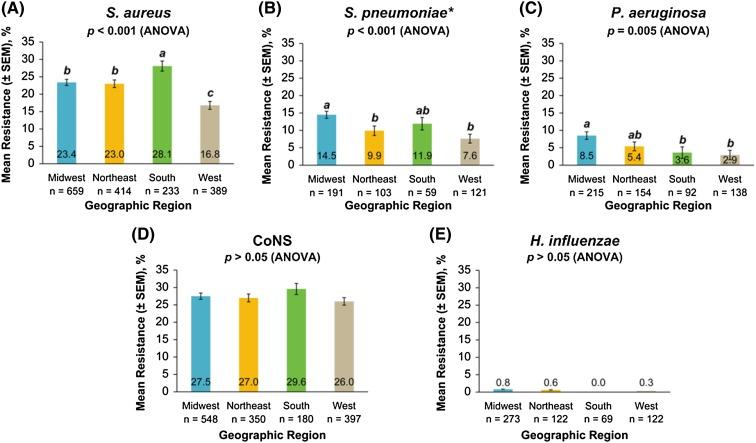
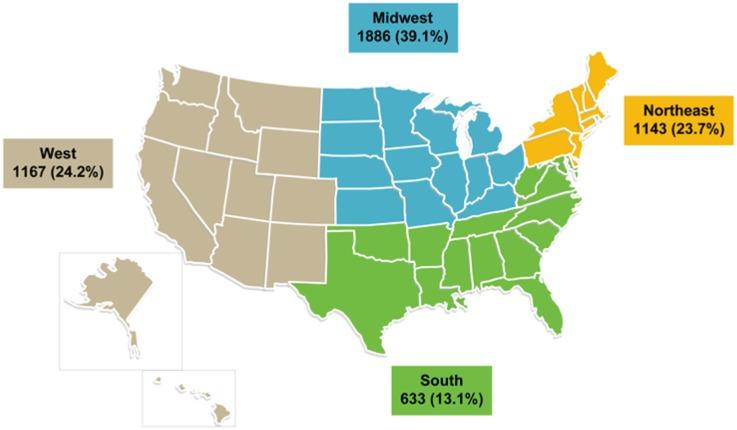
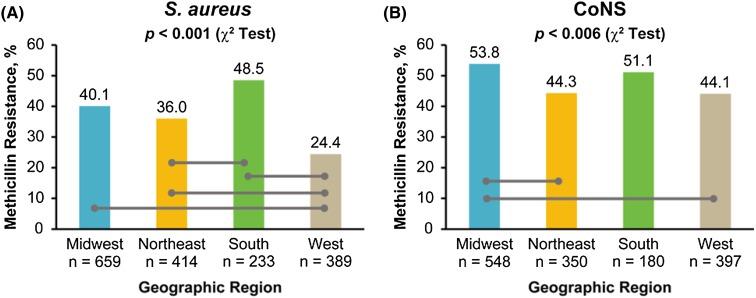
Overall, 4829 isolates (Midwest, 1886; West, 1167; Northeast, 1143; South, 633) were evaluated. Across all regions, azithromycin resistance was high among S. aureus (49.4-67.8%), CoNS (61.0-62.8%), and S. pneumoniae (22.3-48.7%), whereas fluoroquinolone resistance ranged from 26.1% to 47.8% among S. aureus and CoNS. Across all regions, all staphylococci were susceptible to vancomycin; besifloxacin MICs were similar to those of vancomycin. Geographic differences were observed for overall mean resistance among S. aureus, S. pneumoniae, and P. aeruginosa isolates (p ≤ 0.005); no regional differences were found among CoNS and H. influenzae isolates. Methicillin resistance in particular was higher among S. aureus isolates from the South and CoNS isolates from the Midwest (p ≤ 0.006).
CONCLUSION
This analysis of bacterial isolates from the ARMOR study demonstrated geographic variation in resistance rates among ocular isolates, with greater in vitro resistance apparent in the South and Midwest for some organisms. These data may inform clinicians in selecting appropriate treatment options for ocular infections.
FUNDING
Bausch & Lomb, Inc.
引言
眼部微生物抗生素耐药性监测(ARMOR)研究是一项正在进行的全国性监测项目,旨在调查眼部细菌病原体的体外抗生素耐药率及趋势。我们报告了2009年至2016年期间按地理区域划分的分离株耐药率。
方法
从美国各地临床中心收集眼部感染的金黄色葡萄球菌、凝固酶阴性葡萄球菌(CoNS)、肺炎链球菌、流感嗜血杆菌和铜绿假单胞菌分离株,并根据所在州按地理区域进行分类。在一个中央实验室测定各种抗生素的最低抑菌浓度(MIC),并根据既定的断点将分离株分类为敏感或耐药。通过χ检验和多重比较评估葡萄球菌中甲氧西林耐药性的地理差异,而通过单因素方差分析和Tukey检验评估平均抗生素耐药百分比的地理差异。
结果
总体上,共评估了4829株分离株(中西部地区1886株;西部地区1167株;东北部地区1143株;南部地区633株)。在所有地区,金黄色葡萄球菌(49.4%-67.8%)、CoNS(61.0%-62.8%)和肺炎链球菌(22.3%-48.7%)对阿奇霉素的耐药率较高,而金黄色葡萄球菌和CoNS对氟喹诺酮类药物的耐药率在26.1%至47.8%之间。在所有地区,所有葡萄球菌对万古霉素敏感;贝西沙星的MIC与万古霉素相似。在金黄色葡萄球菌、肺炎链球菌和铜绿假单胞菌分离株的总体平均耐药性方面观察到地理差异(p≤0.005);在CoNS和流感嗜血杆菌分离株中未发现区域差异。特别是来自南部的金黄色葡萄球菌分离株和来自中西部的CoNS分离株的甲氧西林耐药性较高(p≤0.006)。
结论
对ARMOR研究中的细菌分离株进行的这项分析表明,眼部分离株的耐药率存在地理差异,对于某些微生物,南部和中西部地区的体外耐药性更为明显。这些数据可为临床医生选择眼部感染的合适治疗方案提供参考。
资金来源
博士伦公司
 Zotero 插件