
全基因组规模分析以鉴定胰十二指肠切除术后早期胰腺导管腺癌患者的预后微小RNA生物标志物。
Genome-scale analysis to identify prognostic microRNA biomarkers in patients with early stage pancreatic ductal adenocarcinoma after pancreaticoduodenectomy.
作者信息
Liao Xiwen, Wang Xiangkun, Huang Ketuan, Yang Chengkun, Yu Tingdong, Han Chuangye, Zhu Guangzhi, Su Hao, Huang Rui, Peng Tao
机构信息
Department of Hepatobiliary Surgery, The First Affiliated Hospital of Guangxi Medical University, Nanning 530021, Guangxi Zhuang Autonomous Region, People's Republic of China,
Department of Hematology, The First Affiliated Hospital of Guangxi Medical University, Nanning 530021, Guangxi Zhuang Autonomous Region, People's Republic of China.
出版信息
Cancer Manag Res. 2018 Aug 10;10:2537-2551. doi: 10.2147/CMAR.S168351. eCollection 2018.
BACKGROUND
The aim of the study was to investigate potential prognostic microRNA (miRNA) biomarkers for patients with early stage pancreatic ductal adenocarcinoma (PDAC) after pancreaticoduodenectomy using a miRNA-sequencing (miRNA-seq) data set from The Cancer Genome Atlas (TCGA). A miRNA expression-based prognostic signature was generated, and the potential role of target genes in overall survival (OS) in patients with PDAC was examined.
METHODS
A miRNA-seq data set of 112 PDAC patients who underwent pancreaticoduodenectomy was obtained from TCGA. Survival analysis was performed to identify potential prognostic biomarkers.
RESULTS
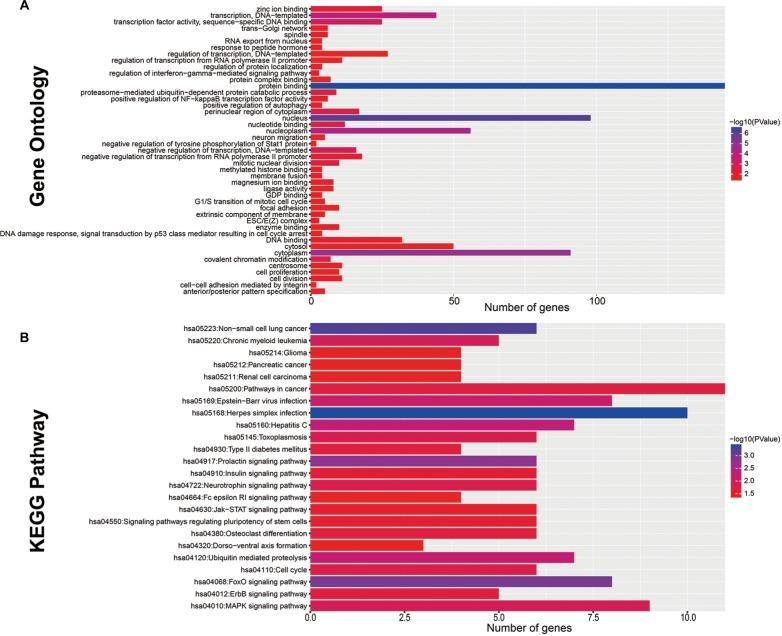
Eleven miRNAs (hsa-mir-501, hsa-mir-4521, hsa-mir-5091, hsa-mir-24-1, hsa-mir-126, hsa-mir-30e, hsa-mir-3157, hsa-let-7a-3, hsa-mir-133a-1, hsa-mir-4709, and hsa-mir-421) were used to construct a prognostic signature using the step function. The 11-miRNA prognostic signature showed good performance for prognosis prediction (adjusted <0.0001, adjusted hazard ratio =4.285, 95% confidence interval =2.146-8.554), and the time-dependent receiver operating characteristic analysis showed an area under the curve of 0.864, 0.877, and 0.787 for 1-, 2-, and 3-year PDAC OS predictions, respectively. Comprehensive survival analysis suggested that the prognostic signature could serve as an independent prognostic factor for PDAC OS and performs better in prognosis prediction than other traditional clinical indicators. Functional assessment of the target genes of the miRNAs indicated that they were significantly enriched in multiple biological processes and pathways, including cell proliferation, cell cycle biological processes, the forkhead box O, mitogen-activated protein kinase, Janus kinase/signal transducers and activators of transcription signaling pathways, pathways in cancer, and the ErbB signaling pathway. Several target genes of these miRNAs were also associated with PDAC OS.
CONCLUSION
The present study identified a novel miRNA expression signature that showed potential as a prognostic biomarker for PDAC after pancreaticoduodenectomy.
背景
本研究旨在利用来自癌症基因组图谱(TCGA)的miRNA测序(miRNA-seq)数据集,调查胰十二指肠切除术后早期胰腺导管腺癌(PDAC)患者潜在的预后微小RNA(miRNA)生物标志物。生成了基于miRNA表达的预后特征,并研究了靶基因在PDAC患者总生存期(OS)中的潜在作用。
方法
从TCGA获得了112例行胰十二指肠切除术的PDAC患者的miRNA-seq数据集。进行生存分析以识别潜在的预后生物标志物。
结果
使用逐步函数,利用11种miRNA(hsa-mir-501、hsa-mir-4521、hsa-mir-5091、hsa-mir-24-1、hsa-mir-126、hsa-mir-30e、hsa-mir-3157、hsa-let-7a-3、hsa-mir-133a-1、hsa-mir-4709和hsa-mir-421)构建了一个预后特征。该11-miRNA预后特征在预后预测方面表现良好(校正P值<0.0001,校正风险比=4.285,95%置信区间=2.146-8.554),并且时间依赖性受试者工作特征分析显示,对于1年、2年和3年PDAC OS预测,曲线下面积分别为0.864、0.877和0.787。综合生存分析表明,该预后特征可作为PDAC OS的独立预后因素,并且在预后预测方面比其他传统临床指标表现更好。对这些miRNA靶基因的功能评估表明,它们在多个生物学过程和途径中显著富集,包括细胞增殖、细胞周期生物学过程、叉头框O、丝裂原活化蛋白激酶、Janus激酶/信号转导子和转录激活子信号通路、癌症中的途径以及ErbB信号通路。这些miRNA的几个靶基因也与PDAC OS相关。
结论
本研究鉴定出一种新的miRNA表达特征,其显示出作为胰十二指肠切除术后PDAC预后生物标志物的潜力。




 Zotero 插件