
德克萨斯州青少年对香烟、电子烟、雪茄和水烟易感性的测量及预测价值。
Measurement and predictive value of susceptibility to cigarettes, e-cigarettes, cigars, and hookah among Texas adolescents.
作者信息
Carey Felicia R, Wilkinson Anna V, Harrell Melissa B, Cohn Elisabeth A, Perry Cheryl L
机构信息
Michael & Susan Dell Center for Healthy Living, University of Texas Health Science Center at Houston, School of Public Health in Austin, 1616 Guadalupe St, Suite 6.300, Austin, TX 78701, United States of America.
出版信息
Addict Behav Rep. 2018 Aug 18;8:95-101. doi: 10.1016/j.abrep.2018.08.005. eCollection 2018 Dec.
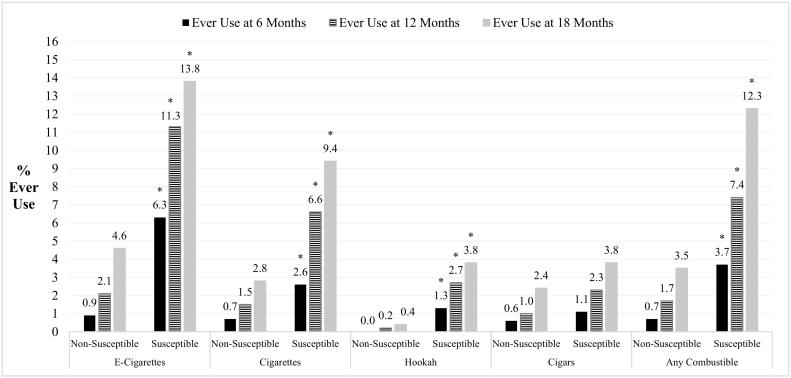
Susceptibility to cigarette smoking, defined as the lack of a firm commitment not to smoke in the future, begins in childhood and is a phase in the transition from never to ever use of cigarettes. While a consistent and validated predictor of cigarette use, little research has assessed whether the susceptibility construct applies equally well across other tobacco products. Baseline data were collected in 2014-2015 from a representative sample of ( = 2844) middle and high school students in five counties surrounding the four largest cities in Texas, (49% female and mean age 13.13 years, with subsequent waves at 6, 12, and 18 months. Confirmatory factor analysis examined the appropriateness of a three-item susceptibility measure (product-specific curiosity, intention to use, and peer influence) across product types and ethnic groups (Hispanic versus non-Hispanic). Logistic regression examined whether product specific susceptibility at baseline predicted future product initiation. At baseline, 11.5%, 17.0%, 17.4% and 29.4%, of adolescent never users were susceptible to cigars, cigarettes, hookah and e-cigarettes, respectively; significantly more Hispanic than non-Hispanic adolescents were susceptible to e-cigarettes (32.4% versus 26%, < 0.01) and cigarettes (19.9% versus 13.9%, < 0.05). Product-specific items were significantly and consistently associated with the respective underlying susceptibility product construct and across ethnic groups ( < 0.001 for all). Susceptibility to e-cigarettes (AOR = 2.28-6.64) or any combustible product (cigarettes, hookah, cigars; AOR = 3.38-5.20) significantly predicted subsequent ever use. This study confirms the appropriateness of the susceptibility construct across four tobacco product types and ethnic groups, and the utility of susceptibility in predicting future product use among adolescents.
对吸烟的易感性定义为未来没有坚决不吸烟的承诺,始于童年时期,是从不吸烟到开始吸烟转变过程中的一个阶段。虽然它是吸烟行为的一个一致且经过验证的预测指标,但很少有研究评估这种易感性结构是否同样适用于其他烟草制品。2014 - 2015年从得克萨斯州四大城市周边五个县的2844名中学生代表性样本中收集了基线数据(49%为女性,平均年龄13.13岁,随后在6个月、12个月和18个月进行随访)。验证性因素分析检验了一个三项易感性测量指标(特定产品好奇心、使用意图和同伴影响)在不同产品类型和种族群体(西班牙裔与非西班牙裔)中的适用性。逻辑回归分析检验了基线时特定产品的易感性是否能预测未来开始使用该产品。在基线时,从不吸烟的青少年中,分别有11.5%、17.0%、17.4%和29.4%对雪茄、香烟、水烟和电子烟易感;西班牙裔青少年比非西班牙裔青少年更容易对电子烟(32.4%对26%,P<0.01)和香烟(19.9%对13.9%,P<0.05)易感。特定产品项目与各自潜在的易感性产品结构以及不同种族群体之间存在显著且一致的关联(所有P<0.001)。对电子烟的易感性(比值比[AOR]=2.28 - 6.64)或任何可燃产品(香烟、水烟、雪茄;AOR = 3.38 - 5.20)显著预测了随后的吸烟行为。本研究证实了易感性结构在四种烟草产品类型和种族群体中的适用性,以及易感性在预测青少年未来产品使用方面的效用。
 Zotero 插件