
成人数字视觉模拟量表疼痛评分与传统纸质视觉模拟量表的验证
Validation of Digital Visual Analog Scale Pain Scoring With a Traditional Paper-based Visual Analog Scale in Adults.
作者信息
Delgado Domenica A, Lambert Bradley S, Boutris Nickolas, McCulloch Patrick C, Robbins Andrew B, Moreno Michael R, Harris Joshua D
机构信息
Houston Methodist Hospital, Houston, TX (Ms. Delgado, Dr. Lambert, Dr. Boutris, Dr. McCulloch, Dr. Moreno, and Dr. Harris), and Texas A&M University, College Station, TX (Dr. Lambert, Mr. Robbins, and Dr. Moreno).
出版信息
J Am Acad Orthop Surg Glob Res Rev. 2018 Mar 23;2(3):e088. doi: 10.5435/JAAOSGlobal-D-17-00088. eCollection 2018 Mar.
BACKGROUND
The visual analog scale (VAS) is a validated, subjective measure for acute and chronic pain. Scores are recorded by making a handwritten mark on a 10-cm line that represents a continuum between "no pain" and "worst pain."
METHODS
One hundred consecutive patients aged ≥18 years who presented with a chief complaint of pain were asked to record pain scores via a paper VAS and digitally via both the laptop computer and mobile phone. Ninety-eight subjects, 51 men (age, 44 ± 16 years) and 47 women (age, 46 ± 15 years), were included. A mixed-model analysis of covariance with the Bonferroni post hoc test was used to detect differences between the paper and digital VAS scores. A Bland-Altman analysis was used to test for instrument agreement between the platforms. The minimal clinically important difference was set at 1.4 cm (14% of total scale length) for detecting clinical relevance between the three VAS platforms. A paired one-tailed Student -test was used to determine whether differences between the digital and paper measurement platforms exceeded 14% ( < 0.05).
RESULTS
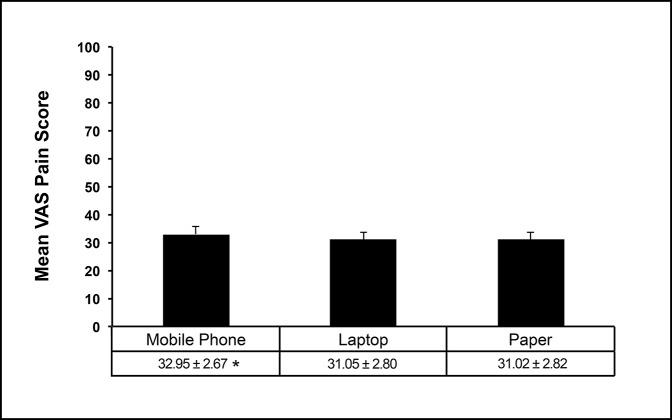
A significant difference in scores was found between the mobile phone-based (32.9% ± 0.4%) and both the laptop computer- and paper-based platforms (31.0% ± 0.4%, < 0.01 for both). These differences were not clinically relevant (minimal clinically important difference <1.4 cm). No statistically significant difference was observed between the paper and laptop computer platforms. Measurement agreement was found between the paper- and laptop computer-based platforms (mean difference, 0.0% ± 0.5%; no proportional bias detected) but not between the paper- and mobile phone-based platforms (mean difference, 1.9% ± 0.5%; proportional bias detected).
CONCLUSION
No clinically relevant difference exists between the traditional paper-based VAS assessment and VAS scores obtained from laptop computer- and mobile phone-based platforms.
背景
视觉模拟评分法(VAS)是一种经过验证的用于评估急慢性疼痛的主观测量方法。通过在一条10厘米长的线上手写标记来记录分数,该线代表从“无疼痛”到“最剧烈疼痛”的连续区间。
方法
连续纳入100例年龄≥18岁、以疼痛为主诉的患者,要求他们通过纸质VAS以及通过笔记本电脑和手机以数字方式记录疼痛评分。纳入了98名受试者,其中51名男性(年龄44±16岁)和47名女性(年龄46±15岁)。采用协方差混合模型分析并结合Bonferroni事后检验来检测纸质和数字VAS评分之间的差异。采用Bland-Altman分析来检验各平台之间的仪器一致性。将最小临床重要差异设定为1.4厘米(占总刻度长度的14%),以检测三个VAS平台之间的临床相关性。采用配对单尾学生t检验来确定数字测量平台和纸质测量平台之间的差异是否超过14%(P<0.05)。
结果
发现基于手机的平台(32.9%±0.4%)与基于笔记本电脑和纸质的平台(均为31.0%±0.4%,两者P<0.01)之间的评分存在显著差异。但这些差异无临床相关性(最小临床重要差异<1.4厘米)。在纸质和笔记本电脑平台之间未观察到统计学上的显著差异。在基于纸质和笔记本电脑的平台之间发现测量一致性(平均差异,0.0%±0.5%;未检测到比例偏差),但在基于纸质和手机的平台之间未发现测量一致性(平均差异,1.9%±0.5%;检测到比例偏差)。
结论
传统的纸质VAS评估与从笔记本电脑和手机平台获得的VAS评分之间不存在临床相关差异。



 Zotero 插件