
静电纺丝的 PCL/莫匹罗星和壳聚糖/盐酸利多卡因多功能双层纳米纤维支架,用于伤口敷料应用。
Electrospun PCL/mupirocin and chitosan/lidocaine hydrochloride multifunctional double layer nanofibrous scaffolds for wound dressing applications.
机构信息
Department 4, State Key Laboratory of Trauma, Burns and Combined Injury, Institute of Surgery Research, Daping Hospital, Army Medical University, Chongqing 400042, China,
Department of Pediatric Intensive Care Unit, Children's Hospital of Chongqing Medical University, Ministry of Education Key Laboratory of Child Development and Disorders, Chongqing 400014, China.
出版信息
Int J Nanomedicine. 2018 Sep 10;13:5287-5299. doi: 10.2147/IJN.S177256. eCollection 2018.
BACKGROUND
An ideal wound dressing should exhibit good biocompatibility, minimize pain and infection, absorb excess exudates, and maintain a moist environment. However, few clinical products meet all these needs. Therefore, the aim of this study was to fabricate a multifunctional double layer nanofibrous scaffolds (DLS) as a potential material for wound dressing.
MATERIALS AND METHODS
The scaffold was formed from mupirocin and lidocaine hydrochloride homogeneously incorporated into polycaprolactone as the first layer of scaffolds and chitosan as the second layer of scaffolds nanofibers through electrospinning. The fabricated nanofibrous scaffolds were characterized by scanning electron microscopy, Fourier transform infrared spectroscopy, thermogravimetric analysis, differential scanning calorimetry, and measurement of swelling ratio, contact angle, drug release, and mechanical properties. Furthermore, antibacterial assessment, live/dead cell assays, and MTT assays were used to investigate the antibacterial activity and cytotoxicity of the nanofibrous scaffolds.
RESULTS
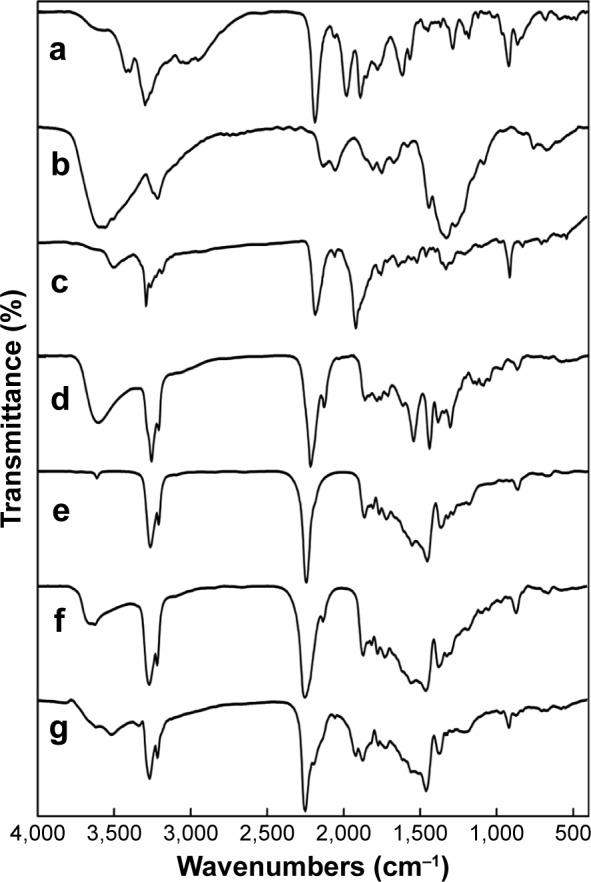
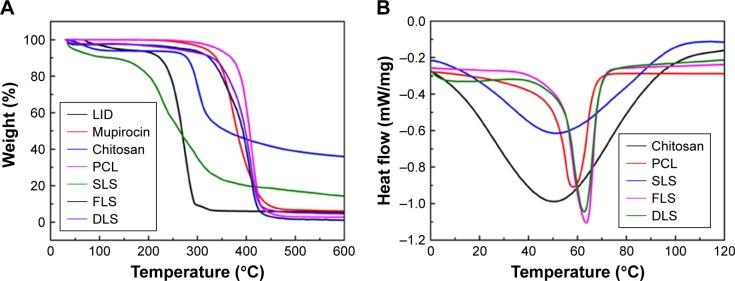
The morphology of the nanofibrous scaffolds was studied by scanning electron microscopy, showing successful nanofibrous scaffolds. Fourier transform infrared spectroscopy demonstrated the successful incorporation of the material used to produce the produced nanofibrous scaffolds. Thermal studies with thermogravimetric analysis and differential scanning calorimetry indicated that the DLS had high thermal stability. The DLS also showed good in vitro characteristics in terms of improved swelling ratio and contact angle. The mechanical results revealed that the DLS had an improved tensile strength of 3.88 MPa compared with the second layer of scaffold (2.81 MPa). The release of drugs from the scaffold showed different profiles for the two drugs. Lidocaine hydrochlo ride exhibited an initial burst release (66% release within an hour); however, mupirocin exhibited only a 5% release. Furthermore, the DLS nanofibers displayed highly effective antibacterial activities against , and and were nontoxic to fibroblasts.
CONCLUSION
The fabricated DLS exhibited excellent hydrophilicity, cytocompatibility, sustained drug release, and antibacterial activity, which are favorable qualities for its use as a multifunctional material for wound dressing applications.
背景
理想的伤口敷料应具有良好的生物相容性,最大限度地减少疼痛和感染,吸收过多的渗出物,并保持湿润的环境。然而,很少有临床产品能满足所有这些需求。因此,本研究的目的是制备一种多功能双层纳米纤维支架(DLS)作为伤口敷料的潜在材料。
材料和方法
支架由米诺环素和盐酸利多卡因均匀掺入聚己内酯形成第一层支架,壳聚糖形成第二层支架纳米纤维,通过静电纺丝形成。通过扫描电子显微镜、傅里叶变换红外光谱、热重分析、差示扫描量热法以及溶胀比、接触角、药物释放和机械性能的测量对所制备的纳米纤维支架进行了表征。此外,还采用抗菌评估、活/死细胞检测和 MTT 检测来研究纳米纤维支架的抗菌活性和细胞毒性。
结果
扫描电子显微镜研究了纳米纤维支架的形态,结果表明成功制备了纳米纤维支架。傅里叶变换红外光谱表明成功地将用于制备纳米纤维支架的材料掺入其中。热重分析和差示扫描量热法的热研究表明,DLS 具有较高的热稳定性。DLS 还在体外具有良好的特性,表现为改善的溶胀比和接触角。机械性能结果表明,DLS 的拉伸强度比第二层支架(2.81 MPa)提高了 3.88 MPa。支架中药物的释放呈现出两种不同的药物释放曲线。盐酸利多卡因在 1 小时内表现出初始突释(66%的药物释放);然而,米诺环素仅释放了 5%。此外,DLS 纳米纤维对 、 和 具有高度有效的抗菌活性,对成纤维细胞无毒。
结论
所制备的 DLS 具有优异的亲水性、细胞相容性、持续的药物释放和抗菌活性,这使其成为多功能伤口敷料应用的潜在材料。




 Zotero 插件