
丙泊酚/瑞芬太尼全凭静脉麻醉与七氟醚吸入麻醉对乳腺癌手术后VEGF-C和TGF-β释放及预后的影响:一项前瞻性、随机对照研究
Effects of propofol/remifentanil-based total intravenous anesthesia versus sevoflurane-based inhalational anesthesia on the release of VEGF-C and TGF-β and prognosis after breast cancer surgery: a prospective, randomized and controlled study.
作者信息
Yan Tao, Zhang Guo-Hua, Wang Bao-Na, Sun Li, Zheng Hui
机构信息
Department of Anesthesiology, National Cancer Center/National Clinical Research Center for Cancer/Cancer Hospital, Chinese Academy of Medical Sciences and Peking Union Medical College, No.17 Pan-Jia-Yuan nanli Road, Chaoyang District, Beijing, 100021, China.
出版信息
BMC Anesthesiol. 2018 Sep 22;18(1):131. doi: 10.1186/s12871-018-0588-3.
BACKGROUND
Vascular endothelial growth factor (VEGF) and transforming growth factor-β (TGF-β) have been involved in tumor growth and metastasis. Sevoflurane may promote angiogenesis, whereas propofol can present an anti-angiogenic effect. In this study, we compared the effects of propofol/remifentanil-based total intravenous anesthesia (TIVA) and sevoflurane-based inhalational anesthesia on the release of VEGF-C and TGF-β, as well as recurrence- free survival (RFS) rates in the patients undergoing breast cancer surgery.
METHODS
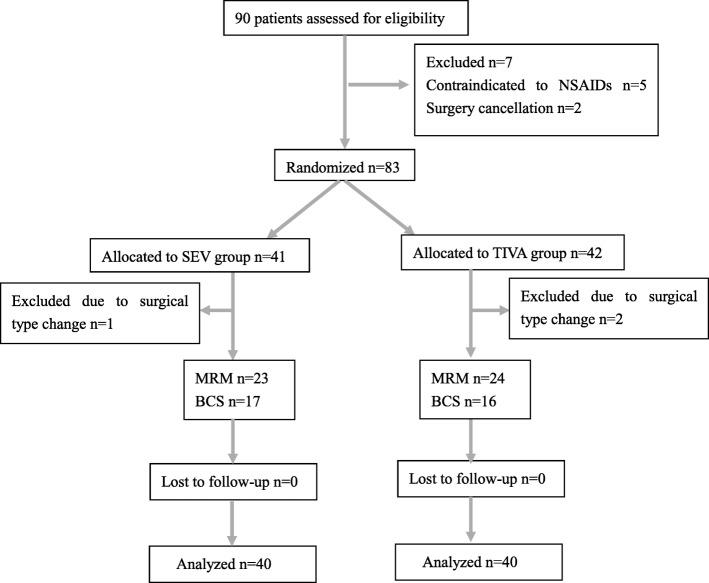
Eighty female patients undergoing breast cancer resection were enrolled and randomized to receive either sevoflurane-based inhalational anesthesia (SEV group) or propofol/remifentanil-based TIVA (TIVA group). The serum concentrations of VEGF-C and TGF-β before and 24 h after surgery were measured and RFS rates over a two-year follow-up were analyzed in both groups. The postoperative pain scores assessed using a visual analogue scale (VAS) and the use of perioperative opioids were also evaluated.
RESULTS
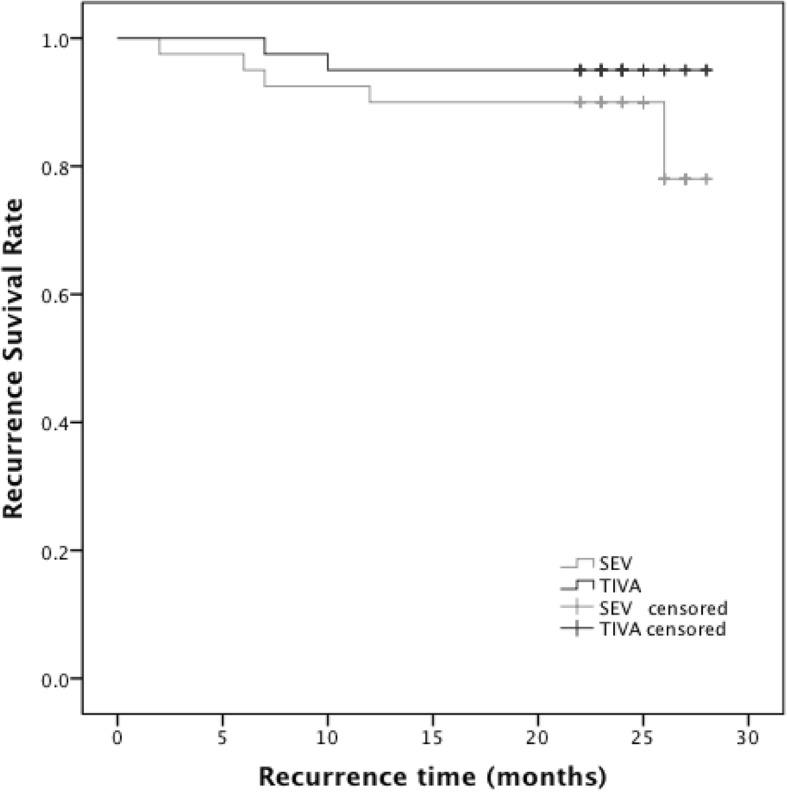
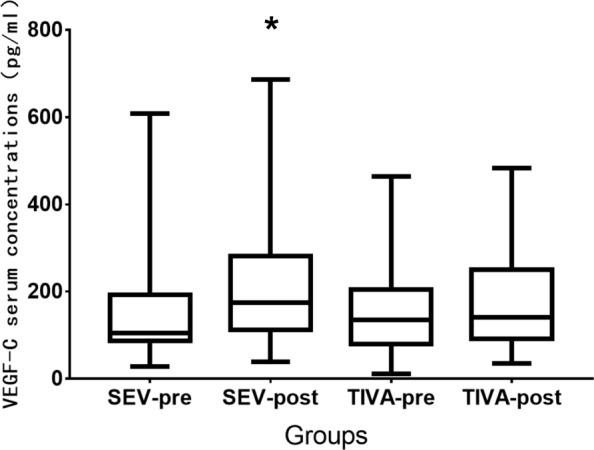
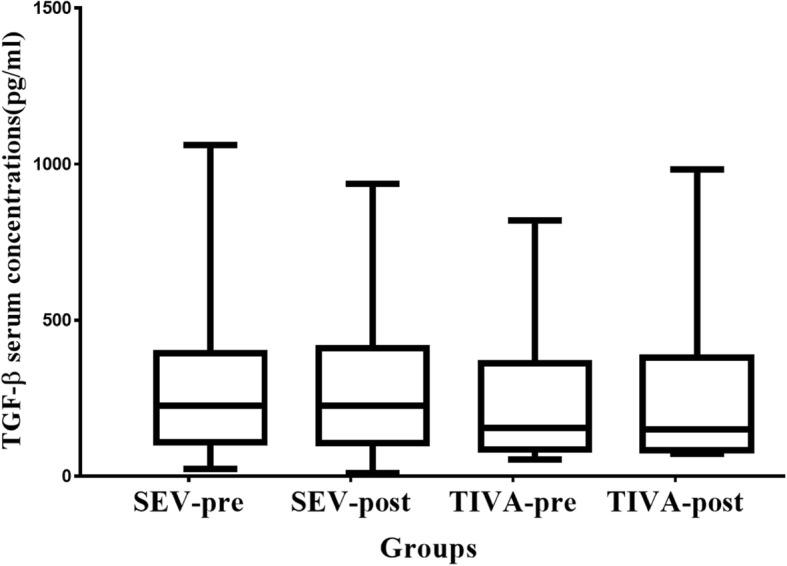
Although VAS scores at 2 h and 24 h after surgery were comparable between the two groups, there were more patients receiving postoperative fentanyl in the TIVA group (16[40%]) compared with the SEV group (6[15%], p = 0.023). VEGF-C serum concentrations increased after surgery from 105 (87-193) pg/ml to174 (111-281) pg/ml in the SEV group (P = 0.009), but remained almost unchanged in the TIVA group with 134 (80-205) pg/ml vs.140(92-250) pg/ml(P = 0.402). The preoperative to postoperative change for VEGF-C of the SEV group (50 pg/ml) was significantly higher than that of the TIVA group (12 pg/ml) with a difference of 46 (- 11-113) pg/ml (P = 0.008). There were also no significant differences in the preoperative and postoperative TGF-β concentrations between the two groups. The two-year RFS rates were 78% and 95% in the SEV and TIVA groups (P = 0.221), respectively.
CONCLUSION
In comparison with sevoflurane-based inhalational anesthesia, propofol/remifentanil -based total intravenous anesthesia can effectively inhibit the release of VEGF-C induced by breast surgery, but didn't seem to be beneficial in the short-term recurrence rate of breast cancer.
TRIAL REGISTRATION
Chictr.org.cn ChiCTR1800017910 . Retrospectively Registered (Date of registration: August 20, 2018).
背景
血管内皮生长因子(VEGF)和转化生长因子-β(TGF-β)与肿瘤生长和转移有关。七氟醚可能促进血管生成,而丙泊酚具有抗血管生成作用。在本研究中,我们比较了丙泊酚/瑞芬太尼全静脉麻醉(TIVA)和七氟醚吸入麻醉对乳腺癌手术患者VEGF-C和TGF-β释放以及无复发生存率(RFS)的影响。
方法
80例行乳腺癌切除术的女性患者入组并随机分为七氟醚吸入麻醉组(SEV组)或丙泊酚/瑞芬太尼TIVA组(TIVA组)。测量手术前和术后24小时血清VEGF-C和TGF-β浓度,并分析两组患者两年随访期间的RFS率。还评估了使用视觉模拟量表(VAS)评估的术后疼痛评分以及围手术期阿片类药物的使用情况。
结果
虽然两组术后2小时和24小时的VAS评分相当,但TIVA组(16例[40%])接受术后芬太尼的患者比SEV组(6例[15%])更多(P = 0.023)。SEV组术后VEGF-C血清浓度从105(87-193)pg/ml增加到174(111-281)pg/ml(P = 0.009),而TIVA组几乎保持不变,分别为134(80-205)pg/ml和140(92-250)pg/ml(P = 0.402)。SEV组VEGF-C术前至术后变化(50 pg/ml)显著高于TIVA组(12 pg/ml),差异为46(-11-113)pg/ml(P = 0.008)。两组术前和术后TGF-β浓度也无显著差异。SEV组和TIVA组的两年RFS率分别为78%和95%(P = 0.221)。
结论
与七氟醚吸入麻醉相比,丙泊酚/瑞芬太尼全静脉麻醉可有效抑制乳腺癌手术诱导的VEGF-C释放,但似乎对乳腺癌短期复发率无益处。
试验注册
Chictr.org.cn ChiCTR1800017910。回顾性注册(注册日期:2018年8月20日)。
 Zotero 插件