
三线以内化疗治疗方案对转移性结直肠癌的疗效比较
Comparative Effectiveness of Up To Three Lines of Chemotherapy Treatment Plans for Metastatic Colorectal Cancer.
作者信息
Toumazis Iakovos, Kurt Murat, Toumazi Artemis, Karacosta Loukia G, Kwon Changhyun
机构信息
Department of Radiology, Stanford University, Stanford, California (IT, LGK).
Economic and Data Sciences, Merck Research Labs, North Wales, Pennsylvania (MK).
出版信息
MDM Policy Pract. 2017 Aug 30;2(2):2381468317729650. doi: 10.1177/2381468317729650. eCollection 2017 Jul-Dec.
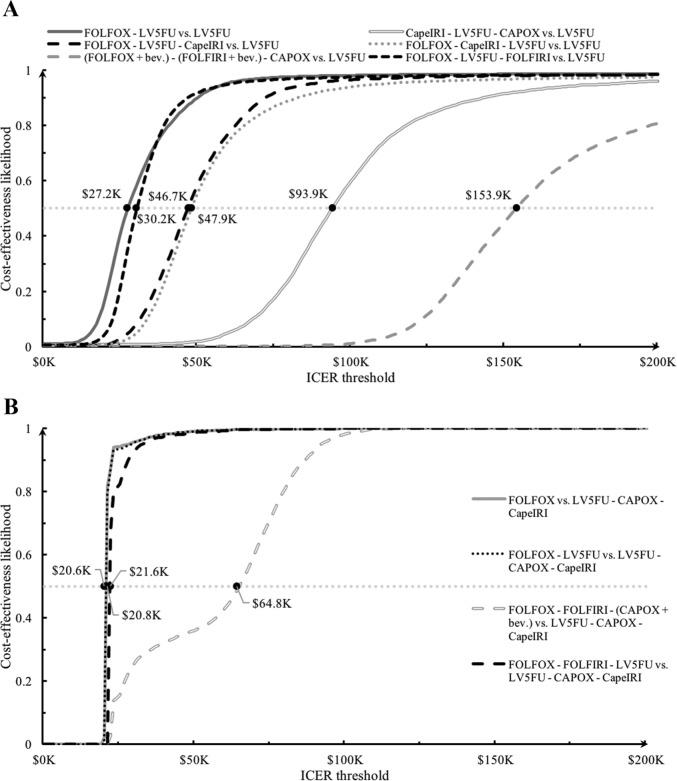
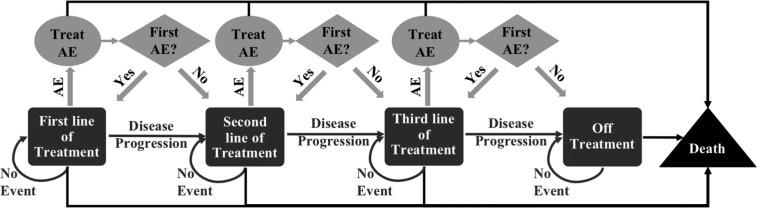
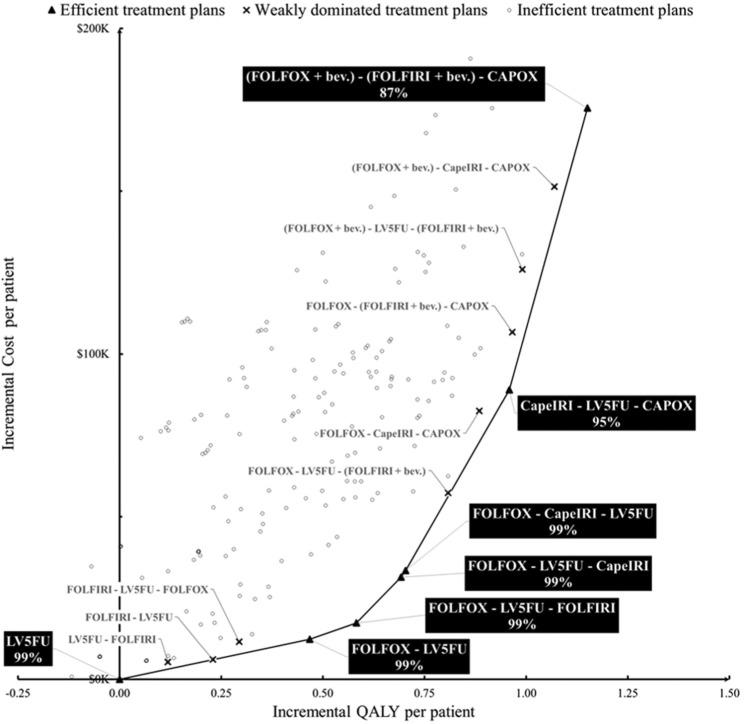
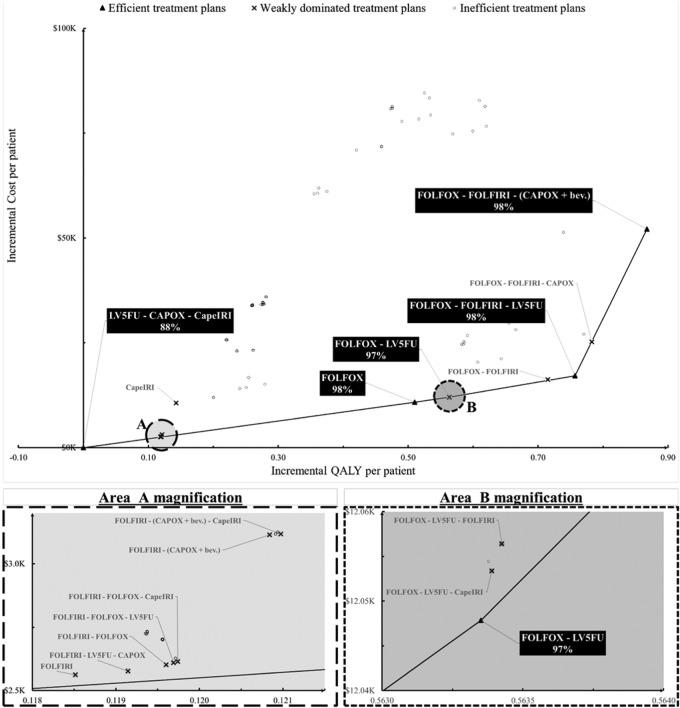
Modern chemotherapy agents transformed standard care for metastatic colorectal cancer (mCRC) but raised concerns about the financial burden of the disease. We studied comparative effectiveness of treatment plans that involve up to three lines of therapies and impact of treatment sequencing on health and cost outcomes. We employed a Markov model to represent the dynamically changing health status of mCRC patients and used Monte-Carlo simulation to evaluate various treatment plans consistent with existing guidelines. We calibrated our model by a meta-analysis of published data from an extensive list of clinical trials and measured the effectiveness of each plan in terms of cost per quality-adjusted life year. We examined the sensitivity of our model and results with respect to key parameters in two scenarios serving as base case and worst case for patients' overall and progression-free survivals. The derived efficient frontiers included seven and five treatment plans in base case and worst case, respectively. The incremental cost-effectiveness ratio (ICER) ranged between $26,260 and $152,530 when the treatment plans on the efficient frontiers were compared against the least costly efficient plan in the base case, and between $21,256 and $60,040 in the worst case. All efficient plans were expected to lead to fewer than 2.5 adverse effects and on average successive adverse effects were spaced more than 9 weeks apart from each other in the base case. Based on ICER, all efficient treatment plans exhibit at least 87% chance of being efficient. Sensitivity analyses show that the ICERs were most dependent on drug acquisition cost, distributions of progression-free and overall survivals, and health utilities. We conclude that improvements in health outcomes may come at high incremental costs and are highly dependent in the order treatments are administered.
现代化疗药物改变了转移性结直肠癌(mCRC)的标准治疗方案,但引发了对该疾病经济负担的担忧。我们研究了涉及多达三线治疗方案的治疗计划的比较有效性,以及治疗顺序对健康和成本结果的影响。我们采用马尔可夫模型来表示mCRC患者动态变化的健康状况,并使用蒙特卡洛模拟来评估与现有指南一致的各种治疗方案。我们通过对大量临床试验发表数据的荟萃分析来校准模型,并以每质量调整生命年的成本来衡量每个方案的有效性。我们在两种情景下,分别作为患者总生存期和无进展生存期的基础病例和最差病例,检验了模型和结果对关键参数的敏感性。在基础病例和最差病例中,得出的有效前沿分别包括七个和五个治疗方案。当将有效前沿上的治疗方案与基础病例中成本最低的有效方案进行比较时,增量成本效益比(ICER)在26,260美元至152,530美元之间,在最差病例中则在21,256美元至60,040美元之间。预计所有有效方案导致的不良反应少于2.5次,在基础病例中,平均连续不良反应之间的间隔超过9周。基于ICER,所有有效治疗方案至少有87%的概率是有效的。敏感性分析表明,ICER最依赖于药品采购成本、无进展生存期和总生存期的分布以及健康效用。我们得出结论,健康结果的改善可能伴随着高昂的增量成本,并且高度依赖于治疗的给药顺序。

 Zotero 插件