
青蒿琥酯-咯萘啶和双氢青蒿素-哌喹治疗巴布亚新几内亚无并发症疟疾的疗效。
Efficacy of artemether-lumefantrine and dihydroartemisinin-piperaquine for the treatment of uncomplicated malaria in Papua New Guinea.
机构信息
Papua New Guinea Institute of Medical Research, PO Box 378, Madang, Papua New Guinea.
Swiss Tropical and Public Health Institute, PO Box, 4002, Basel, Switzerland.
出版信息
Malar J. 2018 Oct 5;17(1):350. doi: 10.1186/s12936-018-2494-z.
BACKGROUND
In 2009, the Papua New Guinea (PNG) Department of Health adopted artemether-lumefantrine (AL) and dihydroartemisinin-piperaquine (DHA-PPQ) as the first- and second-line treatments for uncomplicated malaria, respectively. This study was conducted to assess the efficacy of both drugs following adoption of the new policy.
METHODS
Between June 2012 and September 2014, a therapeutic efficacy study was conducted in East Sepik and Milne Bay Provinces of PNG in accordance with the standard World Health Organization (WHO) protocol for surveillance of anti-malarial drug efficacy. Patients ≥ 6 months of age with microscopy confirmed Plasmodium falciparum or Plasmodium vivax mono-infections were enrolled, treated with AL or DHA-PPQ, and followed up for 42 days. Study endpoints were adequate clinical and parasitological response (ACPR) on days 28 and 42. The in vitro efficacy of anti-malarials and the prevalence of selected molecular markers of resistance were also determined.
RESULTS
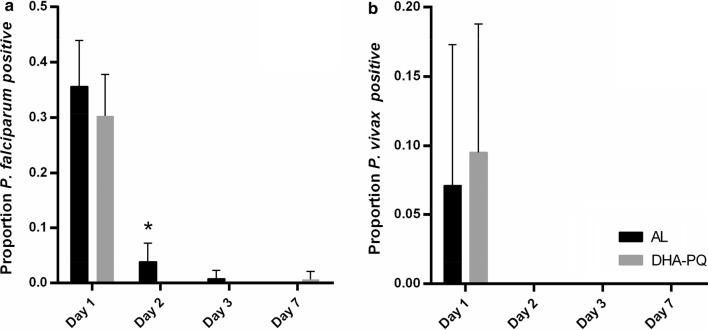
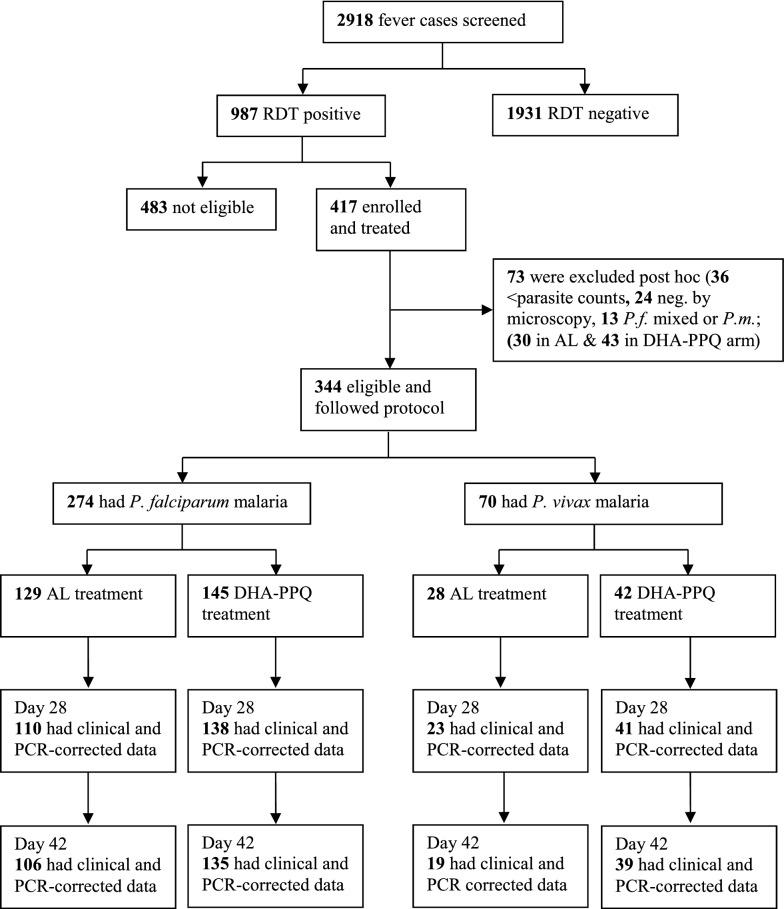
A total of 274 P. falciparum and 70 P. vivax cases were enrolled. The day-42 PCR-corrected ACPR for P. falciparum was 98.1% (104/106) for AL and 100% (135/135) for DHA-PPQ. The day-42 PCR-corrected ACPR for P. vivax was 79.0% (15/19) for AL and 92.3% (36/39) for DHA-PPQ. Day 3 parasite clearance of P. falciparum was 99.2% with AL and 100% with DHA-PPQ. In vitro testing of 96 samples revealed low susceptibility to chloroquine (34% of samples above IC threshold) but not to lumefantrine (0%). Molecular markers assessed in a sub-set of the study population indicated high rates of chloroquine resistance in P. falciparum (pfcrt SVMNT: 94.2%, n = 104) and in P. vivax (pvmdr1 Y976F: 64.8%, n = 54).
CONCLUSIONS
AL and DHA-PPQ were efficacious as first- and second-line treatments for uncomplicated malaria in PNG. Continued in vivo efficacy monitoring is warranted considering the threat of resistance to artemisinin and partner drugs in the region and scale-up of artemisinin-based combination therapy in PNG.
背景
2009 年,巴布亚新几内亚(PNG)卫生部分别采用青蒿琥酯-咯萘啶(AL)和双氢青蒿素-哌喹(DHA-PPQ)作为治疗无并发症疟疾的一线和二线药物。本研究旨在评估新政策实施后这两种药物的疗效。
方法
2012 年 6 月至 2014 年 9 月,按照世界卫生组织(WHO)监测抗疟药疗效标准方案,在东塞皮克和米尔恩湾省开展了一项疗效研究。纳入年龄≥6 个月、经显微镜证实为恶性疟原虫或间日疟原虫单感染的患者,分别给予 AL 或 DHA-PPQ 治疗,并随访 42 天。研究终点为第 28 天和第 42 天的适当临床和寄生虫学反应(ACPR)。还测定了抗疟药物的体外疗效和耐药性相关分子标记物的流行率。
结果
共纳入 274 例恶性疟原虫和 70 例间日疟原虫病例。第 42 天 PCR 校正的恶性疟原虫 ACPR 为 AL 组的 98.1%(104/106),DHA-PPQ 组为 100%(135/135)。第 42 天 PCR 校正的间日疟原虫 ACPR 为 AL 组的 79.0%(15/19),DHA-PPQ 组为 92.3%(36/39)。第 3 天 AL 组的疟原虫清除率为 99.2%,DHA-PPQ 组为 100%。对 96 份样本进行的体外检测显示,氯喹的敏感性较低(34%的样本高于 IC 阈值),但对青蒿琥酯没有影响。在研究人群的一个亚组中评估的分子标记物表明,恶性疟原虫(pfcrt SVMNT:94.2%,n=104)和间日疟原虫(pvmdr1 Y976F:64.8%,n=54)对氯喹的耐药率很高。
结论
AL 和 DHA-PPQ 作为 PNG 无并发症疟疾的一线和二线治疗药物是有效的。鉴于该地区青蒿素及其联合用药耐药性的威胁以及 PNG 地区青蒿素类复方疗法的扩大,需要继续进行体内疗效监测。
 Zotero 插件