
训练有素、适应生酮饮食的运动员的高胆固醇血症悖论。
Paradox of hypercholesterolaemia in highly trained, keto-adapted athletes.
作者信息
Creighton Brent C, Hyde Parker Neil, Maresh Carl M, Kraemer William J, Phinney Stephen D, Volek Jeff S
机构信息
Virta Health, San Francisco, California, USA.
Department of Human Sciences, The Ohio State University, Columbus, Ohio, USA.
出版信息
BMJ Open Sport Exerc Med. 2018 Oct 4;4(1):e000429. doi: 10.1136/bmjsem-2018-000429. eCollection 2018.
OBJECTIVE
A growing number of ultra-endurance athletes have switched to a very low-carbohydrate/high-fat eating pattern. We compared markers of cholesterol and the lipoprotein profile in a group of elite ultra-runners consuming a high-carbohydrate (HC) or low-carbohydrate (LC) diet.
METHODS
Fasting blood was obtained from competitive male ultra-endurance runners habitually consuming a very low-carbohydrate (LC; n=10) or high-carbohydrate (HC; n=10) diet to determine blood cholesterol profile, lipoprotein particle distribution and sterol biomarkers of cholesterol balance.
RESULTS
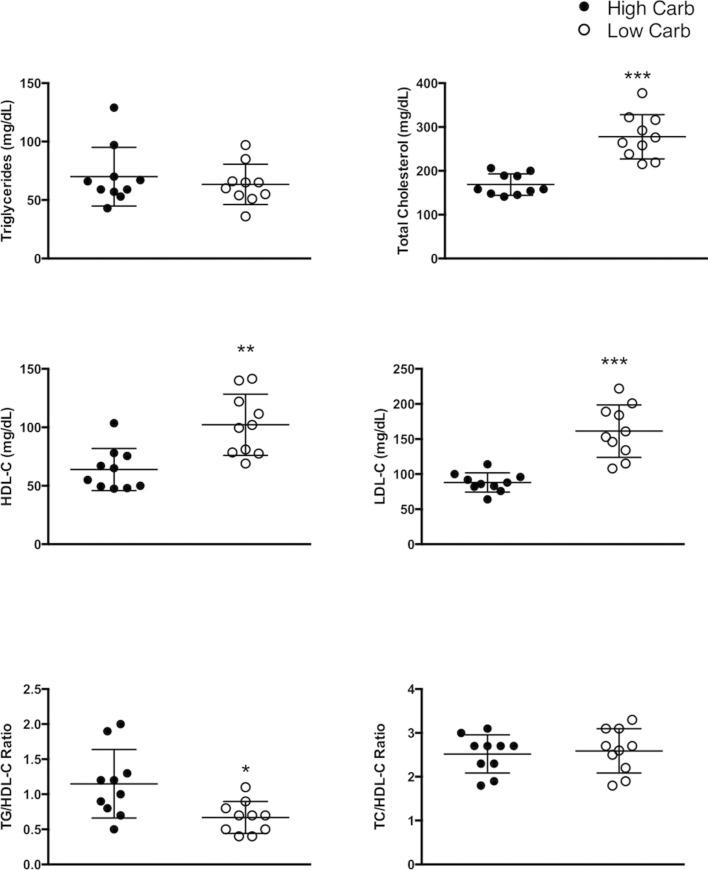
Plasma total cholesterol, low-density lipoprotein (LDL-C) and high-density lipoprotein (HDL-C) cholesterol were all significantly greater (p<0.000) in the LC group (65%, 83% and 60%, respectively). There were also significant differences in lipoprotein particle distribution as evidenced by a greater size and concentration of large HDL and LDL particles, and total LDL particle concentration was significantly greater in the LC group, but they had significantly fewer small LDL particles.
CONCLUSION
Ultra-endurance athletes habitually consuming a very low-carbohydrate/high-fat diet for over a year showed unique cholesterol profiles characterised by consistently higher plasma LDL-C and HDL-C, less small LDL particles, and lipoprotein profiles consistent with higher insulin sensitivity. There may be a functional purpose to the expansion of the circulating cholesterol pool to meet the heightened demand for lipid transport in highly trained, keto-adapted athletes.
目的
越来越多的超耐力运动员已转向极低碳水化合物/高脂肪的饮食模式。我们比较了一组食用高碳水化合物(HC)或低碳水化合物(LC)饮食的精英超级跑步运动员的胆固醇标志物和脂蛋白谱。
方法
从习惯性食用极低碳水化合物(LC;n = 10)或高碳水化合物(HC;n = 10)饮食的男性竞技超耐力跑步运动员中获取空腹血液,以确定血液胆固醇谱、脂蛋白颗粒分布和胆固醇平衡的固醇生物标志物。
结果
LC组的血浆总胆固醇、低密度脂蛋白(LDL-C)和高密度脂蛋白(HDL-C)胆固醇均显著更高(p < 0.000),分别高出65%、83%和60%。脂蛋白颗粒分布也存在显著差异,表现为大HDL和LDL颗粒的大小和浓度更大,LC组的总LDL颗粒浓度显著更高,但小LDL颗粒显著更少。
结论
习惯性食用极低碳水化合物/高脂肪饮食超过一年的超耐力运动员表现出独特的胆固醇谱,其特征是血浆LDL-C和HDL-C持续升高、小LDL颗粒减少,以及与更高胰岛素敏感性一致的脂蛋白谱。循环胆固醇池的扩大可能有功能性目的,以满足训练有素、适应生酮饮食的运动员对脂质运输增加的需求。
 Zotero 插件