
铜信号转导:病因与后果。
Copper signalling: causes and consequences.
机构信息
Functional Pharmacology Research Group, Institute of Organic Chemistry, Research Centre for Natural Sciences, Hungarian Academy of Sciences, Magyar Tudósok körútja 2, Budapest, 1117, Hungary.
Institute of Neurophysiology, Charité-Universitätsmedizin, Berlin, Germany.
出版信息
Cell Commun Signal. 2018 Oct 22;16(1):71. doi: 10.1186/s12964-018-0277-3.
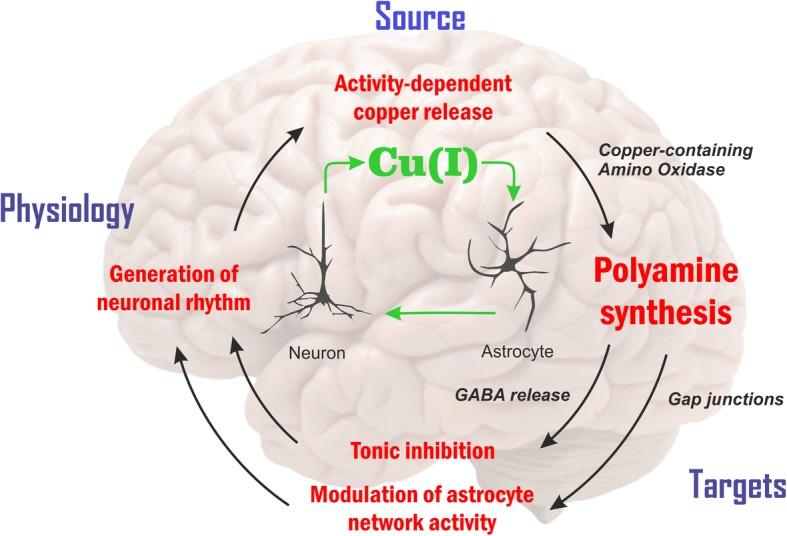
Copper-containing enzymes perform fundamental functions by activating dioxygen (O) and therefore allowing chemical energy-transfer for aerobic metabolism. The copper-dependence of O transport, metabolism and production of signalling molecules are supported by molecular systems that regulate and preserve tightly-bound static and weakly-bound dynamic cellular copper pools. Disruption of the reducing intracellular environment, characterized by glutathione shortage and ambient Cu(II) abundance drives oxidative stress and interferes with the bidirectional, copper-dependent communication between neurons and astrocytes, eventually leading to various brain disease forms. A deeper understanding of of the regulatory effects of copper on neuro-glia coupling via polyamine metabolism may reveal novel copper signalling functions and new directions for therapeutic intervention in brain disorders associated with aberrant copper metabolism.
含铜酶通过激活分子氧(O)并因此允许有氧代谢的化学能量转移来发挥基本功能。分子系统支持 O 运输、代谢和信号分子产生的铜依赖性,这些系统调节和保护紧密结合的静态和弱结合的动态细胞铜池。以谷胱甘肽短缺和环境 Cu(II) 丰富为特征的还原细胞内环境的破坏会导致氧化应激,并干扰神经元和星形胶质细胞之间双向、依赖铜的通讯,最终导致各种形式的脑部疾病。通过多胺代谢深入了解铜对神经胶质偶联的调节作用,可能揭示新的铜信号功能和治疗干预与异常铜代谢相关的脑部疾病的新方向。


 Zotero 插件