
用于检测急性髓系白血病和骨髓增生异常综合征中残留疾病的多色流式细胞术分析的临床验证机器学习算法。
Clinically validated machine learning algorithm for detecting residual diseases with multicolor flow cytometry analysis in acute myeloid leukemia and myelodysplastic syndrome.
机构信息
Department of Internal Medicine, National Taiwan University Hospital, Taipei, Taiwan.
Tai-Cheng Stem Cell Therapy Center, National Taiwan University, Taipei, Taiwan.
出版信息
EBioMedicine. 2018 Nov;37:91-100. doi: 10.1016/j.ebiom.2018.10.042. Epub 2018 Oct 22.
BACKGROUND
Multicolor flow cytometry (MFC) analysis is widely used to identify minimal residual disease (MRD) after treatment for acute myeloid leukemia (AML) and myelodysplastic syndrome (MDS). However, current manual interpretation suffers from drawbacks of time consuming and interpreter idiosyncrasy. Artificial intelligence (AI), with the expertise in assisting repetitive or complex analysis, represents a potential solution for these drawbacks.
METHODS
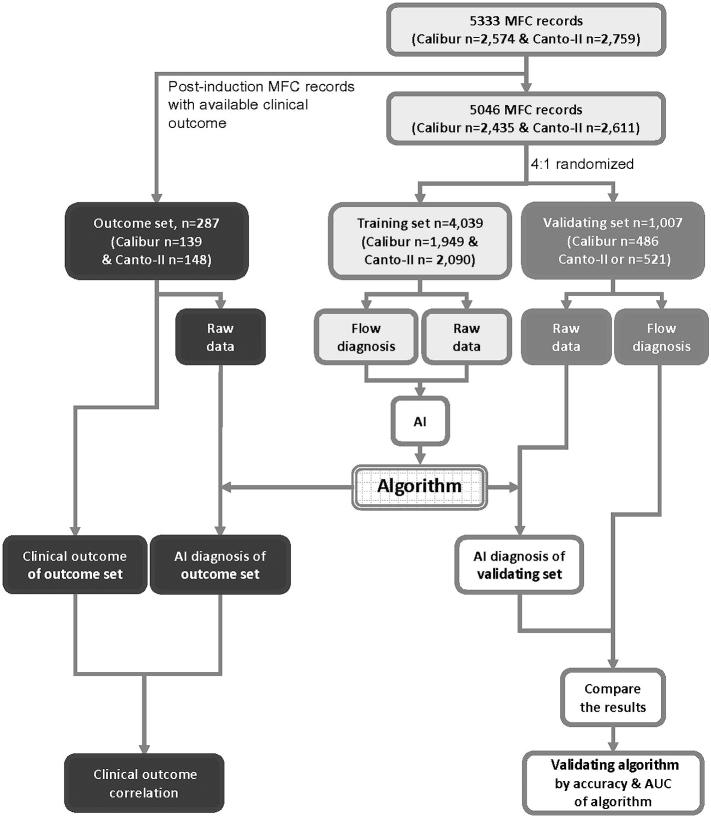
From 2009 to 2016, 5333 MFC data from 1742 AML or MDS patients were collected. The 287 MFC data at post-induction were selected as the outcome set for clinical outcome validation. The rest were 4:1 randomized into the training set (n = 4039) and the validation set (n = 1007). AI algorithm learned a multi-dimensional MFC phenotype from the training set and input it to support vector machine (SVM) classifier after Gaussian mixture model (GMM) modeling, and the performance was evaluated in The validation set.
FINDINGS
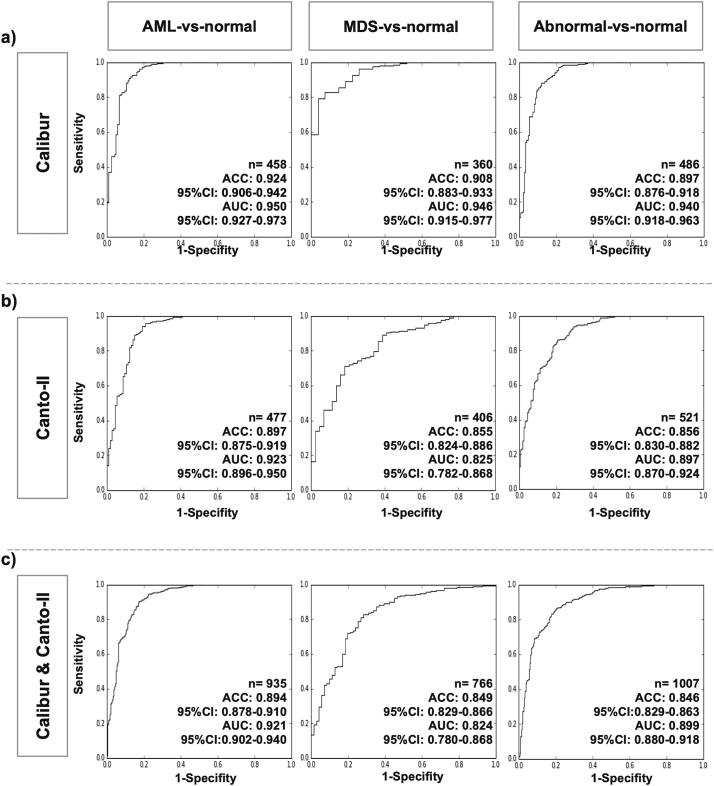
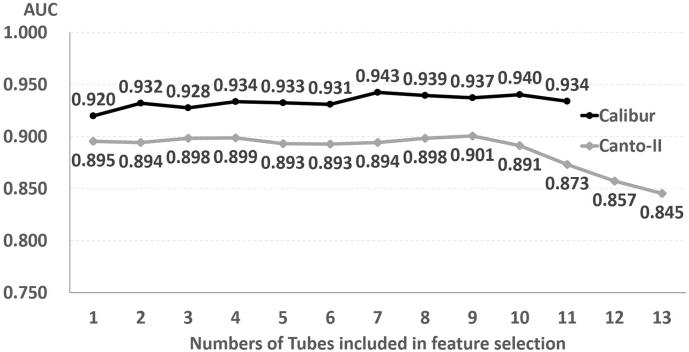
Promising accuracies (84·6% to 92·4%) and AUCs (0·921-0·950) were achieved by the developed algorithms. Interestingly, the algorithm from even one testing tube achieved similar performance. The clinical significance was validated in the outcome set, and normal MFC interpreted by the AI predicted better progression-free survival (10·9 vs 4·9 months, p < 0·0001) and overall survival (13·6 vs 6·5 months, p < 0·0001) for AML.
INTERPRETATION
Through large-scaled clinical validation, we showed that AI algorithms can produce efficient and clinically-relevant MFC analysis. This approach also possesses a great advantage of the ability to integrate other clinical tests. FUND: This work was supported by the Ministry of Science and Technology (107-2634-F-007-006 and 103-2314-B-002-185-MY2) of Taiwan.
背景
多色流式细胞术(MFC)分析广泛用于治疗急性髓细胞白血病(AML)和骨髓增生异常综合征(MDS)后的微小残留病(MRD)检测。然而,目前的手动解释存在耗时和解释者偏见的缺点。人工智能(AI)在协助重复性或复杂分析方面具有专业知识,代表了解决这些缺点的潜在解决方案。
方法
从 2009 年到 2016 年,收集了 1742 例 AML 或 MDS 患者的 5333 份 MFC 数据。选择 287 份诱导后 MFC 数据作为临床结果验证的结局集。其余数据按 4:1 随机分为训练集(n=4039)和验证集(n=1007)。AI 算法从训练集中学习多维 MFC 表型,在经过高斯混合模型(GMM)建模后将其输入支持向量机(SVM)分类器,并在验证集中评估性能。
发现
所开发算法的准确率(84.6%至 92.4%)和 AUC(0.921-0.950)均达到较高水平。有趣的是,即使是一个检测管的算法也能达到类似的性能。在结局集中验证了临床意义,由 AI 解释的正常 MFC 预测 AML 的无进展生存期(10.9 个月与 4.9 个月,p<0.0001)和总生存期(13.6 个月与 6.5 个月,p<0.0001)更好。
解释
通过大规模临床验证,我们表明 AI 算法可以产生高效且具有临床相关性的 MFC 分析。这种方法还具有整合其他临床检测的优势。
资金
这项工作得到了台湾科技部(107-2634-F-007-006 和 103-2314-B-002-185-MY2)的支持。

 Zotero 插件