
优化胃癌腹膜转移患者的治疗结局。
Optimizing outcomes for patients with gastric cancer peritoneal carcinomatosis.
作者信息
Leiting Jennifer L, Grotz Travis E
机构信息
Division of Hepatobiliary and Pancreas Surgery, Mayo Clinic, Rochester, MN 55905, United States.
出版信息
World J Gastrointest Oncol. 2018 Oct 15;10(10):282-289. doi: 10.4251/wjgo.v10.i10.282.
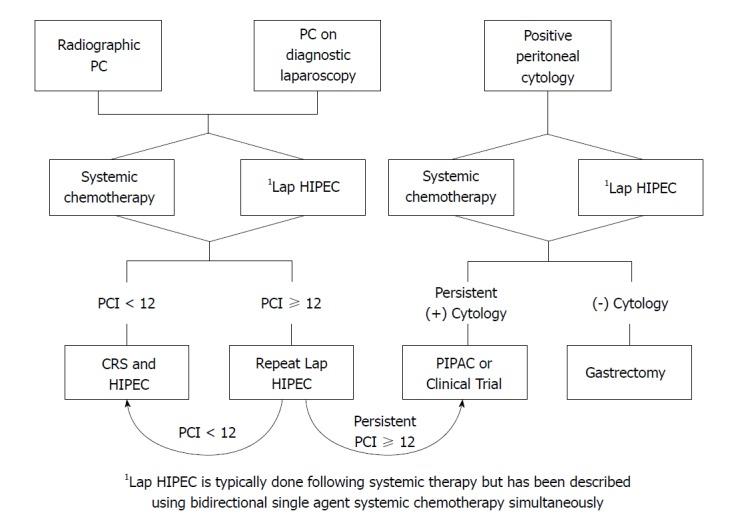
Peritoneal carcinomatosis (PC) from gastric cancer has traditionally been considered a terminal progression of the disease and is associated with poor survival outcomes. Positive peritoneal cytology similarly worsens the survival of patients with gastric cancer and treatment options for these patients have been limited. Recent advances in multimodality treatment regimens have led to innovative ways to care for and treat patients with this disease burden. One of these advances has been to use neoadjuvant therapy to try and convert patients with positive cytology or low-volume PC to negative cytology with no evidence of active peritoneal disease. These strategies include the use of neoadjuvant systemic chemotherapy alone, using neoadjuvant laparoscopic heated intraperitoneal chemotherapy (NLHIPEC) after systemic chemotherapy, or using neoadjuvant intraperitoneal and systemic chemotherapy (NIPS) in a bidirectional manner. For patients with higher volume PC, cytoreductive surgery (CRS) and hyperthermic intraperitoneal chemotherapy (HIPEC) have been mainstays of treatment. When used together, CRS and HIPEC can improve overall outcomes in properly selected patients, but overall survival outcomes remain unacceptably low. The extent of peritoneal disease, commonly measured by the peritoneal carcinomatosis index (PCI), and the completeness of cytoreduction, has been shown to greatly impact outcomes in patients undergoing CRS and HIPEC. The uses of NLHIPEC and NLHIPEC plus NIPS have both been shown to decrease the PCI and thus increase the opportunity for complete cytoreduction. Newer therapies like pressurized intraperitoneal aerosol chemotherapy and immunotherapy, such as catumaxomab, along with improved systemic chemotherapeutic regimens, are being explored with great interest. There is exciting progress being made in the management of PC from gastric cancer and its' treatment is no longer futile.
胃癌引起的腹膜癌病(PC)传统上被认为是疾病的终末期进展,且与不良生存结果相关。阳性腹膜细胞学同样会使胃癌患者的生存率降低,而针对这些患者的治疗选择一直有限。多模式治疗方案的最新进展带来了护理和治疗这类疾病负担患者的创新方法。其中一项进展是使用新辅助治疗,试图将细胞学阳性或低负荷PC患者转化为细胞学阴性且无活动性腹膜疾病证据的患者。这些策略包括单独使用新辅助全身化疗、在全身化疗后使用新辅助腹腔镜热灌注化疗(NLHIPEC),或以双向方式使用新辅助腹腔内和全身化疗(NIPS)。对于高负荷PC患者,减瘤手术(CRS)和热灌注化疗(HIPEC)一直是主要治疗手段。联合使用时,CRS和HIPEC可改善适当选择患者的总体预后,但总体生存结果仍低得令人难以接受。腹膜疾病的范围通常通过腹膜癌指数(PCI)来衡量,而减瘤的彻底性已被证明对接受CRS和HIPEC的患者的预后有很大影响。NLHIPEC以及NLHIPEC加NIPS的使用均已证明可降低PCI,从而增加完全减瘤的机会。加压腹腔内气溶胶化疗和免疫疗法(如卡妥索单抗)等新疗法,以及改进的全身化疗方案,正受到极大关注。胃癌腹膜癌病的管理正在取得令人兴奋的进展,其治疗不再是徒劳无功的。
 Zotero 插件