
胆汁酸合成途径中酶的缺失解释了哺乳动物之间胆汁组成的差异。
Loss of Enzymes in the Bile Acid Synthesis Pathway Explains Differences in Bile Composition among Mammals.
机构信息
Max Planck Institute of Molecular Cell Biology and Genetics, Dresden, Germany.
Max Planck Institute for the Physics of Complex Systems, Dresden, Germany.
出版信息
Genome Biol Evol. 2018 Dec 1;10(12):3211-3217. doi: 10.1093/gbe/evy243.
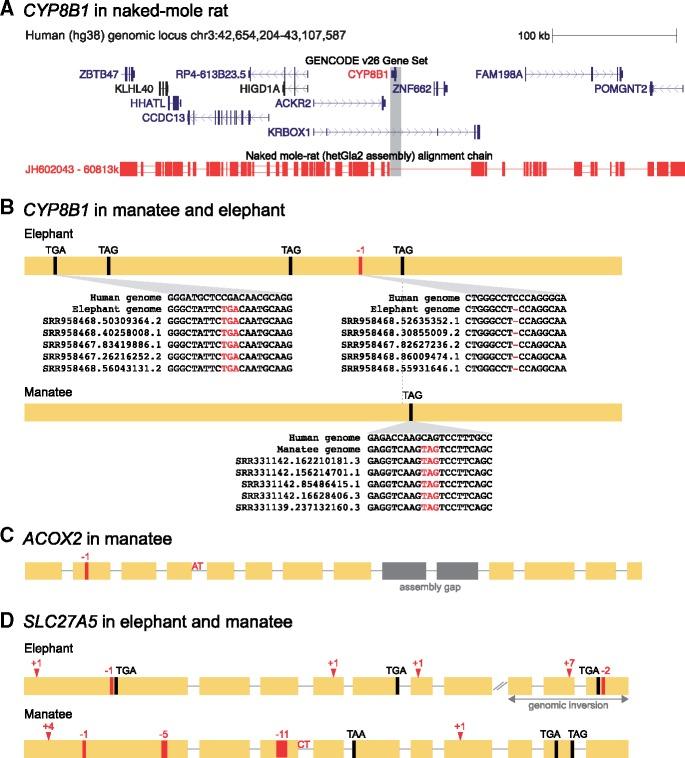
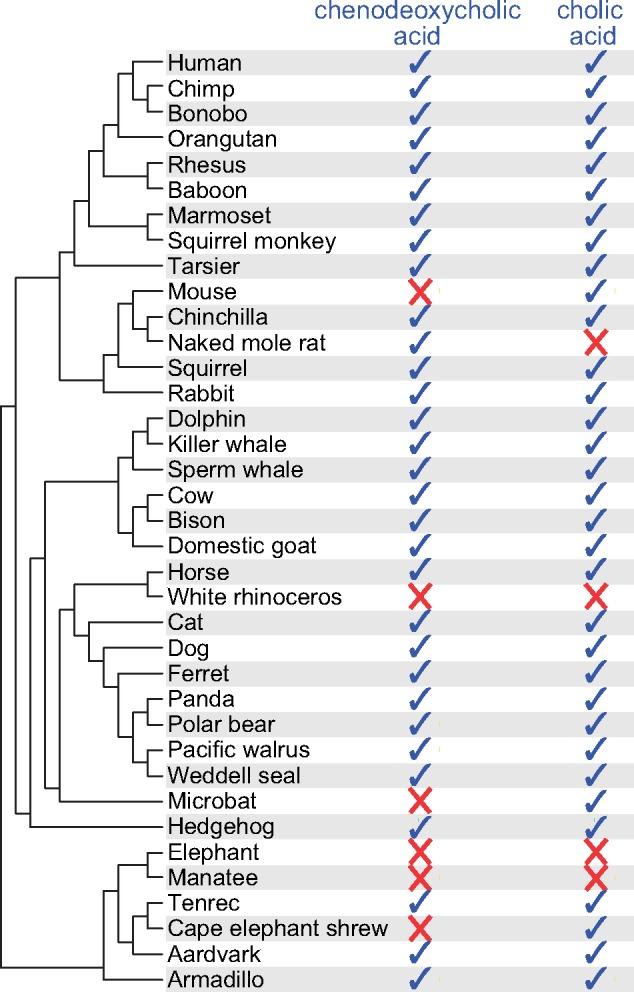
Bile acids are important for absorbing nutrients. Most mammals produce cholic and chenodeoxycholic bile acids. Here, we investigated genes in the bile acid synthesis pathway in four mammals that deviate from the usual mammalian bile composition. First, we show that naked-mole rats, elephants, and manatees repeatedly inactivated CYP8B1, an enzyme uniquely required for cholic acid synthesis, which explains the absence of cholic acid in these species. Second, no gene-inactivating mutations were found in any pathway gene in the rhinoceros, a species that lacks bile acids, indicating an evolutionarily recent change in its bile composition. Third, elephants and/or manatees that also lack bile acids altogether have lost additional nonessential enzymes (SLC27A5, ACOX2). Apart from uncovering genomic differences explaining deviations in bile composition, our analysis of bile acid enzymes in bile acid-lacking species suggests that essentiality prevents gene loss, while loss of pleiotropic genes is permitted if their other functions are compensated by functionally related proteins.
胆汁酸对于营养物质的吸收很重要。大多数哺乳动物都会产生胆酸和鹅脱氧胆酸。在这里,我们研究了四种在胆汁酸合成途径中与常见哺乳动物胆汁组成不同的哺乳动物的基因。首先,我们发现裸鼹鼠、大象和海牛反复失活了 CYP8B1 基因,该基因是合成胆酸所必需的,这就解释了这些物种中没有胆酸的原因。其次,在缺乏胆汁酸的犀牛中,没有发现任何途径基因的基因失活突变,这表明其胆汁组成在进化上是最近才发生改变的。第三,完全缺乏胆汁酸的大象和/或海牛还失去了其他非必需的酶(SLC27A5,ACOX2)。除了揭示解释胆汁成分差异的基因组差异外,我们对缺乏胆汁酸的物种中的胆汁酸酶的分析表明,必需性阻止了基因的丢失,而如果其其他功能被功能相关的蛋白质所补偿,则允许多效性基因的丢失。

 Zotero 插件