
全球常规疫苗接种覆盖率-2017 年。
Global Routine Vaccination Coverage - 2017.
出版信息
MMWR Morb Mortal Wkly Rep. 2018 Nov 16;67(45):1261-1264. doi: 10.15585/mmwr.mm6745a2.
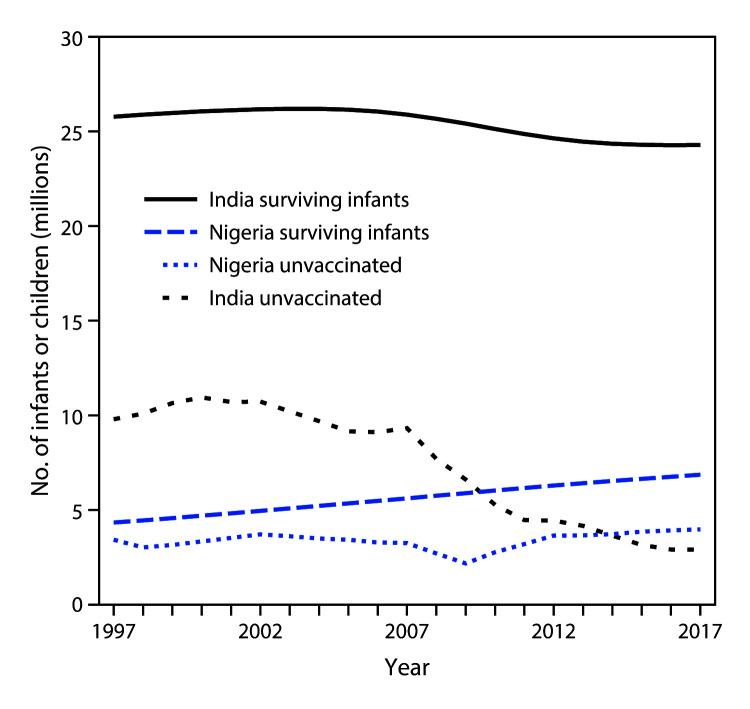
Endorsed by the World Health Assembly in 2012, the Global Vaccine Action Plan 2011-2020 (GVAP) (1) calls on all countries to reach ≥90% national coverage with all vaccines in the country's national immunization schedule by 2020. This report updates previous reports (2,3) and presents global, regional, and national vaccination coverage estimates and trends as of 2017. It also describes the number of infants surviving to age 1 year (surviving infants) who did not receive the third dose of diphtheria and tetanus toxoids and pertussis-containing vaccine (DTP3), a key indicator of immunization program performance (4,5), with a focus on the countries with the highest number of children who did not receive DTP3 in 2017. Based on the World Health Organization (WHO) and United Nations Children's Fund (UNICEF) estimates, global DTP3 coverage increased from 79% in 2007 to 84% in 2010, and has remained stable from 2010 to 2017 (84% to 85%). In 2017, among the 19.9 million children who did not receive DTP3 in the first year of life, 62% (12.4 million) lived in 10 countries. From 2007 to 2017, the number of children who had not received DTP3 decreased in five of these 10 countries and remained stable or increased in the other five. Similar to DTP3 coverage, global coverage with the first measles-containing vaccine dose (MCV1) increased from 80% in 2007 to 84% in 2010, and has remained stable from 2010 to 2017 (84% to 85%). Coverage with the third dose of polio vaccine (Pol3) has remained stable at 84%-85% since 2010. From 2007 to 2017, estimated global coverage with the second MCV dose (MCV2) increased from 33% to 67%, as did coverage with the completed series of rotavirus (2% to 28%), pneumococcal conjugate (PCV) (4% to 44%), rubella (26% to 52%), Haemophilus influenzae type b (Hib) (25% to 72%) and hepatitis B (HepB) (birth dose: 24% to 43%; 3-dose series: 63% to 84%) vaccines. Targeted, context-specific strategies are needed to reach and sustain high vaccination coverage, particularly in countries with the highest number of unvaccinated children.
2012 年世界卫生大会批准了《全球疫苗行动计划 2011-2020 年》(GVAP)(1),呼吁所有国家到 2020 年实现国家免疫规划中所有疫苗的全国覆盖率达到≥90%。本报告更新了以往的报告(2,3),提供了截至 2017 年的全球、区域和国家疫苗接种覆盖率估计数和趋势。它还描述了未接种第三剂白喉、破伤风类毒素和无细胞百日咳疫苗(DTP3)的存活至 1 岁婴儿(存活婴儿)人数,这是免疫规划绩效的一个关键指标(4,5),重点介绍了 2017 年未接种 DTP3 的儿童数量最多的国家。根据世界卫生组织(世卫组织)和联合国儿童基金会(儿童基金会)的估计,全球 DTP3 覆盖率从 2007 年的 79%增加到 2010 年的 84%,并保持稳定,自 2010 年以来一直保持在 84%至 85%之间(84%至 85%)。2017 年,在 1990 万未在出生后第一年接种 DTP3 的儿童中,有 62%(1240 万)生活在 10 个国家。从 2007 年到 2017 年,这 10 个国家中有 5 个国家未接种 DTP3 的儿童人数有所减少,而其他 5 个国家的人数保持稳定或有所增加。与 DTP3 覆盖率一样,全球首剂含麻疹疫苗(MCV1)覆盖率从 2007 年的 80%增加到 2010 年的 84%,并保持稳定,自 2010 年以来一直保持在 84%至 85%之间(84%至 85%)。自 2010 年以来,脊髓灰质炎疫苗(Pol3)第三剂的覆盖率一直稳定在 84%-85%之间。从 2007 年到 2017 年,全球第二剂麻疹疫苗(MCV2)覆盖率估计数从 33%增加到 67%,轮状病毒(2%至 28%)、肺炎球菌结合疫苗(PCV)(4%至 44%)、风疹(26%至 52%)、b 型流感嗜血杆菌(Hib)(25%至 72%)和乙型肝炎(HepB)(出生剂量:24%至 43%;3 剂系列:63%至 84%)疫苗的覆盖率也有所增加。需要采取有针对性的、具体国情的战略来实现和维持高疫苗覆盖率,特别是在儿童未接种疫苗数量最多的国家。
 Zotero 插件