
将 CAR T 细胞疗法变为实体瘤的可靠选择。
Making CAR T Cells a Solid Option for Solid Tumors.
机构信息
Cellular Immunotherapy Program, Cancer Center, Massachusetts General Hospital, Harvard Medical School, Boston, MA, United States.
出版信息
Front Immunol. 2018 Nov 8;9:2593. doi: 10.3389/fimmu.2018.02593. eCollection 2018.
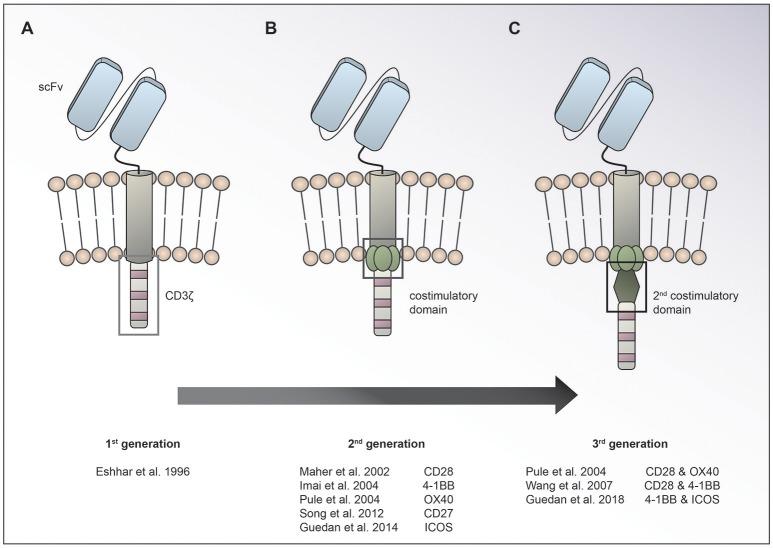
Adoptive cell therapy with chimeric antigen receptor (CAR) T cells aims to redirect the patient's own immune system to selectively attack cancer cells. To do so, CAR T cells are endowed with specific antigen recognition moieties fused to signaling and costimulatory domains. While this approach has shown great success for the treatment of B cell malignancies, response rates among patients with solid cancers are less favorable. The major challenges for CAR T cell immunotherapy in solid cancers are the identification of unique tumor target antigens, as well as improving CAR T cell trafficking to and expansion at the tumor site. This review focuses on combinatorial antigen targeting, regional delivery and approaches to improve CAR T cell persistence in the face of a hostile tumor microenvironment.
嵌合抗原受体 (CAR) T 细胞过继细胞疗法旨在引导患者自身免疫系统选择性地攻击癌细胞。为此,CAR T 细胞被赋予与信号和共刺激结构域融合的特定抗原识别部分。虽然这种方法在治疗 B 细胞恶性肿瘤方面取得了巨大成功,但实体瘤患者的反应率并不理想。CAR T 细胞免疫疗法在实体瘤中的主要挑战是识别独特的肿瘤靶抗原,以及改善 CAR T 细胞在肿瘤部位的迁移和扩增。本综述重点讨论了组合抗原靶向、区域性递送以及面对恶劣的肿瘤微环境时提高 CAR T 细胞持久性的方法。


 Zotero 插件