
光触媒环境消毒作为控制耐甲氧西林金黄色葡萄球菌传播的辅助措施:高发环境中的前瞻性队列研究。
Environmental disinfection with photocatalyst as an adjunctive measure to control transmission of methicillin-resistant Staphylococcus aureus: a prospective cohort study in a high-incidence setting.
机构信息
Department of Internal Medicine, Bundang Jesaeng Hospital, 180-2Seohyeon-ro, Bundang-gu, Seongnam-si, Gyeonggi-do, 463-774, South Korea.
Department of Laboratory Medicine, Bundang Jesaeng Hospital, 180-2Seohyeon-ro, Bundang-gu, Seongnam-si, Gyeonggi-do, 463-774, South Korea.
出版信息
BMC Infect Dis. 2018 Dec 3;18(1):610. doi: 10.1186/s12879-018-3555-1.
BACKGROUND
Environmental disinfection with continuously antimicrobial surfaces could offer superior control of surface bioburden. We sought to decide the efficacy of photocatalyst antimicrobial coating in reducing methicillin-resistant Staphylococcus aureus (MRSA) acquisition in high incidence setting.
METHODS
We performed prospective cohort study involving patients hospitalized in medical intensive care unit. A titanium dioxide-based photocatalyst was coated on high touch surfaces and walls. Five months of pre-intervention data were compared with five months of post-intervention data. The incidence rates of multidrug-resistant organism acquisition and the rates of hospital-acquired blood stream infection, pneumonia, urinary tract infection, and Clostridium difficile-associated diseases were compared using Cox proportional hazards regression analysis.
RESULTS
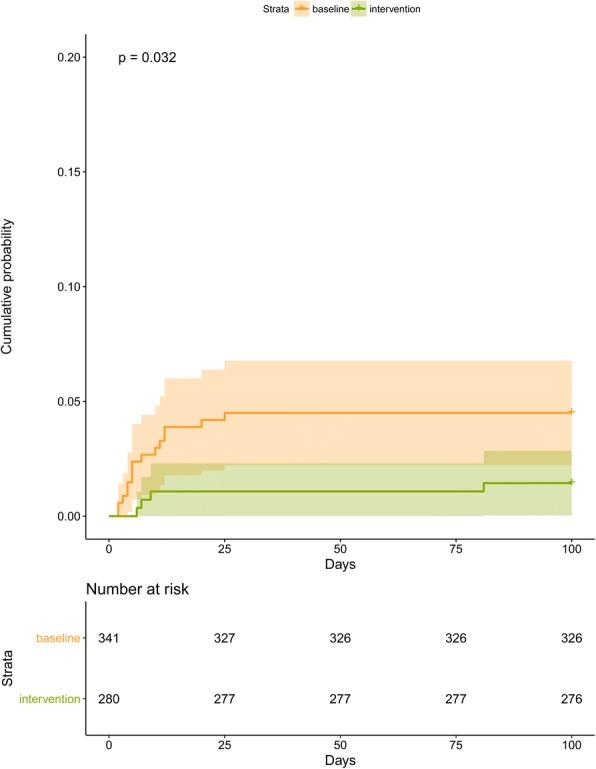
In total, 621 patients were included. There was significant decrease in MRSA acquisition rate after photocatalyst coating (hazard ratio, 0.37; 95% confidence interval, 0.14-0.99; p = 0.04). However, clinical identification of vancomycin-resistant Enterococcus spp. and multidrug-resistant Acinetobacter baumannii did not decrease significantly. The hazard of contracting hospital-acquired pneumonia during the intervention period compared to baseline period was 0.46 (95% confidence interval, 0.23-0.94; p = 0.03).
CONCLUSIONS
In conclusion, MRSA rate was significantly reduced after photocatalyst coating. We provide evidence that photocatalyst disinfection can be an adjunctive measure to control MRSA acquisition in high-incidence settings.
TRIAL REGISTRATION
ISRCTN Registry ( ISRCTN31972004 ). Registered retrospectively on November 19, 2018.
背景
具有持续抗菌表面的环境消毒可以提供更好的表面生物负荷控制。我们旨在确定光催化剂抗菌涂层在减少高发环境中耐甲氧西林金黄色葡萄球菌(MRSA)获得方面的功效。
方法
我们进行了一项前瞻性队列研究,涉及住院于重症监护病房的患者。在高接触表面和墙壁上涂覆基于二氧化钛的光催化剂。将 5 个月的干预前数据与 5 个月的干预后数据进行比较。使用 Cox 比例风险回归分析比较多药耐药菌获得的发生率以及医院获得性血流感染、肺炎、尿路感染和艰难梭菌相关性疾病的发生率。
结果
共纳入 621 例患者。光催化剂涂层后,MRSA 获得率显著下降(风险比,0.37;95%置信区间,0.14-0.99;p=0.04)。然而,万古霉素耐药肠球菌和多药耐药鲍曼不动杆菌的临床鉴定并未显著减少。与基线期相比,干预期间发生医院获得性肺炎的风险为 0.46(95%置信区间,0.23-0.94;p=0.03)。
结论
总之,光催化剂涂层后,MRSA 率显著降低。我们提供的证据表明,光催化剂消毒可以作为控制高发环境中 MRSA 获得的辅助措施。
试验注册
ISRCTN 注册表(ISRCTN31972004)。于 2018 年 11 月 19 日回顾性注册。

 Zotero 插件