
激光烧蚀电感耦合等离子体质谱法对肝铁过载疾病的定量分析
Quantification of liver iron overload disease with laser ablation inductively coupled plasma mass spectrometry.
作者信息
Kim Philipp, Weiskirchen Sabine, Uerlings Ricarda, Kueppers Astrid, Stellmacher Florian, Viveiros André, Zoller Heinz, Weiskirchen Ralf
机构信息
Institute of Molecular Pathobiochemistry, Experimental Gene Therapy and Clinical Chemistry (IFMPEGKC), RWTH University Hospital Aachen, Pauwelsstr 30, D-52074, Aachen, Germany.
Central Institute for Engineering, Electronics and Analytics, ZEA-3, Forschungszentrum Jülich, Jülich, Germany.
出版信息
BMC Med Imaging. 2018 Dec 4;18(1):51. doi: 10.1186/s12880-018-0291-3.
BACKGROUND
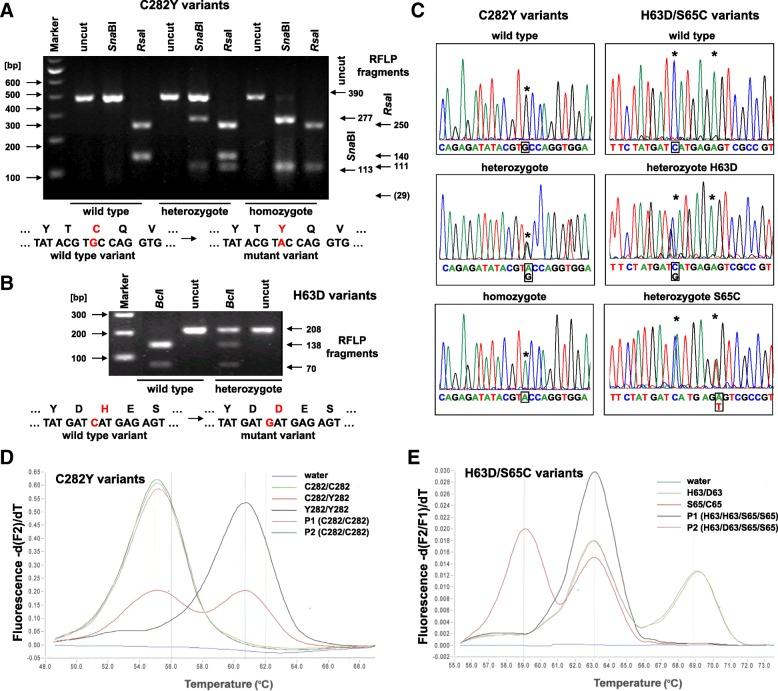
Hereditary hemochromatosis is the most frequent, identified, genetic disorder in Caucasians affecting about 1 in 1000 people of Northern European ancestry, where the associated genetic defect (homozygosity for the p.Cys282Tyr polymorphism in the HFE gene) has a prevalence of approximately 1:200. The disorder is characterized by excess iron stores in the body. Due to the incomplete disease penetrance of disease-associated genotype, genetic testing and accurate quantification of hepatic iron content by histological grading of stainable iron, quantitative chemical determination of iron, or imaging procedures are important in the evaluation and staging of hereditary hemochromatosis.
METHODS
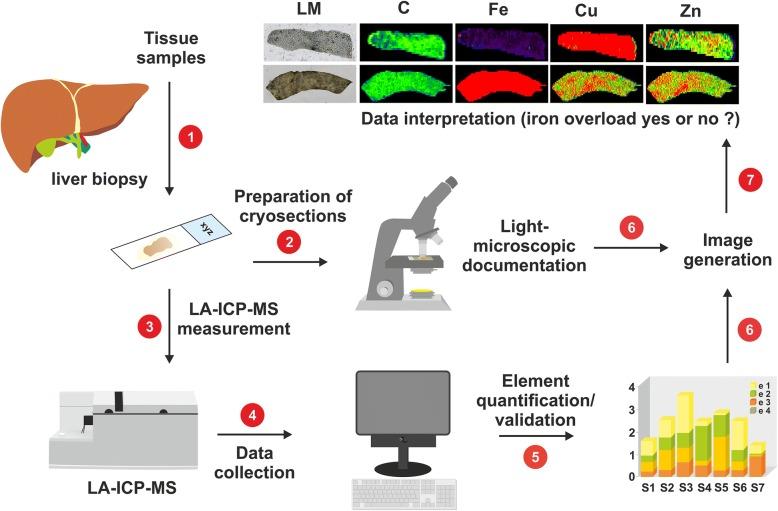
We here established novel laser ablation inductively coupled plasma mass spectrometry protocols for hepatic metal bio-imaging for diagnosis of iron overload.
RESULTS
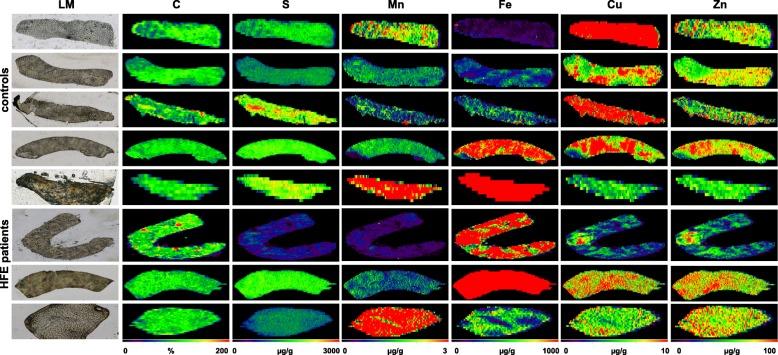
We demonstrate that these protocols are a significant asset in the diagnosis of iron overload allowing iron measurements and simultaneous determination of various other metals and metalloids with high sensitivity, spatial resolution, and quantification ability.
CONCLUSIONS
The simultaneous measurement of various metals and metalloids offers unique opportunities for deeper understanding of metal imbalances. Laser ablation inductively coupled plasma mass spectrometry (LA-ICP-MS) is a highly powerful and sensitive technique for the analysis of a variety of solid samples with high spatial resolution. We conclude that this method is an important add-on to routine diagnosis of iron overload and associated hepatic metal dysbalances resulting thereof.
背景
遗传性血色素沉着症是高加索人群中最常见的已确定的遗传性疾病,在北欧血统的人群中,约每1000人中有1人受其影响,其中相关的基因缺陷(HFE基因中p.Cys282Tyr多态性的纯合子)患病率约为1:200。该疾病的特征是体内铁储存过多。由于疾病相关基因型的疾病外显率不完全,通过可染色铁的组织学分级、铁的定量化学测定或成像程序对肝铁含量进行基因检测和准确定量,对于遗传性血色素沉着症的评估和分期很重要。
方法
我们在此建立了用于肝金属生物成像以诊断铁过载的新型激光烧蚀电感耦合等离子体质谱法方案。
结果
我们证明,这些方案是诊断铁过载的一项重要资产,能够以高灵敏度、空间分辨率和定量能力进行铁测量并同时测定各种其他金属和类金属。
结论
同时测量各种金属和类金属为更深入了解金属失衡提供了独特的机会。激光烧蚀电感耦合等离子体质谱法(LA-ICP-MS)是一种用于分析各种固体样品的强大且灵敏的技术,具有高空间分辨率。我们得出结论,该方法是铁过载及其相关肝金属失衡常规诊断的重要补充。


 Zotero 插件