
使用体外共培养模型对纳米颗粒肠道转运进行表征
Characterization of Nanoparticle Intestinal Transport Using an In Vitro Co-Culture Model.
作者信息
Strugari Alina F G, Stan Miruna S, Gharbia Sami, Hermenean Anca, Dinischiotu Anca
机构信息
University of Bucharest, Faculty of Biology, Department of Biochemistry and Molecular Biology, 91-95 Splaiul Independentei, 050095 Bucharest, Romania.
Institute of Life Sciences, Vasile Goldis Western University of Arad, 86 Rebreanu, 310414 Arad, Romania.
出版信息
Nanomaterials (Basel). 2018 Dec 21;9(1):5. doi: 10.3390/nano9010005.
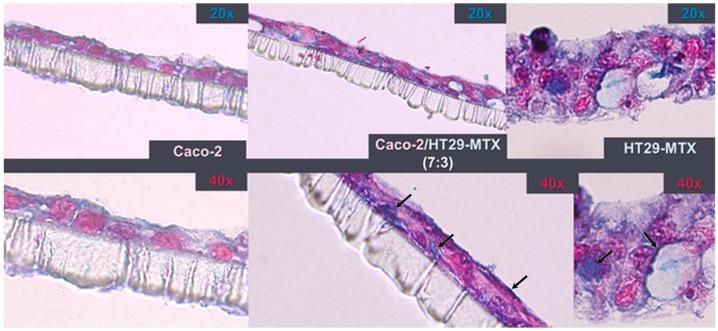
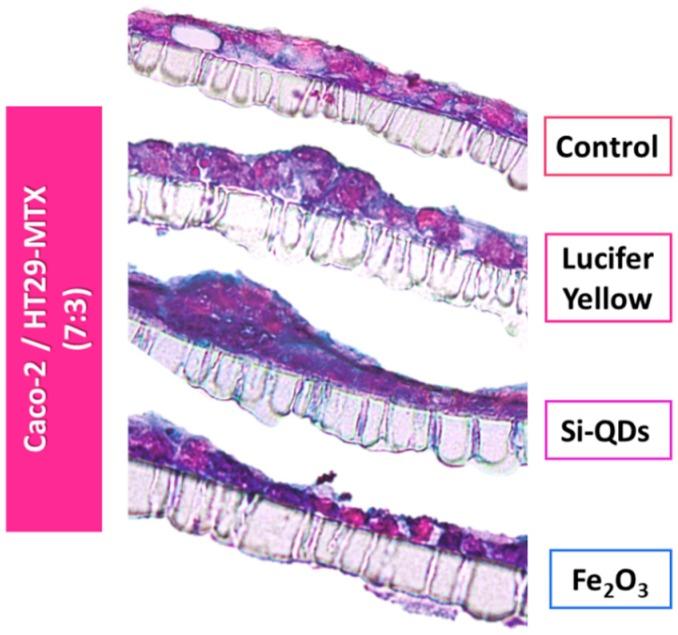
We aimed to obtain a tunable intestinal model and study the transport of different types of nanoparticles. Caco-2/HT29-MTX co-cultures of different seeding ratios (7:3 and 5:5), cultured on Transwell® systems, were exposed to non-cytotoxic concentration levels (20 μg/mL) of silicon quantum dots and iron oxide (α-Fe₂O₃) nanoparticles. Transepithelial electric resistance was measured before and after exposure, and permeability was assessed via the paracellular marker Lucifer Yellow. At regular intervals during the 3 h transport study, samples were collected from the basolateral compartments for the detection and quantitative testing of nanoparticles. Cell morphology characterization was done using phalloidin-FITC/DAPI labeling, and Alcian Blue/eosin staining was performed on insert cross-sections in order to compare the intestinal models and evaluate the production of mucins. Morphological alterations of the Caco-2/HT29-MTX (7:3 ratio) co-cultures were observed at the end of the transport study compared with the controls. The nanoparticle suspensions tested did not diffuse across the intestinal model and were not detected in the receiving compartments, probably due to their tendency to precipitate at the monolayer surface level and form visible aggregates. These preliminary results indicate the need for further nanoparticle functionalization in order to appropriately assess intestinal absorption in vitro.
我们旨在获得一个可调节的肠道模型,并研究不同类型纳米颗粒的转运。将不同接种比例(7:3和5:5)的Caco-2/HT29-MTX共培养物培养在Transwell®系统上,使其暴露于非细胞毒性浓度水平(20μg/mL)的硅量子点和氧化铁(α-Fe₂O₃)纳米颗粒中。在暴露前后测量跨上皮电阻,并通过细胞旁标记物荧光素黄评估通透性。在3小时的转运研究期间,定期从基底外侧隔室收集样品,用于纳米颗粒的检测和定量测试。使用鬼笔环肽-FITC/DAPI标记进行细胞形态表征,并对插入物横截面进行阿尔辛蓝/伊红染色,以比较肠道模型并评估粘蛋白的产生。与对照组相比,在转运研究结束时观察到Caco-2/HT29-MTX(7:3比例)共培养物的形态学改变。所测试的纳米颗粒悬浮液未扩散穿过肠道模型,且在接收隔室中未检测到,这可能是由于它们倾向于在单层表面水平沉淀并形成可见聚集体。这些初步结果表明,为了在体外适当地评估肠道吸收,需要进一步对纳米颗粒进行功能化处理。



 Zotero 插件