
优化的 GIP 类似物通过 GIPR 激动作用而不是拮抗作用促进小鼠体重降低。
Optimized GIP analogs promote body weight lowering in mice through GIPR agonism not antagonism.
机构信息
Department of Chemistry, Indiana University, Bloomington, IN 47405, USA.
Novo Nordisk Research Center Indianapolis, Indianapolis, IN 46241, USA; Helmholtz Zentrum München, German Research Center for Environmental Health (GmbH), 85764 Munich-Neuherberg, Germany.
出版信息
Mol Metab. 2019 Feb;20:51-62. doi: 10.1016/j.molmet.2018.12.001. Epub 2018 Dec 5.
OBJECTIVE
Structurally-improved GIP analogs were developed to determine precisely whether GIP receptor (GIPR) agonism or antagonism lowers body weight in obese mice.
METHODS
A series of peptide-based GIP analogs, including structurally diverse agonists and a long-acting antagonist, were generated and characterized in vitro using functional assays in cell systems overexpressing human and mouse derived receptors. These analogs were characterized in vivo in DIO mice following acute dosing for effects on glycemic control, and following chronic dosing for effects on body weight and food intake. Pair-feeding studies and indirect calorimetry were used to survey the mechanism for body weight lowering. Congenital Gipr-/- and Glp1r-/- DIO mice were used to investigate the selectivity of the agonists and to ascribe the pharmacology to effects mediated by the GIPR.
RESULTS
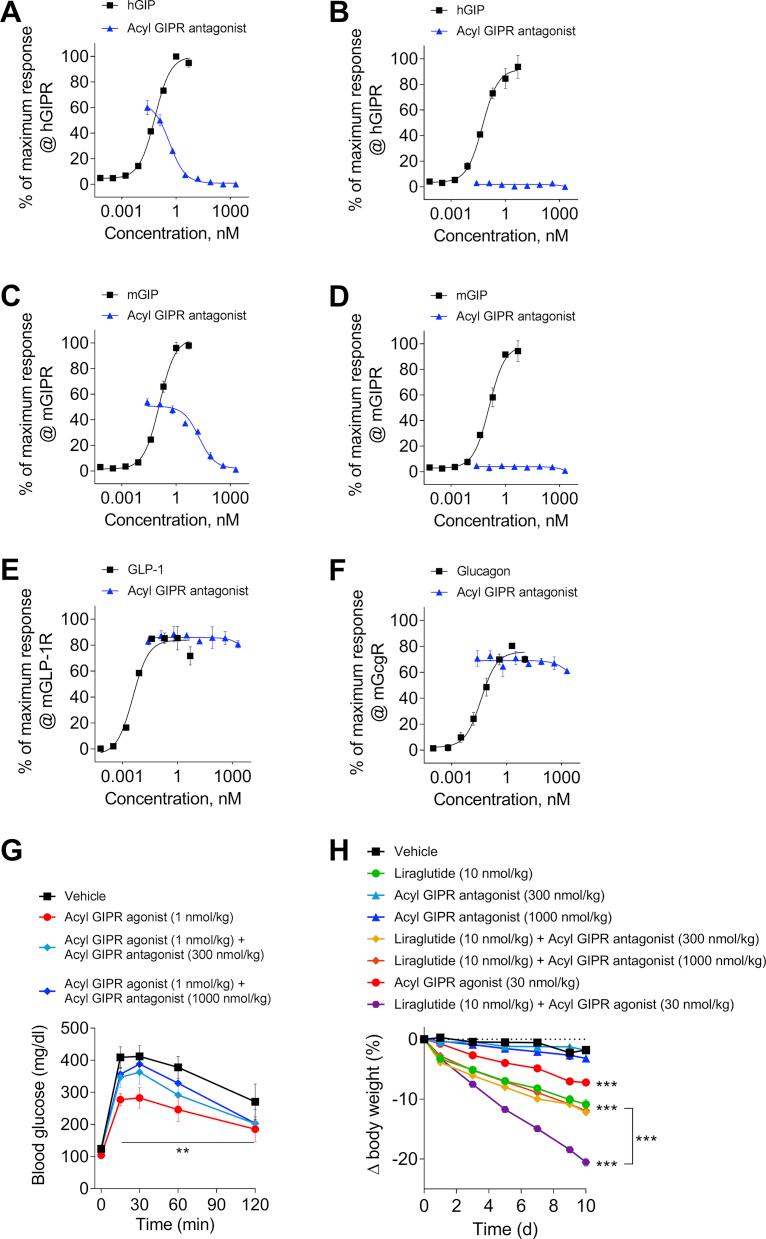
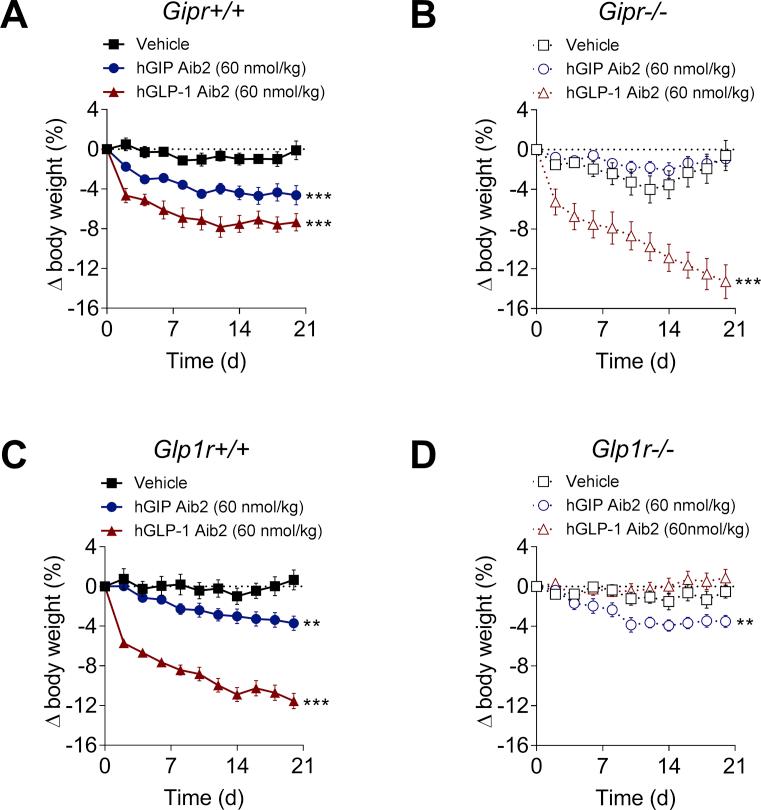
Non-acylated, Aib2 substituted analogs derived from human GIP sequence showed full in vitro potency at human GIPR and subtly reduced in vitro potency at mouse GIPR without cross-reactivity at GLP-1R. These GIPR agonists lowered acute blood glucose in wild-type and Glp1r-/- mice, and this effect was absent in Gipr-/- mice, which confirmed selectivity towards GIPR. Chronic treatment of DIO mice resulted in modest yet consistent, dose-dependent decreased body weight across many studies with diverse analogs. The mechanism for body weight lowering is due to reductions in food intake, not energy expenditure, as suggested by pair-feeding studies and indirect calorimetry assessment. The weight lowering effect was preserved in DIO Glp-1r-/- mice and absent in DIO Gipr-/- mice. The body weight lowering efficacy of GIPR agonists was enhanced with analogs that exhibit higher mouse GIPR potency, with increased frequency of administration, and with fatty-acylated peptides of extended duration of action. Additionally, a fatty-acylated, N-terminally truncated GIP analog was shown to have high in vitro antagonism potency for human and mouse GIPR without cross-reactive activity at mouse GLP-1R or mouse glucagon receptor (GcgR). This acylated antagonist sufficiently inhibited the acute effects of GIP to improve glucose tolerance in DIO mice. Chronic treatment of DIO mice with high doses of this acylated GIPR antagonist did not result in body weight change. Further, co-treatment of this acylated GIPR antagonist with liraglutide, an acylated GLP-1R agonist, to DIO mice did not result in increased body weight lowering relative to liraglutide-treated mice. Enhanced body weight lowering in DIO mice was evident however following co-treatment of long-acting selective individual agonists for GLP-1R and GIPR, consistent with previous data.
CONCLUSIONS
We conclude that peptide-based GIPR agonists, not peptide-based GIPR antagonists, that are suitably optimized for receptor selectivity, cross-species activity, and duration of action consistently lower body weight in DIO mice, although with moderate efficacy relative to GLP-1R agonists. These preclinical rodent pharmacology results, in accordance with recent clinical results, provide definitive proof that systemic GIPR agonism, not antagonism, is beneficial for body weight loss.
目的
开发结构改良的 GIP 类似物,以明确 GIP 受体 (GIPR) 激动剂或拮抗剂是否能降低肥胖小鼠的体重。
方法
生成了一系列基于肽的 GIP 类似物,包括结构不同的激动剂和长效拮抗剂,并在过表达人源和鼠源受体的细胞系统中通过功能测定进行了鉴定。这些类似物在 DIO 小鼠中进行了体内研究,急性给药评估对血糖控制的影响,慢性给药评估对体重和食物摄入的影响。通过限食和间接测热法研究了体重下降的机制。使用先天性 Gipr-/- 和 Glp1r-/- DIO 小鼠研究了激动剂的选择性,并将药理学归因于 GIPR 介导的作用。
结果
源自人 GIP 序列的非酰化、Aib2 取代类似物在人 GIPR 中具有完全的体外效力,在鼠 GIPR 中效力略有降低,而对 GLP-1R 无交叉反应。这些 GIPR 激动剂降低了野生型和 Glp1r-/- 小鼠的急性血糖水平,而 Gipr-/- 小鼠则没有这种作用,这证实了对 GIPR 的选择性。DIO 小鼠的慢性治疗导致多种类似物的许多研究中均出现适度但一致的、剂量依赖性的体重下降。体重下降的机制是由于食物摄入量减少,而不是能量消耗减少,这一点通过限食研究和间接测热评估得到了证实。体重下降的效果在 DIO Glp-1r-/- 小鼠中得到了保留,而在 DIO Gipr-/- 小鼠中则没有。具有更高的鼠 GIPR 效力、更高的给药频率和具有延长作用持续时间的脂肪酸酰化肽的 GIPR 激动剂的体重下降效果增强。此外,一种脂肪酸酰化的、N 端截断的 GIP 类似物被证明对人源和鼠源 GIPR 具有高体外拮抗效力,而对鼠源 GLP-1R 或鼠源胰高血糖素受体 (GcgR) 无交叉反应活性。这种酰化拮抗剂足以抑制 GIP 的急性作用,改善 DIO 小鼠的葡萄糖耐量。DIO 小鼠用高剂量这种酰化 GIPR 拮抗剂进行慢性治疗不会导致体重变化。此外,将这种酰化的 GIPR 拮抗剂与利拉鲁肽(一种酰化的 GLP-1R 激动剂)共同治疗 DIO 小鼠,与利拉鲁肽治疗的小鼠相比,不会导致体重下降增加。然而,DIO 小鼠中的体重下降增强在长效选择性 GLP-1R 和 GIPR 激动剂共同治疗时是明显的,这与先前的数据一致。
结论
我们得出结论,适合受体选择性、种间活性和作用持续时间优化的肽基 GIPR 激动剂而非肽基 GIPR 拮抗剂可一致降低 DIO 小鼠的体重,尽管相对于 GLP-1R 激动剂,其效果中等。这些临床前啮齿动物药理学结果与最近的临床结果一致,明确证明全身 GIPR 激动剂而非拮抗剂对体重减轻有益。



 Zotero 插件