
罕见病概念验证药物试验的招募挑战:三叉神经痛的经验
Challenges recruiting to a proof-of-concept pharmaceutical trial for a rare disease: the trigeminal neuralgia experience.
作者信息
Zakrzewska Joanna M, Palmer Joanne, Bendtsen Lars, Di Stefano Giulia, Ettlin Dominik A, Maarbjerg Stine, Obermann Mark, Morisset Valerie, Steiner Deb, Tate Simon, Cruccu Giorgio
机构信息
Facial Pain Unit, Division of Diagnostic, Surgical and Medical Sciences, Eastman Dental Hospital, University College London Hospitals NHS Foundation Trust/University College London, London, UK.
Eastman Dental Hospital, 256 Gray's Inn Road, London, UK.
出版信息
Trials. 2018 Dec 27;19(1):704. doi: 10.1186/s13063-018-3045-1.
BACKGROUND
This study aimed to describe recruitment challenges encountered during a phase IIa study of vixotrigine, a state and use-dependent Nav1.7 channel blocker, in individuals with trigeminal neuralgia.
METHODS
This was an international, multicenter, placebo-controlled, randomized withdrawal study that included a 7-day run-in period, a 21-day open-label phase, and a 28-day double-blind phase in which patients (planned n = 30) were randomized to vixotrigine or placebo. Before recruitment, all antiepileptic drugs had to be stopped, except for gabapentin or pregabalin. After the trial, patients returned to their original medications. Patient recruitment was expanded beyond the original five planned (core) centers in order to meet target enrollment (total recruiting sites N = 25). Core sites contributed data related to patient identification for study participation (prescreening data). Data related to screening failures and study withdrawal were also analyzed using descriptive statistics.
RESULTS
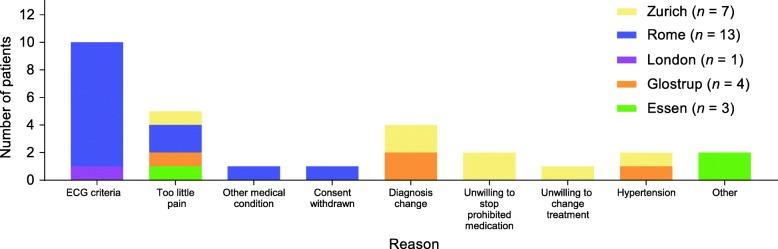
Approximately half (322/636; 50.6%) of the patients who were prescreened at core sites were considered eligible for the study and 56/322 (17.4%) were screened. Of those considered eligible, 26/322 (8.1%) enrolled in the study and 6/322 (1.9%) completed the study. In total, 125 patients were screened across all study sites and 67/125 (53.6%) were enrolled. At prescreening, reasons for noneligibility varied by site and were most commonly diagnosis change (78/314; 24.8%), age > 80 years (75/314; 23.9%), language/distance/mobility (61/314; 19.4%), and noncardiac medical problems (53/314; 16.9%). At screening, frequently cited reasons for noneligibility included failure based on electrocardiogram, insufficient pain, and diagnosis change.
CONCLUSIONS
Factors contributing to recruitment challenges encountered in this study included diagnosis changes, anxiety over treatment changes, and issues relating to distance, language, and mobility. Wherever possible, future studies should be designed to address these challenges.
TRIAL REGISTRATION
ClinicalTrials.gov, NCT01540630 . EudraCT, 2010-023963-16. 07 Aug 2015.
背景
本研究旨在描述在一项针对三叉神经痛患者的IIa期研究中,使用维索曲秦(一种电压和使用依赖性Nav1.7通道阻滞剂)时遇到的招募挑战。
方法
这是一项国际多中心、安慰剂对照的随机撤药研究,包括7天的导入期、21天的开放标签期和28天的双盲期,在此期间患者(计划n = 30)被随机分配至维索曲秦或安慰剂组。招募前,除加巴喷丁或普瑞巴林外,所有抗癫痫药物均须停用。试验结束后,患者恢复原用药。为达到目标入组人数(总招募地点N = 25),患者招募范围扩大至原计划的五个(核心)中心之外。核心站点提供与参与研究的患者识别相关的数据(预筛选数据)。还使用描述性统计分析与筛选失败和研究退出相关的数据。
结果
在核心站点进行预筛选的患者中,约一半(322/636;50.6%)被认为符合研究条件,其中56/322(17.4%)接受了筛选。在符合条件的患者中,26/322(8.1%)入组研究,6/322(1.9%)完成研究。所有研究站点共筛选了125名患者,其中67/125(53.6%)入组。预筛选时,不符合条件的原因因站点而异,最常见的是诊断改变(78/314;24.8%)、年龄>80岁(75/314;23.9%)、语言/距离/行动能力(61/314;19.4%)和非心脏内科问题(53/314;16.9%)。筛选时,常见的不符合条件原因包括心电图检查不合格、疼痛不足和诊断改变。
结论
本研究中导致招募挑战的因素包括诊断改变、对治疗改变的焦虑以及与距离、语言和行动能力相关的问题。未来的研究应尽可能设计应对这些挑战的方案。
试验注册
ClinicalTrials.gov,NCT01540630。EudraCT,2010 - 023963 - 16。2015年8月7日。


 Zotero 插件